Zap! Curiosity shoots soil on Mars with laser
October 24, 2012

Credit: NASA/JPL
This bizarre-looking animation is not some kind zit popping (which is the first thing that came to mind when I first saw it), but in fact the hole left behind in some Martian soil after the Curiosity rover zapped with a high-powered laser in order to study its chemical composition. Curiosity has been steadily traveling across its home, Gale Crater, and doing lots of good science along the way. This latest experiment zapped the soil 30 times to heat it up to a temperature so hot that it glows. Each element glows at a specific color of light when heated to those temperatures, and an instrument called a spectroscope reads those colors emitted and can discern exactly what elements the glowing material is made of. Curiosity also recently took several scoops of soil from the surface which will be delivered to various onboard instruments this week, which will directly examine its mineral makeup. I’m looking forward the release of those results, as they could tell us whether or not Mars could’ve supported life in the past. But I couldn’t resist posting this bizarre animated GIF… just keep staring at that for a while.
(Via Bad Astronomy and NASA)
Our nearest galactic neighbor Alpha Centauri has a planet!
October 17, 2012
 Very exciting news in the world of planet hunting! Our nearest star (that’s not our own sun) Alpha Centauri has an Earth-mass planet orbiting it! The planet is 1.13 times the mass of Earth, but only takes 3.24 days to orbit the star. That short orbital period means it’s VERY close to its parent star Alpha Centauri B, and probably has a surface covered in hot molten lava- not a pleasant place. The Alpha Centauri system is famous because it’s so close to us and has been included in many sci fi movies and stories. It’s a triple-star system only 4.3 light years away, and if it does turn out to have a habitable planet, it would no doubt be the destination of our first interstellar travels, if and when we ever develop the technology for it. This planet was found using the radial velocity method, which observes the faint wobble that an orbiting planet exerts on its parent star. Apparently this wobble was so faint and hard to detect that its discovery is somewhat of a milestone in the art of planet hunting. Scientists also think that this discovery increases the chance that we will find a habitable world in the Alpha Centauri system. For more info check out Bad Astronomy or New Scientist.
Felix Baumgartner’s chest cam footage/more timelapse from the ISS
October 16, 2012
This video clip shows some of the amazing footage from Felix Baumgartner’s chest and head cameras during his successful supersonic skydive attempt Sunday. I’m sure you’ve heard most of this by now, but the preliminary numbers are 9 minutes & 3 seconds jump to landing, top speed of 833.9 mph or Mach 1.24, jump height of 128,100 feet, and freefall time of 4 minutes & 20 seconds. He broke all the records previously owned by Col. Joe Kittinger (who was a consultant on the mission and coached Felix through the whole jump) except for one: longest freefall. Presumably this is because he fell so fast. The faster you fall the shorter your freefall time will be. Felix entered a terrifying spin during the first part of the dive, but he managed to regain control and did not have to deploy the emergency stabilization chute, which would have prevented him from breaking speed of sound.
In other science-related news, photographer and videographer Christopher Malin created a surreal new type of timelapse that I’ve yet to see used on space station footage- a stack. Stacking involves blending each frame of the footage into the next, creating a blurred effect with light trails and star trails. Just watch it, it’s kind of a head trip:
A combination of technical problems and gusty winds caused Feliz Baumgartner’s record-breaking 23-mile supersonic skydive attempt to be aborted just as the balloon was being inflated today. They had a good window of calm winds to work with, but weren’t able to get the balloon off before a gust of wind came along and blew parts of the partially inflated balloon onto the ground. This is a dicey situation, because the balloon material is so delicate and folded so meticulously that once it’s been unfolded, it cannot be deflated and used again. As far as I can gather from what was said during live webcast, they only have one backup balloon. Since this is the largest balloon of its type ever made or used, it’s REALLY expensive, so they really have to get it right on the next attempt.
The air at the surface, and for roughly the first 1,000 feet off the ground, must be absolutely still for the launch to happen safely. Even a little bit of crosswind can take the balloon off course, dragging the capsule across the ground or smashing it into anything nearby, just as NASA learned first-hand a few years ago during this failed balloon launch in Australia.
Just a quick roundup of some news and updates in the science world:
- Felix Baumgartner’s supersonic, record-setting skydive attempt was delayed until Tuesday morning due to weather concerns. The balloon launch is scheduled for around dawn, so I’ll try to tune into the interwebs tomorrow morning to see how it goes. More at Discovery News.
- Space X successfully launched its first official, non-demonstration mission to the ISS last night. The launch was successful despite the Falcon 9 rocket losing one of its 9 main engines about 90 seconds into the launch. The faulty engine was immediately shut down and the onboard computer recalculated the flight trajectory, adding the necessary burn time to get its Dragon capsule to the correct orbit to rendezvous with the ISS. Phil Plait at Bad Astronomy has the full deets.
- The Mars Rover Curiosity successfully scooped up a sample of soil and agitated it in a bin this past weekend. Instruments on board will soon run a series of tests to determine if the soil could have supported microbial life in the past. Check out this video created from a couple hundred photos taken of the sample as it was being agitated.
Daredevil Felix Baumgartner gets go-ahead for supersonic skydive
September 27, 2012

Image via Discovery News
From the department of “Is This Guy Totally Insane or Totally Badass or Both?” daredevil Felix Baumgartner is finally ready to attempt the world-record breaking skydive for which he’s been training and planning for many years. The Red Bull sponsored event is scheduled to take place Oct. 8th in New Mexico, weather permitting. Statistically early fall is the best time of year for balloon launches and other such experiments and atmospheric shenanigans. If successful, Baumgartner will become the first human to freefall faster than the speed of sound. He will also set the record for the highest skydive, jumping from an altitude of 120,000 feet. This is high enough that his capsule must be enclosed and pressurized, and his suit must be pressurized as well, all while being able to withstand the stresses of supersonic freefall. Just sit back and let that sink in for a while. The guy is jumping out of a balloon capsule at 120,000 feet and will freefall at roughly 700 mph or even faster.
On the surface the whole thing seems like a really expensive adrenaline rush, but it’s really much more. The technological advances required to build his dive suit, and the medical knowledge gained by the close monitoring if his body and vital signs during the freefall, all will contribute to future spacesuit designs and other areas of space exploration and human spaceflight. I’m really looking forward to October 8th, and hope the weather is good for them. (Via Discovery News)
Warp Drives and Fire Tornadoes: your daily dose of awesome
September 20, 2012
What could possibly be more awesome than a TORNADO MADE OF FIRE?!? Not much. This is a spectacular natural phenomenon that occurs in wildfires. It’s the same atmospheric process that causes dust devils- the difference here is that the strong updraft is from the heat of the fire, so it’s much more intense than a normal dust devil. The hot air rises rapidly and the surrounding winds happen to be flowing into the updraft at just the right angles so that the rising column of air gets a twist. From there the law of conservation of angular momentum takes over and the vortex becomes self-sustaining. This one was captured recently in Australia.
Also from the department of TOTALLY AWESOME: Warp Drives (like the ones they used in Star Trek) may actually be much closer to reality than ever thought. NASA physicist Dr. Harold White has recently done some tweaking of the theoretical design of the famous Alcubierre Warp Drive, originally proposed in 1994 by physicist Miguel Alcubierre. The original design, while theoretically possible, was completely impractical because it required more energy than a human mind can comprehend. But with Dr. White’s tweaks, the amount of energy required to run this thing suddenly became more plausible. Essentially the ship would be able to travel much faster than light, without actually traveling faster than light. It does this by literally compressing a region of space-time ahead of it and expanding a region behind it. The ship itself is in a bubble in which it never breaks the speed of light relative to the space-time it’s in. Think of it like surfing a wave of space-time. Granted, the amount of energy require to run the Warp Drive is still roughly equivalent to 1.5 million Hiroshima bombs, but with a little antimatter (about 500 kilograms) that number is not out of reach. The problem is that the idea hasn’t been tested in real life. So Dr. White and his team are currently attempting to actually warp space-time on a microscopic scale in their lab. Take a moment to digest that. Right now, we are attempting to warp space-time in a lab. It doesn’t get much more awesome than that. For more info on how the drive actually works check out this article on Extreme Tech or this article on Discovery News.
Science roundup: Higgs boson passes peer review/Antimatter propulsion looks feasible
September 12, 2012
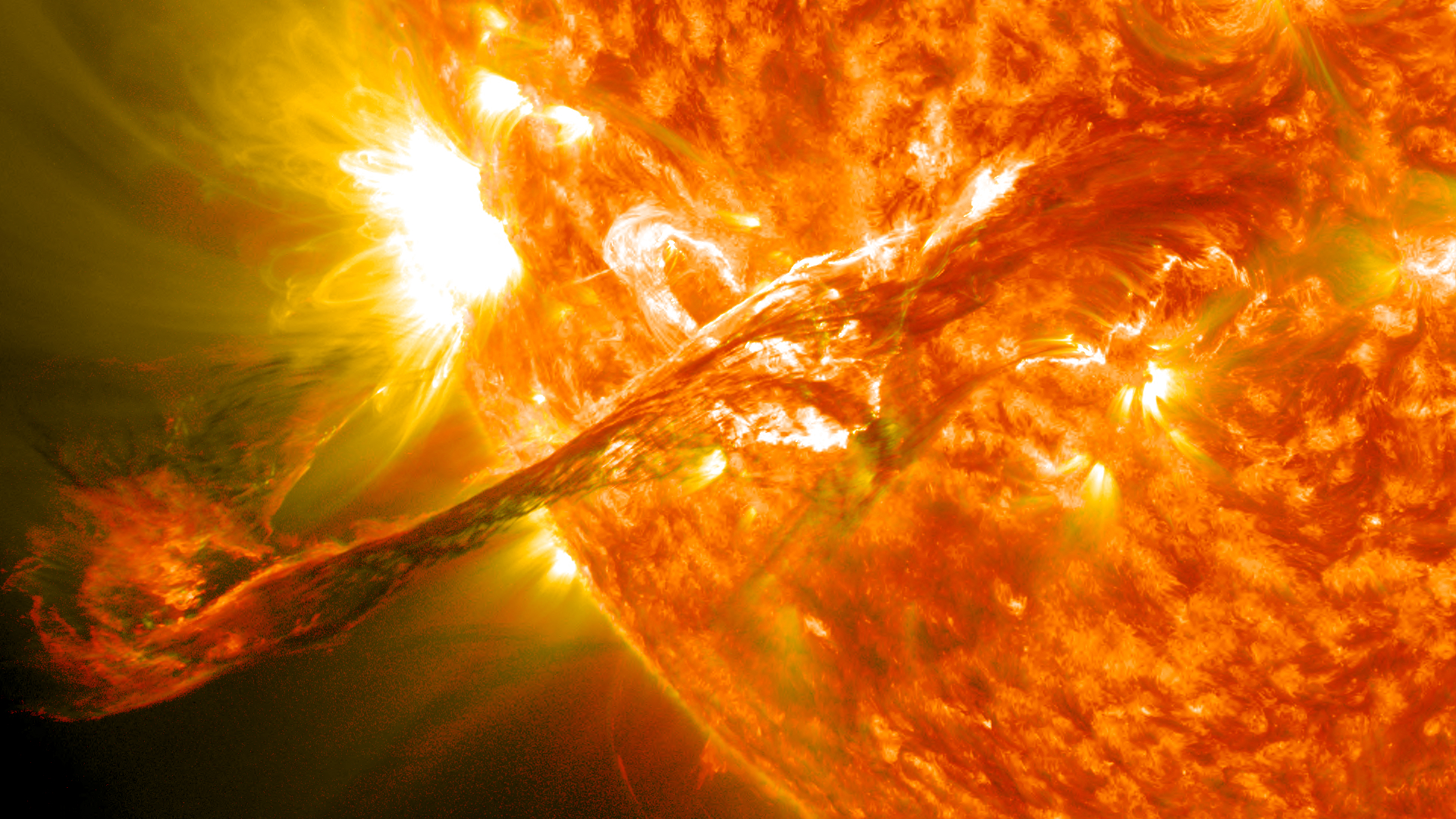
Click to enlarge. Trust me- you want to do this!
Before the newsy stuff I had to give you that eye-gasm of a photo of our nearest star a.k.a. the Sun, blowing off millions of tons of hot gas into space a couple weeks ago. This image combines two spectrums of light that we can’t see with our eyes, both of which are in the ultraviolet range and show the magnetic activity better. Both were taken with NASA’s Solar Dynamic Observatory (SDO). We should be glad this enormous eruption wasn’t aimed directly at Earth, else we could have had serious satellite and power disruptions.
Now for the headlines:
- The teams of physicists at the Large Hadron Collider have officially published their findings on the Higgs boson in a legit, peer-reviewed journal- Physics Letters B. This is the same journal in which Peter Higgs first published his revolutionary paper that began the hunt for the boson to begin with. Once a discovery passes this level of scrutiny, it’s DONE. That means we did it! Scientists have been a little hesitant to actually call this discovered particle the Higgs boson, however, since all the properties and attributes of the particle are yet to be nailed down. Over the next few years we’ll start to get a better picture of just what this particle looks and feels like, so to speak, and I’m sure there will be many more questions raised than answered. (Via NewScientist)
- Star Trek is starting to look a bit more like reality than science fiction thanks to new research being done into anitmatter and fusion propulsion. That’s right- antimatter, as in the stuff they used to run the Enterprise‘s Warp Drive. NASA teamed up with consulting firm the Tauri Group for a presentation that included a prediction that human technology will have advanced to the point that antimatter and fusion propulsion will be possible for spaceships by around 2060. The technology will not, however be capable of faster-than-light travel. According to the 2010 report the presentation was based upon, it would take about 4 months to get a ship to Jupiter with this technology. That’s significantly faster than current technology, but still a very VERY far cry from Warp speed. (Via Space.com)
Rocketfest: I met Phil Plait!
September 5, 2012

SO MUCH NERD HAPPENING RIGHT HERE
This past Monday (Labor Day) I had the pleasure of meeting someone you’ve seen me reference approximately 8,956 times on this blog- the one and only Dr. Phil Plait, a.k.a. the Bad Astronomer. As I mentioned last week, the U. S. Space & Rocket Center in Huntsville, AL held a fundraising event called Rocketfest for the Space Camp Foundation, an organization that creates scholarships for kids to go to Space Camp. If you don’t know what Space Camp is, then you need help. Above is photographic proof of the insane amount of nerdery that occurred. Just look at our shirts!
As a music snob of sorts, I had a hard time with the musical performances, though Molly Lewis’ anti-folk leanings reminded me of Jeffrey Lewis at times. That’s definitely a good thing. Phil Plait gave a short presentation on the Mars rover Curiosity, and while it was all stuff I’ve already seen and/or know about the mission, his passionate and charismatic delivery was the star of the show for me. He’s one of the best ambassadors of science to the general public I’ve ever seen, right up there with Adam Savage, and I sincerely hope he continues to become more of a public figure.
The whole point of the event was to raise money for Space Camp scholarships, so if you care about the future of human race, make a donation now. I say that because our future depends on the kids of today becoming more interested in STEM and thus becoming the scientists and engineers that will continue to innovate and improve our technology. Programs like Space Camp are what inspire kids to enter those fields. I wasn’t lucky enough to get to go when I was a kid, but I sure as hell want my kids to go someday. I will probably be able to afford the tuition, but some families aren’t as fortunate, and those kids deserve the chance to go just as much as the fortunate ones.
I now step down from my soapbox. 🙂
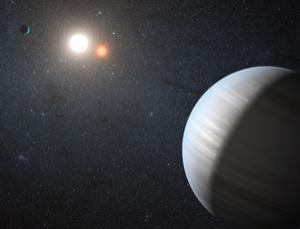
Artist interpretation of Kepler 47c. Credit: NASA/JPL-Caltech/T. Pyle
It’s been a while since we had any juicy exoplanet news. That changed yesterday as a new breakthrough was announced in exoplanet science. For the first time astronomers have confirmed multiple planets orbiting a binary star. The star is about 5,000 light years away and what really makes this discovery interesting is that one of the two planets orbits in the habitable zone, where liquid water could exist on its surface. The catch is- the planet is a gas giant, similar to Jupiter and Saturn, but more the size of Uranus. However, planets like that almost always have many moons, some of which could have an atmosphere and even support life, just like the Forest Moon of Endor, home of the Ewoks in Star Wars. Pretty exciting stuff! Read more about it at NewScientist.
 In other news, if you’re anywhere in the southeast and looking for some nerdy fun this Labor Day, look no further than Rocket Fest at the U.S. Space & Rocket Center in Huntsville, AL. This event just popped onto my radar today via Bad Astronomy, and low & behold Dr. Plait himself will be one of the guest speakers! It should be no secret that I’m a big fan of him and and his blog. This is a fundraiser open to anyone, any age, and the proceeds go to the scholarship fund for Space Camp, and the U.S. Space & Rocket Center Foundation. Honestly what excites me the most about it (besides seeing Phil Plait speak) is the fact that you can get a signed print of that AWESOME poster for a mere $20 donation. I’m not sure yet if I’ll be there, but I had to mention it because it’s all sorts of awesome!

 steve cross loves music and science