
Success! Astronaut Don Pettit successfully captured SpaceX’s Dragon capsule today at 9:56am EDT with the space station’s robotic arm. They will now bring the Dragon capsule in and dock it with the ISS. This is an historic moment- the first time a commercial spacecraft has ever docked with the ISS. Hopefully within a few years, these amazing private spaceflight companies such as SpaceX can fully take over the duties of ferrying cargo and people to and from the ISS. More at NASA.gov.
(Fast forward to about 2:30 to get to the actual launch.)
SpaceX successfully launched their Falcon 9 rocket, carrying a Dragon capsule filled with supplies and experiments bound for the International Space Station this morning at 3:44am EDT. This mission is far from complete, however, and with the capsule now in orbit the company must also prove their capsule can be docked with space station, unloaded, reloaded with used experiments, and splash back down safely in the pacific ocean. This flight is historic because it will be the first private, non-NASA rocket to complete a full mission to the ISS.
SpaceX has thus far been the leader among the various private companies vying for the top NASA contract to ferry cargo and astronauts to the ISS. The Dragon capsule will catch up to the ISS and perform a few maneuvers before slowly and incrementally approaching until the crew of the ISS can latch onto the capsule with the station’s robotic arm. They will then bring it in for docking using that arm this Friday May 25th. I really hope this mission is successful because as I’ve said all along, I’m a big fan of private companies taking over the low earth orbit duties for NASA. Keep your eye on the NASA website for updates. (Video via Universe Today)

Credit: Planetary Habitability Laboratory at UPR Arecibo, NASA, EUMETSAT, NERC Satellite Receiving Station, University of Dundee.
As you probably already know, there was an annular solar eclipse that was visible to parts of the Pacific rim last night/this morning. Because of the international dateline, I had the days mixed up and thought it was happening today (Monday May 21st) for the western U.S., when in fact for us it was at sunset last night. But it was Monday May 21st when it began for areas like Japan, because for them it happened early in the morning. Confusing right? It’s like the eclipse time-traveled. Anyway, the above photograph gives you a different perspective on it. The dark dot over the northern Pacific Ocean is the shadow of the moon! (Photo via Universe Today)
In other space-related news: SpaceX scrubbed the launch of their Falcon 9 rocket early Saturday morning due to a faulty check valve in one of the nine Merlin main engines. Their system has a computer that runs a full diagnostic check on everything right as the engines fire, and if even the slightest problem is detected the system shuts off everything immediately. Engineers are working diligently to get the valve replaced and run diagnostics with the rocket still on the launch pad. The new target launch date is May 22nd at 3:44am Eastern Daylight Time. I hope this all works out- I’m a fan of commercial spaceflight and feel that it is essential that NASA be able to rely on private companies to handle all their low-Earth orbit operations so that it can focus its main efforts on exploring asteroids and Mars. For more info see SpaceX’s website, and NASA.
Space X ready to launch historic mission May 19th/Andy Warhol gets a crater named after him
May 17, 2012
Friends/readers- my apologies for being a bit behind on the blog this week. I’m juggling a lot this week and have been stretched pretty thin. But here are a couple of tidbits I’ve rounded up that piqued my interest.
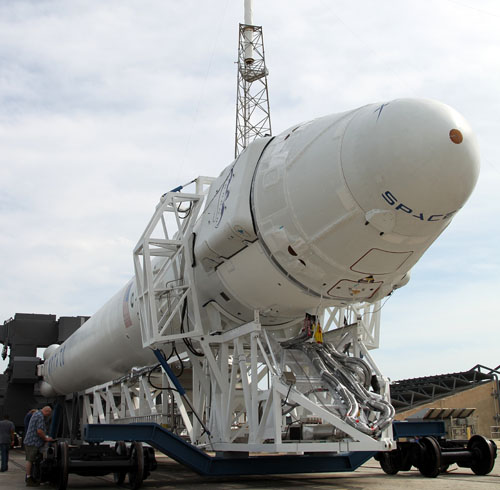
Credit: SpaceX
The current leader in the commercial spaceflight race for ferrying NASA’s astronauts and supplies to the International Space Station is Elon Musk’s SpaceX. They decided to combine the next two missions into one sometime last year, but the combined mission has faced several delays recently. Originally scheduled to launch late last year, this mission will be the first commercial mission to launch and dock with the ISS. That’s why this flight is so important and why they are double and triple checking to make sure they’ve dotted all their i’s and crossed all their t’s. If all goes well the Falcon 9 rocket will blast off from Cape Canaveral at 4:55 AM EDT Saturday morning. For more visit NASA or Bad Astronomy.
In other space-related news, NASA’s Messenger mission has been busy orbiting and making detailed maps of planet Mercury. Having no atmosphere, Mercury’s blistering surface is nothing but craters, and thus the International Astronomical Union (IAU) has been busy naming those craters. Andy Warhol was the latest celeb to get a crater named after him, and to celebrate, the mission managers created this image of the Warhol crater in the style of the pop art screen prints he’s famous for:

Credit: NASA/Johns Hopkins University Applied Physics Laboratory/Carnegie Institution of Washington

Credit: Google/NASA Meteor Watch
California and Nevada residents may have been terrified by the loud sonic boom that shook their houses Sunday morning, but now that we know what caused it, they should feel privileged to have experienced such a rare event. We now know that the cause was a fairly large meteor that entered our atmosphere with the energy equivalent to a 5-kiloton explosion. I’ve read other estimates for the energy, but that is the official number from NASA’s Meteoroid Environments Office. That puts it entering our atmosphere at a blistering speed of over 33,000 mph. This meteor was about the size of a minivan, so it was easily visible during the daylight, and that fact that it caused a massive sonic boom means that it made it all the way down to the troposphere, the lowest level of atmosphere, or the level in which clouds and weather occur. Most meteors are much MUCH smaller, and even if they did cause a sonic boom, they burn up far too high in the atmosphere for us to hear it, not to mention that that the air up there is much thinner and doesn’t carry sound waves as well. Because of this meteor’s size and density there’s a decent chance that some fragments of it may have made it to the ground. Once they hit the ground they’re called meteorites, and there are people who make it their living to hunt for them. The rarity of this event is why I think the people who got to see it or hear it are very lucky. I’d give anything to witness something like that. Meteors of this size only occur about once a year, and the simple fact that earth is about 75% covered in water means that us land-dwellers only have a 25% chance of seeing one when they do hit. (Other sources: Universe Today and Discovery News)

Image credit: Dr. Phil Plait/Bad Astronomy Blog
Rant warning: I’m about to go on a major rant. Don’t say I didn’t warn you.
There’s simply no way else to put it, science classrooms in Tennessee’s public schools are fucked. It’s clear that our Republican Governor Bill Haslam didn’t actually like the so-called “monkey bill” that will allow teachers in TN public schools to teach creationism and climate change denialism under the guise of “scientific weaknesses,” but unfortunately he proved to be a coward by finding the political equivalent of “having your cake and eating it too”- allowing it to pass without his signature. The bill is nothing more than Bible-thumping socially conservative legislators trying to create a seemingly politically correct path for religious-based ideas to be taught alongside thoroughly proven scientific principles in our public schools. Honestly the state Board of Education is who should be making decisions like this, not state lawmakers. The separation of church and state is made crystal clear by the US Constitution, and teaching pseudoscience that is solely based on religion- creationism and intelligent design- should never EVER be allowed in public schools. Climate change denialism, while not religiously motivated per se, is very politically motivated and not supported by scientific evidence. Both evolution and climate change are overwhelmingly supported by rock-solid scientific evidence. Both are large and complex topics, the minor details of which are constantly going to be debated/improved/clarified, but the overall facts of both are very certain. They are not “scientifically controversial,” they are only politically controversial. It’s times like these that I’m quite ashamed of my home state. Dr. Phil Plait of Bad Astronomy Blog has much better and more professional commentary on this than I, so I suggest reading his blog post about it.
However, things like this Elon Musk interview from last night’s Daily Show with Jon Stewart bring me right back up when I’m down. Watch part 1 here and part 2 here, because you can’t embed Comedy Central videos on a wordpress hosted blog. 😦 It’s awesome and inspirational to see people like him be successful. People who have both the money and the vision to do great things and push the boundaries of mankind’s knowledge and capabilities. Elon Musk is one of many who are pushing the human race forward. The religious right pandering morons in the TN legislature and our coward of a Governor are among those pulling the human race backward.
End of rant.
 This is so cool I had to share- OMG Space. I just love things that really put the vastness of space and the unfathomable sizes of objects like the sun (which is literally a tiny spec compared to some stars) into a perspective/scale that our feeble human brains can comprehend. OMG Space does just that. Start at the top and just scroll. And scroll and scroll and scroll and scroll and scroll and scroll until you get to Mercury. Then you realize “holy shit, I’m only at the first planet!” Then keep doing that. Resist the urge to just click on the planet at the bottom. The point isn’t getting to each planet, it’s the vast space between. If you’re not utterly amazed by that sense of scale and size, then you must not have a pulse. Seriously.
(Via Yewknee)
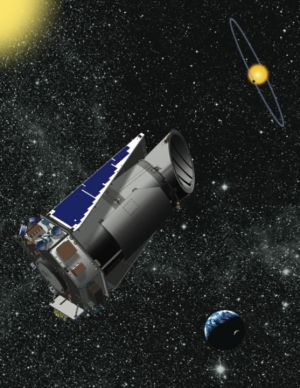 Some fantastic news from NASA today: The astoundingly successful and productive Kepler Mission has been extended through 2016! This is a huge relief for space nerds like me who eagerly watch science news blogs for the next big news item from missions such as Kepler. As you may know, Kepler is a space telescope which looks for planets in other star systems. Most specifically, the mission is looking for earth-like planets in other star systems. The mission has already racked up over 1,000 potential planets, and I have absolutely no doubt that it will find and confirm the first true earth-twin in these next 4 years. There was a lot of concern over the future of the mission due to recent NASA budget cuts- many thought the mission might not get funding to extend it even till 2014, so getting funding till 2016 was actually a pleasant surprise. The funding will, however, be up for review again in 2014. Still, this is a huge relief because Kepler has already seen what could be earth-twins, we just have to wait for a second transit to occur to confirm the initial observation. Since these are truly earth-like planets, it takes them roughly one earth year to orbit their parent star. The major worry was the mission would be ended before a second transit could be observed to confirm the planets’ existence. Thankfully we no longer have to worry about that, and it’s only a matter of time before the holy grail of planet-hunting is found.
(Via Universe Today and Bad Astronomy)
Neutrinos don’t go faster than light, afterall
March 22, 2012
 Just as I and most rationally-minded people in the world thought, it’s almost certain that the alleged faster-than-light neutrinos observed by the OPERA experiment in Geneva last fall were nothing more than a fluke due to measurement errors. As exciting as it would be for the results to be true (especially for the textbook publishing industry- every single science textbook would have to be rewritten and republished, after they rewrite the entire Standard Model of physics!), it looks as though the hypothesis that faulty fiber optic wiring in the detectors were to blame for the 60 nanosecond discrepancy the was observed. Thought scientists apparently aren’t 100% sure that the faulty connection was indeed the cause of the error, they are quite certain that it was some sort of error and not neutrinos actually traveling faster than light. They are quite certain of this because a second experiment- the Imaging Cosmic and Rare Underground Signals, or ICARUS, which uses a different detector in the same facility as the original OPERA experiment could not replicate the results. With the ICARUS experiment, the neutrinos behaved as expected, arriving at the speed of light and obeying the laws of physics as we know them. This, however, is still not enough to put this issue to rest in the eyes of science, and several other experiments around the world intend to independently measure the speed of neutrinos. A few are scheduled to happen in May, and I’d be willing to bet that they will all show that neutrinos aren’t the rebels the initial OPERA experiment showed them to be.
This is how real science works, and why extraordinary claims require extraordinary evidence. One experiment’s results are never, ever enough to conclusively make any kind of claim. Even with established, large-scale theories things can change as new discoveries are made.
All of this via Universe Today and Live Science.
No more posts this week but wormholes may be possible…
March 13, 2012
The bad news (for you at least): No more posts this week because this afternoon I’m embarking on my yearly SXSW jaunt. I’m back in the world of the badgeless this year, and currently have no obligations or assignments from the Scene, so this year should be interesting. Also, my band Scale M0del is playing the Red Gorilla Festival on Friday at 3pm at the Dizzy Rooster on 6th St. So if you’re down there, try to stop by! It’s totally free and doesn’t require a badge or wristband of any kind. Actually that may not be bad news for you at all, because it’s probably of little significance to you whether I post the rest of the week.
 But, I do have good news! Wormhole travel is slightly less inconceivable now thanks to some research by a team of physicists from Germany and Greece! In short- those convenient things called wormholes that made intergalactic travel possible in science fiction such as Stargate, Contact, etc… are actually pretty tricky business, and were once thought to require unfathomable amounts of negative energy to keep stable enough for a person to travel through. All the while, the very existence of negative energy isn’t even a sure thing. BUT, this new research pulls from elements of string theory, quantum theory, and other far-out theories to get around that massive negative energy requirement. This New Scientist article explains it all, so head over and check it out. It’s a long one, but well worth the read. Unfortunately the idea of traveling through a wormhole is still pretty inconceivable, because according to these new calculations, the wormhole would have to be tens to hundreds of light years across in order for a human to travel through it without getting ripped apart by tidal forces. I actually LOL’d at the line “…our galaxy’s stars are crowded together within a few light years of each other. While this doesn’t prevent the existence of a wormhole with a mouth tens of light years across, it makes it hard to position it so that star systems don’t accidentally fall in. Fallen stars would surely disrupt the timetable and so users might avoid our galaxy altogether.” (Emphasis mine.)
This is one of those articles which requires you to create an account through New Scientist, but it’s free, and all you’ll have to endure is a few email newsletters full of fascinating discoveries and other tidbits from the science world. Not bad if you ask me.
I shall see you back here sometime next week, whenever my brain and liver have fully recovered from SXSW. Till then, cheers!

 steve cross loves music and science