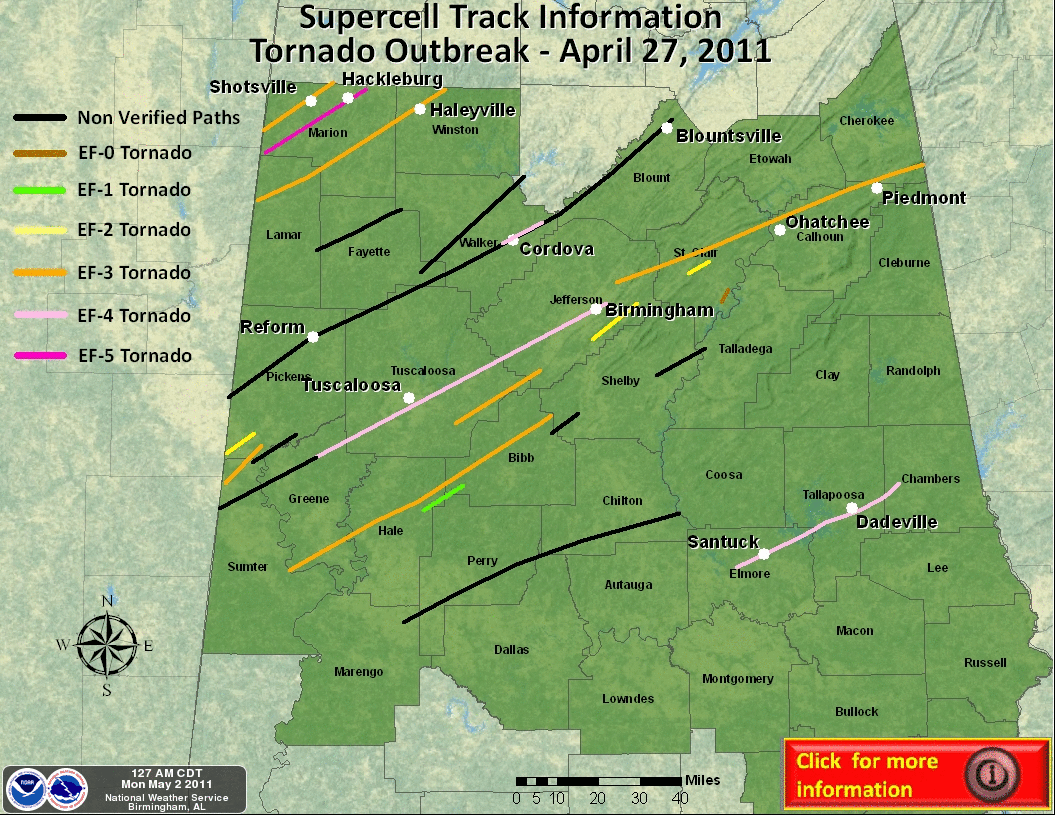
It may take many more days before NWS survey teams can finish their assessment of the damage from the April 27th tornado outbreak, but being the weather nerd that I am, I want to go ahead and share a collection of links where you can find preliminary reports on the tracks and intensities of some of the many twisters that touched down. Note that there is at least one EF-5 (the highest intensity with winds over 200 mph) tornado confirmed, and there could be more upgraded to that status as more damaged is inspected. NWS Memphis survey– covering parts of northern Mississippi. NWS Jackson, MS survey. NWS Hunstville, AL survey. NWS Morristown, TN survey. And finally, this graphic from the NWS Birmingham, AL survey. The most complete graphic I’ve seen:
 So that’s the bad. Please make a donation to the American Red Cross or any other legitimate organization providing relief for those devastated by this natural disaster. Now for some good things to lighten the mood.
I will call the news of Osama bin Laden’s assassination good, but I certainly will never rejoice the death of any human being. While I am relieved somewhat, and do feel that justice has been done, I’m quite certain that the assassination itself as well as the celebrations will only give the rest of al-Qaeda even more reason to attack the US and its allies.
In even better and much much much lighter news, Moustache May has begun its final year of activity. I participated back in 2008 and am doing so again this year. Due to some very important meetings happening last week at my work, I was unable to start my stache until Friday, so I’m basically starting with a clean slate. Right now I look utterly creepy but hopefully we’ll get past that stage very soon as it fills in.
I came across this absolutely amazing new music video for the Supermen Lovers’ track “Take A Chance” and decided that it was the best thing to end this post with. Enjoy. (Via Too Many Sebastians)
Science Friday: Coriolis Effect does NOT affect water drains/indirectly affects tornadoes
April 29, 2011
So I’m thinking that some Fridays I’m gonna steal NPR’s “Science Friday” idea and write a post debunking some popular myths. Not gonna happen every Friday, but I’m gonna make a pointed effort to do it somewhat often.
Today we’ll tackle the myth about water spinning in opposite directions down the drain in the northern and southern hemispheres. This is simply not true at all. While large-scale weather systems do indeed follow this pattern due to a phenomenon called the Coriolis Effect, water going down a drain does not. Minute things such as imperfections in the angle at which a basin was installed, inconsistencies in the surface or shape of the basin, and any residual motion in the water itself are what determine the direction the water rotates when drained. Once the water begins to drain, the conservation of angular momentum takes over and any hint of rotational motion in the water, whether clockwise or counter-clockwise, gets amplified as it moves toward the drain, creating a vortex. This is the same law of physics that causes tornadoes and dust devils to behave the way they do. The classic explanation for this concept is the spinning ice skater. As he/she moves her limbs closer to their body the conservation of angular momentum forces their rotational speed to increase. They can then move their limbs further away and they will slow down again. So no, no matter what you’ve heard, water does NOT always drain counter-clockwise in the northern hemisphere and clockwise in the southern. That being said, experiments have been done that show the Coriolis Effect can be seen in draining water IF AND ONLY IF all other forces are completely removed. A large and absolutely perfect cylinder-shaped container with one very small hole exactly in the center was filled with water and allowed to sit untouched for 24 hours to allow any residual motion in the water to die out. The container was perfectly balanced with extreme precision. The plug in the hole was then carefully removed and the water did eventually start rotating counter-clockwise, and continued to do so when the experiment was repeated. BUT clearly this only happens in extremely controlled conditions. In your sink or toilet, a myriad of other forces are orders of magnitude stronger and completely overwhelm the minute effect of the Earth’s rotation. Snopes has a decent debunking of this myth as well.
Tornadoes are different. I was asked about this yesterday, in the wake of the massive tornado outbreak on Wednesday. The Coriolis Effect does influence the direction tornadoes spin, but in a more indirect way. There have, in fact, been clockwise (anticyclonic) tornadoes documented in many cases in the U.S. There have even been a few storms that dropped multiple tornadoes, both cyclonic and anticyclonic, at the SAME TIME. As I said earlier, the Coriolis Effect is what causes large-scale weather systems such as hurricanes, low pressure systems, and high pressure systems to rotate the way they do. Low pressure systems and hurricanes always rotate counter-clockwise in the northern hemisphere and clockwise in the southern. The opposite is true for high pressure (clear weather) systems. The storms which produces tornadoes are always associated with a large-scale low pressure system. The Coriolis Effect determines the rotation of that large-scale system, which in turn has an indirect influence on the structure of the supercell thunderstorms which spawn tornadoes. Tornadoes are far, far more common in the U.S. than anywhere else in the world, and because the warm moist air which “feeds” these storms at the surface is moving in from the southeast, and the cooler, drier air aloft is moving in from the northwest, that setup naturally lends itself to counter-clockwise rotation, hence most but not all tornadoes in the U.S. spin counter-clockwise. This illustration from NOAA’s National Severe Storms Laboratory shows the inner workings of a tornadic storm quite well:
 The U.S. Department of Energy’s Office of Science Education has a website called NEWTON, with a forum of sorts called “ask a scientist.” This very question regarding the rotation of tornadoes was asked, and I found this particular response quite helpful:
At least the great majority of tornadoes rotate counterclockwise (as do all low-pressure systems) in the northern hemisphere, and clockwise in the southern hemisphere, for the reason (coriolis force) given by Eric Peterson in response #1. But occasionally, it would seem, northern hemisphere tornadoes do rotate clockwise: S. Flora’s book “Tornadoes of the United States” cites an 1890 article in the American Meteorological Journal. Its author, a J.P. Finley, states that, of 550 American tornadoes he studied, 29 were deemed to have rotated clockwise. I have not been able to find any “modern” study of this question. But I believe it could be true. The region of swirling air that contracts to become the tornado is not itself large enough in extent to have its rotation dictated by the coriolis force; rather, it “inherits” this tendency from the great masses of air whose movement sets the stage for the storms and any associated tornadoes. If the study cited is correct and representative, on occasion the direction of rotation is set by some other factor, perhaps the topography in the area where the tornado forms, for example.
So there you have it. I won’t have as much time every week to write up a post this in-depth, so don’t expect this every Friday, but I’ll do my best.
Today is Yuri’s Day/Night
April 12, 2011
 50 years ago today, the USSR beat the US in the first milestone of the space race: they put the first human, Yuri Gagarin, into space. Gagarin’s accomplishment is celebrated each year in a series of “Yuri’s Night” parties. Obviously this year is a big deal, since it’s the 50th Anniversary, and not only does Discovery News have a gallery of photos from various Yuri’s Night parties around the globe, but this story also clued me into something I didn’t yet know about- a feature length film by director Chris Riley that attempts to re-create what Yuri would have seen from his capsule. Audio from the flight has been released, as have video clips of Gagarin’s face during the flight, but no video of the earth below was taken during the flight. So, Riley teamed up with Italian astronaut Paolo Nespoli to capture video footage from the International Space Station’s Cupola as the passed over the same areas Gagarin’s capsule did during that first flight. Check it out on YouTube here.
30 years ago today, the US reached another milestone, coinciding with the 20th anniversary of Gagarin’s flight- they launched the first space shuttle flight. It was shuttle Colombia, with astronauts John Young and Robert Crippen on board. Thus it’s only fitting that today, during a ceremony celebrating 30 years of shuttle flights, NASA will announce the final resting places of the 3 remaining shuttles after they’re decommissioned. Many museums and towns with history tied to the space program have made their cases for getting one of the shuttles, but it’s expected that one will go to the Smithsonian and another to the Kennedy Space Center visitor complex. Beyond that, it’s anyone’s guess, but I have a feeling the 3rd will go to Houston, as it’s home to NASA’s mission control. (Update: the announcement was just made, and Discovery goes to the Smithsonian, Atlantis goes to Kennedy Space Center, and Endeavour goes to the California Science Center in L.A.) This celebration at KSC is just getting underway as I type this at 11:50am CDT, and the announcement regarding the shuttles’ destinations is scheduled for 3pm EDT (2pm here in Nashville). Watch it all at NASA TV if you’re interested. I’ll update this post after the announcement is made.
NASA’s next Mars rover/why eyes are blue
April 6, 2011
This animation shows how NASA’s next Mars rover, called Curiosity, will get to its destination. The mission is schedule to launch late this year and if all goes as planned, 8.5 months later we’ll start learning more about Mars than ever before. This rover is the first we’ve sent to specifically look for evidence of life, both past and present. This video is the first I’ve seen that shows every aspect of how the rover will arrive on the surface. Getting a probe safely on the surface of Mars is much harder than you might think- it’s actually the hardest aspect of the whole mission. Mars has a very thin atmosphere, so not only does the initial entry NOT slow the probe down nearly as much as a thicker atmosphere like Earth’s would, but also the atmosphere renders parachutes almost pointless, because in order for a parachute to slow the probe to a safe touchdown speed they’d have to impractically massive in size. In both cases, the thin air makes the slowing mechanism much less effective. For Curiosity, NASA came up with this “sky-crane” landing process that is simply amazing. The engineering and technology required to pull this off simply can’t be overstated- it’s both magnificent and terrifying at the same time. I say terrifying because one tiny glitch or mechanical failure could cause the rover to crash into the surface, land sideways, or even miss Mars altogether. Every minute detail of the mission must be executed with absolute precision and perfection. In the current economic climate, failure of a mission this expensive would be a catastrophic blow to NASA’s unmanned mission programs, and we likely wouldn’t return to Mars’ surface again for many years. But with the huge successes of 2004’s twin rovers Spirit and Opportunity and 2008’s lander Phoenix, it’s safe to say NASA is getting pretty good at this. (Via Universe Today)
Another interesting tidbit I felt compelled to share: people with blue eyes (such as myself) don’t really have blue eyes. In fact, our eyes are actually pigment-less, and the same effect that makes the sky blue makes our eyes look blue. In a nutshell, irises have 3 layers and people with brown eyes have pigment in all 3. People with blue eyes have pigment only in the back layer, while the front layers have no color. However, those front layers also have tiny particles in suspension that scatter blue light (due to its shorter wavelength) more readily than other colors. This is the same thing that happens in the atmosphere and causes the sky to appear blue. As we age, those particles tend to get larger and scatter a larger portion of the light spectrum, thus our eyes look less blue and more grayish the older we get. (Via i09)
- Credit: NASA
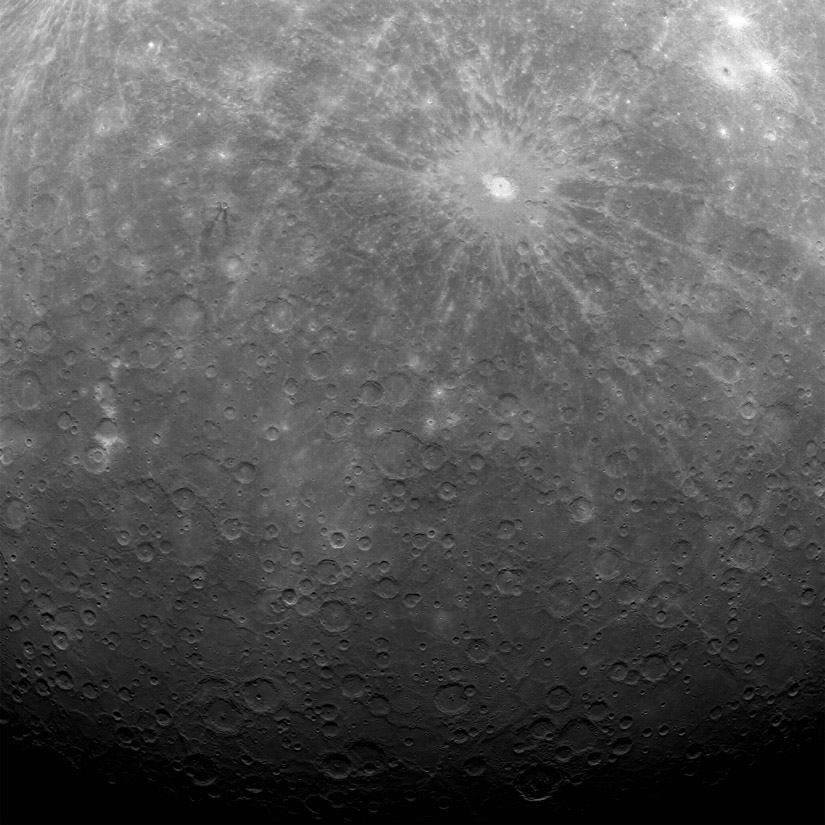
You’re looking at an important piece of history when you look at the above photograph. That’s the first ever image of Mercury taken from orbit. NASA’s Messenger spacecraft successfully entered stable orbit around the solar system’s smallest planet, and yesterday morning we got the first images taken from said orbit. The spacecraft has taken other images of Mercury as it approached, but Messenger just recently actually entered a permanent/stable orbit, and will remain there for at least a year, studying this hot, battered planet in unprecedented detail. This is also the first time any spacecraft has orbited Mercury to begin with. (Via Discovery News)
In some other space-related news, NASA decided to pull the plug on James Cameron’s idea to install a 3D camera on the next Mars rover mission, Curiosity. Honestly, I love this idea, as it would have allowed anyone with 3D glasses to watch cinema quality footage from the surface of Mars. When you really think about that, it’s absolutely mind-boggling: 3D video footage from another planet. However, NASA felt that since this rover is already way over-budget, the risk of failure was too great because the cameras haven’t been thoroughly tested. I’m certain that this technology will end up on another NASA mission to Mars in the future. So just wait. In another 5-10 year’s we’ll be looking at HD footage from Mars in 3D. NBD… (Via i09)
First of all if you haven’t donated to the Red Cross relief efforts in Japan, do it RIGHT NOW by texting “RED CROSS” to 90999. It’s only $10 and I don’t care how fucking broke you are, you can afford to give $10 to help people who have it WAY WORSE. And all you have to do is send a couple texts. They take it out of your phone bill.
There has been a lot of speculation about this quake being caused by the “supermoon.” That is absolute bullshit. Click those words for three different stories from very reliable and respected sources for detailed explanations as to why the moon didn’t cause this quake. In short- the moon’s orbit is elliptical, so it’s distance from earth varies over a 2-week period. When it’s closest we call it perigee, and when it’s farthest it’s called apogee. When the full moon happens to coincide with perigee, we call it a supermoon, because this full moon will appear just a tiny bit bigger than the rest because the moon is at it’s closest. The phase of the moon (how much of it is lit by the sun) cannot have any effect on earth whatsoever beyond the fact that a clear, full moon-lit night will be a little brighter than a clear, new moon-lit (unlit) night. What does have some effect on earth is the moon’s gravity (which causes tides), which is understandably just tiny bit stronger at perigee. If those tiny fluctuations in the moon’s gravitational tug had any effect on earthquakes we would see it every TWO WEEKS because that’s how often the moon goes from perigee to apogee! Again, for more info click those links above.
One thing that is based on scientific fact is that the quake altered the length of one day, and shifted the Earth’s figure axis. The changes are so minute that they are completely insignificant, but interesting nonetheless. According to computer models, Earth’s day is about 1.8 microseconds (millionths of a second) shorter and the Earth’s figure axis moved by about 6.5 inches (17 centimeters). These changes are tiny compared to normal fluctuations of the both of these measurements over a year’s time, however. Both the length of a day and the position of the Earth’s figure axis fluctuate yearly by a margin greater than the amount the earthquake changed them. So, this is nothing to worry about, but it’s still amazing. (Via Universe Today)
I must also point out that Boston Globe’s Big Picture blog, as always, has an amazing collection of stunning photos from the aftermath. Definitely a must-see.

Credit: NASA
Space Shuttle Discovery touched down for the final time this morning just before noon at Kennedy Space Center. The shuttle has spent a total of 365 days in space and traveled a total of 148 million miles on 39 missions. It is the oldest shuttle in the fleet and has always been considered NASA’s workhorse. Universe Today has a post with a crop of great photos from this last mission, as does the NASA website of course. Some cool facts from my own knowledge as well as tweets from Astrophysicist Dr. Neil deGrasse Tyson: the shuttle is traveling roughly 17,500 mph while in orbit, but it’s de-orbit thrusters slow it by only 188 mph. That’s enough to allow it to slowly drop into the upper reaches of earth’s atmosphere, at which point the air begins to take over the slowing process. The drag from the earth’s atmosphere is the only thing that slows the shuttle down from then on, including on the runway because the shuttle has no brakes, just a parachute that deploys just after it touches down. Everything in the re-entry process is meticulously calculated because they only have one chance at it. The shuttle has no power- it’s only a glider once back in the atmosphere, so everything has to be absolutely perfectly executed. The pilot is assisted by lots of powerful onboard computers that take care of most of the difficult fine-tuned adjustments, but the pilot must be able to take over if something goes wrong- the skill level required is immense. On April 12th, NASA is expected to announce the final destinations of the three remaining orbiters after their retirement. Discovery is expected to go to the Smithsonian, but that is not certain until the announcement is made. More on that at Space.com.
I feel I must also mention the alien bacteria craziness that happened over the weekend and earlier this week. NASA scientist Richard Hoover had a paper published that claimed that he had found evidence of extraterrestrial bacteria in a meteorite. Well, basically everyone else in the science community is saying he’s wrong, and I’m inclined to agree. There are a host of reasons why his claim is probably bogus, not the least of which is the fact that contamination of a meteorite by earthly bacteria is all but inevitable. Also, the paper had not completed a peer-review process before it was published, not to mention that it was published in a less-than-reputable journal that has a history of publishing error-laden work. NASA even issued a statement saying that they had nothing to do with Hoover’s paper or his claim. Most of this info comes from Phil Plait’s analysis of the situation. Get the whole story from him.
On a lighter note, enjoy this animated GIF gem, also from Plait’s Bad Astronomy blog:

Amazing footage of Discovery launch from plane/Road to Bonnaroo tonight
February 28, 2011
Some amazing and unique footage of Space Shuttle Discovery’s launch last thursday from an airplane window. The people on this plane got very lucky, as this is something rarely seen by the public. It’s one of those “right place, right time” deals. Be sure to pump it up to HD resolution.
(Via Bad Astronomy)
If you’re in Nashville and are a fan of local music, be sure not to miss tonight’s Road to Bonnaroo 8 off 8th at Mercy Lounge. This is the third year of RTB, and tonight’s lineup looks great. This event really brings out the best in these bands, as most will have some sort of trick up their sleeve. We’ve seen just about every type of gimmick you can think of at these events in the past two years. If you didn’t know, the bands’ scores are made up of 50% audience vote and 50% judge vote. Tonight’s lineup:
Evan P. Donohue
Courtney Jaye
Chancellor Warhol
Majestico
Heartbeater
Kink Ador
The Kicks
Tyler Byant
For more info on the bands/artists and sample mp3s, visit the Mercy Lounge calendar.

Credit: NASA
Space Shuttle Discovery is ready for launch later today (4:50pm Eastern/3:50 Central) on its final trip to space. This mission has been delayed extensively- it was originally scheduled to launch in November of last year, but fuel leaks and then tiny cracks discovered on the external fuel tank caused major delays. The shuttle had to be returned to the massive vehicle assembly building (VAB) for repairs that took several months. But so far all is good for the launch today. The shuttle is carrying an additional storage module (essentially a storage closet in space) to the ISS, along with an external logistics platform and a humanoid robot called Robonaut 2. Robonaut 2, known as R2 (ha!) is basically an experiment to allow engineers to determine how the robot will work in space, and how to best control it from inside the ISS. The end goal is to have a humanoid robot that can venture outside the space station and assist spacewalking astronauts with repairs and upgrades. The robot will be controlled by an astronaut inside the space station via some sort of virtual reality-like interface.
As I said, this is the last flight of Discovery. The only confirmed remaining flight is that of Endeavour, scheduled for launch in April. This mission will carry a very important piece of scientific equipment called the Alpha Magnetic Spectrometer to the ISS. The AMS will help physicists answer some of the most daunting questions in cosmology. An additional flight of Atlantis is likely, though not 100% confirmed. It would launch in June and be the absolute final flight of the Space Shuttle program.
Science funding standoff/solar flare headed for earth
February 15, 2011

Credit: NASA
First of all, I must make the point that these solar flares and coronal mass ejections we’re talking about will NOT harm us. At most, these can cause disruptions with satellite communications, but nothing more. On Sunday the sun belched forth an M-class (medium) solar flare with earth in the crosshairs. The stream of charged particles from the eruption is expected to reach earth sometime late tonight, and could create auroral displays visible as far south as the great lakes area. The sun is capable of flares much more powerful, that would create auroras visible all the way down here in TN, but they’re rare. I do expect there to be one or two of that magnitude in the next few years, however, as the sun is climbing toward its next period of maximum sunspot activity, known as solar maximum. It is possible that tonight’s flare could be more powerful than expected, and the resulting aurorae visible this far south, but it’s highly unlikely. If you’re in Canada or the northern US, however, I recommend going outside and looking north tonight. You just might get a treat. (Via space.com and spaceweather.com)
UPDATE: Apparently this same sunspot region produced another, more powerful flare last night. This time it was an X-class flare, though still not powerful enough to cause aurorae visible this far south. (Via Bad Astronomy)
Obama’s proposed budget for 2012 is basically in direct opposition to the Republicans’ ideas. The biggest area of contention will no doubt be science and education spending. Obama wants to boost funding for most everything science-related, which I applaud of course. But of course, Republicans want to make huge cuts in most everything science-related. It’s incredibly sad that most Republicans these days take such anti-science, anti-reality stances on issues. These proposed budgets are simply the beginnings of what will likely be a long, knock-down drag-out battle between the White House and Congress, and I hope there can be some concessions that will allow us to continue to grow in the areas of education and technology without vastly increasing the national debt. Granted, even a modest cut in the defense budget would probably take care of all these problems, but will that ever happen? Hell no. (Via NewScientist) Also, check out this nice infographic created by LiveScience.

 steve cross loves music and science