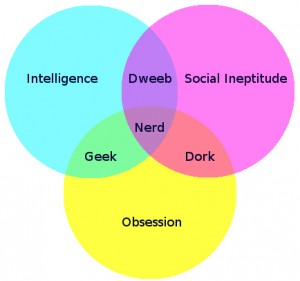
Rocky exoplanet confirmed/nerd Venn diagram
September 17, 2009

Image Via Space.com
A European satellite observatory recently discovered a very small exoplanet that is said to be the first with a proven density similar to Earth’s. Follow-up observations were done at a telescope in Chile to determine the planet’s mass, which was then combined with its radius to calculate its density. The planet has about 5 times Earth’s mass. But don’t get too excited just yet- the planet is far from habitable. It orbits VERY close to its parent star (23 times closer than Mercury is to our Sun), which not only means it’s really effin’ hot, but it also is probably tidally locked, which means the same side of the planet is always facing the star. So one side is literally boiling with molten rock, and the other side is extremely cold. There’s no way it could have any atmosphere, either. BUT this is still an important step toward finding an Earth-twin. No we know that we can find planets similar in size and density to our own. It’s just a matter of time until Kepler or CoRoT finds one orbiting in its star’s habitable zone. (Via Space.com)
Ever wondered about the difference between a nerd, a geek, a dweeb, and dork? Look no further. This pretty much nails it down perfectly. (Via Clusterflock)
NASA can’t get out of LEO with current budget/Levitating Mice
September 10, 2009
Bad news for NASA from the Augustine Commission. Under the current budget through 2015, we can’t even get out of Low-Earth Orbit. What that means is we can only go to the ISS. We can’t even get back to the moon, let alone send people to Mars or beyond. The commission’s recommendations are best summarized in a cool graphic that I found on Universe Today yesterday. See below.

Image via Universe Today
Obviously Obama has to allocate more money to NASA if we are to even think about achieving the current set of goals. (Those being: retiring the space shuttle, developing the new Ares rockets, Orion Crew Module, and Antares Moon Lander, and getting back to the Moon around 2020.) In these times that will be tough, and sadly NASA could get put on the backburner for a few years until we have more economic stability. Let’s hope for the best, though.
In some much better NASA news, the newly refurbished Hubble Space Telescope is working like a charm and is taking better pictures than ever before. Check out some of the gorgeous new images at NASA’s website. You can even download super hi-res versions. Eye. Gasm.
Who knew that we’d be able to build an actual, real-life antigravity device so soon? Scientists have found a way to levitate small creatures as big as mice. We’ve all seen the classroom science experiment where they use a superconductor in liquid nitrogen to levitate a tiny disc. But you can actually do that with almost anything. They key is getting the magnetic field to the right strength. AND there’s a practical goal of this research other than “Holy Shit! We made a mouse float in mid-air! Cool!” The practical goal is to study long-term effects of microgravity on the mice’s bodies, the results of which can be applied to astronauts in space and help NASA plan for missions to Mars and beyond. (Via LiveScience)
Here’s one of those awesome Hubble images:

Image via NASA
Google UFO explained/Shuttle photos/EEstor
September 8, 2009

Image via Universe Today
Whew. That was quite an eye-gasm wasn’t it? That was taken on the current space shuttle mission (STS-128) to the International Space Station. The mission is about to come to an end, with a scheduled landing on Thursday. (Via Universe Today)
I also found on UT the final explanation of the Google UFO logo that caused quite a stir yesterday all over the interwebz. The Google tech-nerds were simply showing some love for the Japanese video game Zero Wing, the one with the famous quote “All your base are belong to us” at the beginning. Google also tweeted a mysterious set of numbers. It turns out if you insert the corresponding letters of the alphabet, you get “All your O are belong to us.” No, Google doesn’t know something we don’t. No, it wasn’t a hint that we’ll soon be visited by aliens, or that the government will finally come clean on a huge conspiracy theory. Sorry, Fox Mulder.
Until this morning I’d never heard of EEStor, but this new technology could revolutionize…. everything. But apparently it’s been met with quite a bit of skepticism. Basically it’s a new way of storing electricity, much more efficient than a lithium ion battery, and it would make storage of power generated by wind turbines and solar cell arrays much easier. The problem with power from the wind and sun is that it isn’t constant, therefore you need a way to store that power so that it can be used at all times, even when it’s dark or there’s no wind. That storage has been a big hurdle for the progress of these types of energy. Basically what they’ve done is invent a capacitor capable of storing much more energy than any capacitor before. It was once thought that basic problems with the very laws of physics prevented the development of capacitors with this much storage potential. But apparently this company has managed to convince the Zenn motor company, along with several investors with deep pockets, that they have found a way around those problems. If they’re really on to something it could make 100% green, sustainable power much closer to reality. If you’re a total electronics nerd and want to read the nitty-gritty on this, check out this article. (Via EcoGeek)
Chicxulub challenges/rocket fuel made of ice/eclectic astronauts
August 24, 2009
 The theory that the dinosaurs were wiped out from an asteroid impact near the modern-day Yucatan Peninsula is beginning to face major challenges. There’s no doubt that a huge impact caused the Chicxculub Crater, but some recent findings suggest that the impact may have occurred some 300,000 years earlier than originally thought. This comes as a second blow to the impact theory, with the first being the discovery/dating of the Deccan Traps in India. This gigantic volcanic feature is the result of a huge eruption that is believed to have lasted around 30,000 years. Can you imagine a massive volcano erupting for 30,000 years and covering an area equivalent to 1/2 of modern India with lava? Trust me, something on that scale is hard for the human mind to comprehend, but that much volcanic ash and gas in the atmosphere would’ve had a devastating effect on the ecosystem, and almost certainly played a major role in the extinction of the dinosaurs. Get ready for science textbooks to be re-written, because the asteroid impact theory is about to see the same fate as the dinosaurs themselves. (Via Daily Galaxy)
NASA recently teamed up with the Air Force Office of Scientific Research to test a new, Earth-friendly type of solid rocket fuel. I’m not exactly sure of the details, but somehow they’ve managed to make rocket fuel out of aluminum powder and ice. Yes ice… as in frozen water. The secret apparently is that the aluminum powder is so finely ground that it’s considered “nanoscale.” The nanoscale aluminum has so much surface area in contact with the water ice that the exothermic reaction when it burns is more efficient than normal solid rocket fuel, which is usually powdered aluminum (not nanoscale) mixed with an oxidizer such as ammonium perchlorate and a binding agent. Seriously though, who would’ve ever thought you could make rocket fuel out of ice and aluminum? It just sounds crazy, but it’s true. (Via EurekAlert)
When you think of the type of person who becomes an astronaut, you don’t typically think of race car drivers or musicians, but two of the astronauts about to launch on Space Shuttle Discovery tomorrow morning are just that- a former off-road truck racer and a drummer. Check out this Space.com article to find out more about Commander Rick Struckrow, formerly a Baja off-road race driver, Pilot Kevin Ford who is also a drummer, and several other astronauts who come from surprising backgrounds.
NASA’s options/Zooey Deschanel dances/vacation
August 6, 2009
This will be my last post for about a week or more. Tomorrow right after work Megan and I are heading westward to spend some time at Yellowstone and the surrounding areas, and possibly Portland as well. Having to make the 34 hour drive back from Portland is looking less and less appealing, however. That being said, posting will be virtually non-existent for a while.

Photo via USA Today
As I mentioned a few days ago, we saw 500 Days of Summer last weekend. Most people would agree that there’s no such thing as too much Zooey Deschanel, and thus I highly recommend watching this cute music video put together as a promotional piece for the movie. It’s for She & Him’s “Why Do You Let Me Stay Here” and features ZD dancing with Joseph Gordon-Levitt. I have no idea how to embed USA Today videos on WordPress, so just go watch it here. (Via Stereogum)
I know I flooded you with science nerdiness yesterday, but I have to post this. I read an article this morning on Space.com containing details on the options for the future direction of NASA that Obama’s Augustine Commission are reviewing. Basically they’ve narrowed it down to 7 generalized options. They’ve been holding public hearings to get input from citizens (which is awesome) and plan to convene to make their final decisions and present them to President Obama at the end of this month. I’ve mentioned this many times on here before, but this is the first time I’ve seen the actual options that are under review. Personally, I’m torn between the “Directly Shuttle-Derived System” and relying on commercial spaceflight. It’s obvious that the current Ares I is having issues. It’s also obvious that many companies, the leader of them being Virgin Galactic, are really close to making commercial spaceflight a simple and easy solution. NASA could just buy flights from a private company to get astronauts to and from the ISS. I definitely think the US has invested way too much time and money into the ISS to end our involvement in 2015, just 4 years after it will be completed. It will still be useful and there’s no sense in abandoning it. Then NASA could possibly use the shuttle-derived plan, along with Ares V (which hasn’t had as many setbacks as Ares I because it’s not intended to carry humans; only cargo) to get to the moon and eventually Mars. Just my two cents.
See y’all in a week!
Ares I-X/Man-made Auroras
August 5, 2009

Image Via Universe Today
NASA is assembling the Ares I-X rocket currently in the the Vehicle Assembly Building at the Kenndey Space Center. This rocket is a test version for the Ares I which, under the current plan, will eventually take astronauts to the ISS and moon. They plan to do the test flight on Oct. 31st of this year. However, Obama’s Augustine Commission is currently reviewing the direction of NASA and could come out with a report that recommends scrapping the Ares rockets in favor of retro-fitting the space shuttle’s external fuel tank/SRB assembly to work with the new Orion Crew Vehicle. (I’ve posted about this before.) I’d say the test will happen regardless of the Augustine Commission’s recommendations, and furthermore I’d speculate that their findings will be somewhat dependent on the results of this test flight. Either way, it’ll be cool to see what happens. (Via Universe Today)
It’s unfortunate that most really big advances and breakthroughs in science are the result of military initiatives. (See: THE INTERNET) A scientist can ask the government for money to research a technology that could greatly improve the lives of everyone, but as soon as he/she mentions that the technology could have military applications, their chance of getting said money goes up exponentially. Such is the case with one of the most mysterious facilities ever to be built. No, I’m not talking about Area 51, I’m talking about HAARP (High Frequency Active Auroral Research Program) in Alaska. This thing is literally capable of creating its own miniature aurora in the sky. It’s a 3.6 megawatt antenna array aimed directly into the sky, and its purpose is to turn the ionosphere (a layer at the top of the atmosphere full of charged particles) into a giant low frequency antenna. I think the intent of the scientists behind this project is good, but the facility has fueled tons of conspiracy theories. Some even say it is responsible for Hurricane Katrina. I’m not knowledgeable enough to know exactly how ultra low frequency radio waves can affect the weather, but I do know that something powerful enough to blast the ionosphere and create a mini-aurora is pretty awesome, and the scientific knowledge that can be gained from such experiments is well-worth the evils of military application. The main military application in this case is the penetrating power of those ultra-low frequency radio waves generated by the ionosphere. Those waves could be used to detect underground bunkers and communicate with submarines deep in the ocean. Other radio waves are quickly absorbed by just a few feet of water or land, but these high-powered, low frequency waves have much more penetrating ability. I suggest reading this well written article on Wired about HAARP for more info if you’re interested. Here’s what the antenna array looks like:

Space Underwear/new state of matter
July 29, 2009
Remember Star Trek IV? That was the movie where they ended up time traveling back to the 20th Century and got stuck there, needing some transparent Aluminum to create a holding tank for a humpback whale. Some scientists have now created just that, if only for about 40 femtoseconds. They say it’s an entirely new state of matter, because they used a high-powered laser to remove one of the core electrons from each atom in a tiny area of Aluminum. This allowed X-ray and ultraviolet radiation to pass through uninhibited, effectively making the Aluminum transparent. (Via LiveScience)

Astronaut Koichi Wakata
There are many common luxuries that we take for granted on Earth, such as being able to wash our clothes. Unfortunately, in space you don’t have that luxury. Just going to the bathroom requires a highly sophisticated and technologically advanced toilet system. When astronauts wash their bodies they use special soap and shampoo that doesn’t require water. But in a microgravity environment where droplets of water can float around and destroy sensitive equipment, washing their clothes just isn’t an option. Unfortunately dirty clothes must be simply discarded. But apparently some Japanese scientists are working to fix that by inventing clothes that clean themselves… or don’t get dirty in the first place, depending on how you look at it. Astronaut Koichi Wakata, who just left the ISS on Endeavour, tested these new clothes during his 4 1/2 moth stay. It sounds utterly disgusting, but he never changed his underwear while he was there. The high-tech material actually kills odor-causing bacteria and absorbs moisture. He says that even after 4 1/2 moths of wear, they didn’t smell at all. This is yet another great example of how manned space exploration drives innovation and ultimately leads to technologies that are very applicable here on the ground. This could one day lead to clothes that literally clean themselves, eliminating the need for washing machines and dryers, which are energy and water hogs. (Via Universe Today)
In a related note, Universe Today also posted a set of great photos from Endeavour’s mission. Check it out.
That’s all I have time for today!
Shuttle Mission update/new Apple tablet/Life on Venus?
July 28, 2009

I agree with Yewknee- Day. Made.
Ok, now that you’ve been properly entertained by that photograph thanks to Yewknee’d, let’s get on with the good stuff.
Rumors have been spreading like wildfire for months that Apple will be releasing a new tablet device that could revolutionize mobile entertainment. According to this article on Financial Times, (via Kottke) it’s looking like the device will be released this fall, just in time for the Holiday shopping season. If this thing is as good as it sounds, Apple’s REALLY gonna cash in, and if it flops, their public image will be severely tarnished. But I have no doubt they will succeed with this in the same way they succeeded with the iPhone, save for that minor pricing debacle when it first came out. It seems to me that this thing will be an iPod Touch on steroids. Having just bought a new Macbook Pro, I sure as hell won’t be able to cough up the cash for one of these, but I can’t wait to go play with them at the Apple Store!
Space Shuttle Endeavour undocked from the ISS today after successfully installing the newest Japanese component. The shuttle is scheduled to land at the Kennedy Space Center this Friday at 10:47am EDT, weather permitting. (Via Space.com)
There’s been a lot of speculation about the possibility of life on Mars and more recently, life on Saturn’s moons Titan and Enceladus, and Jupiter’s moon Europa. But not since the 50’s have we ever thought that life could exist on Venus. People used to think Venus might have a climate somewhat like a tropical paradise, but that notion came to a screeching halt when scientists discovered that its surface is basically a good approximation of hell. Its surface temperature is over 860 degrees Fahrenheit, the atmospheric pressure is 92 times greater than Earth’s and made of mostly CO2 and laden with sulfuric acid clouds. But recent research has shown that it’s possible that microbial life could thrive in conditions found in the upper atmosphere of Venus. We continually discover life in places on Earth once thought to be utterly inhospitable, so it’s no longer such a stretch to imagine life surviving in such extreme environments as are found in Venus’ upper atmosphere. Scientists think that Venus was once much more Earth-like, and even had oceans. But what’s commonly referred to as a “runaway greenhouse effect” took over and caused the planet to heat up enough to boil away all water on the surface and create the hellish environment we see today. It’s possible that primitive life may have emerged during the planet’s more hospitable past and had time to evolve, adapt, and escape to the planet’s outer atmosphere where it could survive. (Via Daily Galaxy)
New Mercy Lounge website/newsy stuff
July 23, 2009
Not much time today so here are newsy bits, as they’re called over at the Cream.
Pitchfork reports that Conor Oberst is probably “closing the book” on Bright Eyes after one more album. Emo girls: you’ll just have to settle for his solo project from now on. Sorry.
 James Jackson Toth moved to Murfreesboro around a year or two ago around the same time his band Wooden Wand was calling it quits. I honestly wasn’t familiar with Wooden Wand until about this time, but I did receive a promo copy of his new album Hard Knox under the name “Wand.” He’s been getting some serious love in the blogosphere as of lately, and is about to embark on a tour with the likes of Destroyer and Akron/Family, among others. Today he was mentioned on both RCRD LBL and Stereogum, both of which have free mp3s.
Local web design champion and music enthusiast Michael Eades did a stupendous (and much needed) redesign of the Mercy Lounge’s website. It’s a vast improvement and the calendar is much more readable and easy to use. They also have a blog in the works that hopefully will startup any day now. Do yourself a favor and check it out.
In some local news- it was cool to learn this morning that an emeritus professor at Vanderbilt was the mathematician responsible for solving the three-body problems required to send the Apollo missions to the moon.
NASA’s new administrator/Solar Eclipse
July 22, 2009
 An historic solar eclipse occurred today over parts of Asia, including India, Nepal, and China. CNN.com has a great slideshow of images from the event. I’ve been patiently awaiting the next solar eclipse that will be seen in the U.S., and there’s a lot more waiting to be done. It won’t happen till 2017. But, when it finally does hit the U.S., Nashville is in for a real treat. Check out this map (be patient, it seems that website is a bit slow) of the Aug. 21st, 2017 total eclipse. You can easily see that the main shadow, or umbra, goes right smack over Nashville. I have no idea if I’ll still be in Nashville in 2017, but you can bet I’ll be traveling back for it if I’m not still living here. A total solar eclipse is a once-in-a-lifetime experience. The May 20th, 2012 annular eclipse barely extends into northern California, but the 2017 one will be much better. For more info and a complete list of solar eclipses for the next several hundred years, check out the NASA eclipse website.
Charles Bolden was confirmed as NASA’s new administrator, along with Lori Garver as his Deputy Administrator. The two laid out some fresh policies at a videoconference with all the NASA centers. Of particular interest is their view toward feelings in the NASA workplace. Garver said “Feelings are not something that were popular in the last few years at NASA, but they’re back. Feelings are back!” I like it. If bringing feelings back to NASA equates to more passion for broadening mankind’s reach into space, then I’m all for it. Hopefully Garver can be successful in keeping Congress interested in what NASA’s up to, and keep them a top priority when it comes to funding. (Via Universe Today)
Speaking of NASA’s budget and direction, a new article on Space.com sheds some more light on details of what our first manned Mars mission would look like. The Ares V rocket under current development would do all the heavy lifting and get the cargo/equipment there, but they’d probably have to develop something a bit roomier than the Orion capsule to get the crew there, as Orion is only big enough to fit 3 people and at least 6 will be needed for a mission to Mars. Check it out here.

 steve cross loves music and science