Copenhagen Suborbitals: your open-source, DIY ticket to space
December 20, 2012
This is an interesting short documentary episode from Vice’s Motherboard series on Copenhagen Suborbitals, a self-proclaimed “open-source, do-it-yourself space endeavor” started by two really smart guys in Denmark. Basically they want the world to realize that getting to space is actually a very achievable thing for average people if they really truly want to do it. It’s an awesome idea and one that I applaud whole-heartedly. Just watch and be amazed at what these guys have accomplished so far with their DIY approach.
NASA does “Gangnam Style” parody and a Grammy nominee plays a Nashville chicken wing joint
December 17, 2012
It’s not every day you see a Grammy-nominated musician play a sweaty set of throaty, in-your-face rock ‘n roll jams at a tiny hot wing joint, but that’s just what happened Saturday night here in Nashville. Singer Brittany Howard of the Grammy-nominated Alabama Shakes fronted a Nashville supergroup called Thunderbitch, featuring members of Fly Golden Eagle and Clear Plastic Masks, last Saturday night at East Nashville hot chicken joint Ghot Wingz. I was there snapping photos of this bizarre show, all of which can be seen over at the Cream, along with The Spin’s more thorough review of the happenings. In short, I had to mention it because it’s one of those shows that will go down in history, and I’m proud that it happened in the music town I call home!
In other news, though NASA’s Johnson Space Center Students create fun promotional videos for NASA every year, this year’s is quite impressive. Behold “NASA Johnson Style,” their parody of “Gangnam Style.” :
NASA scientist mentions Instagram, proves science is hip (and some other science-y tidbits)
December 6, 2012
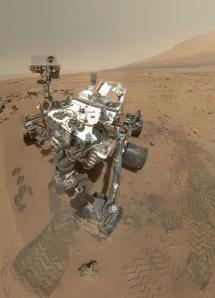
Curiosity’s amazing self-portrait from a few weeks ago. Credit: NASA/JPL
It’s been a very crazy week, and I know this may be old news already for some of you, but I had to post about NASA’s announcement on the Curiosity mission findings that caused such an uproar on the internet a few weeks back. For a detailed explanation of what was found and what it means, check out this article on Universe Today. In short, this was the first time all of Curiosity’s instruments had been used in concert together, and the consistency of the results was exciting. It pointed to organic compounds in the Martian soil, but they can’t say for sure that the Carbon in those compounds is of Martian origin. First they have to determine if the Carbon is actually from Mars, and not a contaminant from earth air trapped in the instruments, then they have to determine whether the Carbon is from a biological or non-biological source. There are lots of possibilities that must be ruled out before we will know for sure what’s in the soil, and where it came from. At the announcement, Curiosity Project Scientist John Grotzinger is quoted as saying, “We’re doing science at the speed of science. But we live in a world that’s sort of at the pace of Instagrams. The enthusiasm that we had, that I had, that our whole team has about what’s going on here, I think it was just misunderstood.” That was after he was questioned about the wild speculation that resulted from his comments in an NPR story about a possible “Earth-shaking” discovery by Curiosity. I just love that a NASA scientist compared the speed of science to the “pace of Instagrams.” Instagram and Science! In the same sentence! That must mean science is hip, right? RIGHT?
In other NASA-related news, it was announced on Tuesday that NASA will build and launch in 2020 another Mars rover very similar to Curiosity. While that may not be the most exciting thing to hear, it shows that NASA is building confidence in its abilities to do mind-blowing things like land a nuclear-powered, car-sized roving science lab on another planet with a rocket-powered sky crane. The more we learn about Mars, the closer we get to putting a man there. Who knows, maybe a prime objective of this new mission will be to actually look for signs of past or current life. No mission to Mars yet has actually had that as an objective. For more on this new mission read this article on New Scientist.
While these next two items aren’t necessarily science-y, they are quite awesome:
- This Russian blog posted a collection of fascinating Autochrome color photographs of Paris taken just before the first World War. They’re some of many early color photos taken by a team of photographers commissioned by French philanthropist Albert Kahn. (Via Kottke)
- Filmmaker and photographer Cy Kuckenbaker created this mesmerizing time-compressed footage of planes landing at San Diego’s airport. Do yourself a favor and put it on fullscreen HD. (Via Kottke)
Mars Rover Curiosity may have made an “earthshaking” discovery
November 21, 2012

Curiosity’s amazing self-portrait from a few weeks ago. Credit: NASA/JPL
NASA scientists have created lots of buzz over the past two days because of an NPR story in which Curiosity’s chief investigator John Grotzinger is quoted as saying the latest round of data from Curiosity’s soil analysis instrument is “gonna be one for the history books.” That’s all the information we’ll get, though, at least for a few weeks. While the scientists are very excited about what they’re seeing, they have to run multiple tests and replicate the results in order to be sure the initial interesting result is not a fluke or a glitch. The instrument in question (SAM) looks for organic molecules in the Martian soil, which are the basic building blocks of life as we know it. While none of the instruments on Curiosity can directly detect the presence of life on Mars, they CAN detect basic organics. Even a confirmation of organic molecules would be a huge, MONUMENTAL discovery.
In the past, scientists that have “blown their load” by prematurely announcing exciting results have been burned by it, so this team really wants to be sure of the accuracy and interpretation of their data before going public. One needn’t look further than NASA’s Martian meteorite fossil fiasco in 1996, or their arsenic-based life announcement in 2010 to know that letting your excitement/amazement at your discovery get in the way of un-biased, fact-based analysis can be disastrous.
I certainly hope that the results they’re guarding/confirming point to organic molecules in the soil they’ve analyzed. Curiosity’s findings thus far prove that large amounts of water once flowed on the surface, right where the rover is exploring. It would make sense to me that some form of basic life once existed there. It also wouldn’t surprise me if one day we discover that the DNA from life there mixed with DNA from life here, and that we’re all part Martian, as the idea of panspermia suggests. Those discoveries are likely years or even decades away from happening, but this is still a very exciting time for science!
This will be my last post before Thanksgiving, so have a happy one!
Happy Birthday Edwin Hubble (and me)
November 20, 2012
 Today I turn 31. Somehow I’ve managed to go this long without knowing that I shared a birthday with the famous astronomer Edwin Hubble (after whom the Hubble Space Telescope is named). This is cool! Even though I also share my birthday with Joe Biden, Mike D (of the Beastie Boys), and Robert F. Kennedy, by far the coolest is Edwin Hubble. If this is not proof of the immensity of my nerdiness, I don’t know what is.
Hubble was a pioneer in the field of extragalactic astronomy. His work, along with that of his colleagues and observations from other astronomers, led to the realization that the universe is continuously expanding. This is know as the metric expansion of space, and is a key component of the Big Bang Theory. Yeah, pretty serious stuff. I feel pretty cool to share a birthday with Mr. Hubble. Were he still alive, he would be 123 years old.
Science Friday: Explore the Milky Way Galaxy with Chrome
November 16, 2012

Michael Eades mentioned this yesterday, but I didn’t get a chance to check it out fully until today. The makers of Google Chrome are doing some very cool experiments with their browser, pushing the limits of what’s possible. This scalable, true-to-scale visualization of our home galaxy, centered on our own Sun, is simply phenomenal. It’s one of the coolest things I’ve seen on the internet in quite some time. Bravo, Chrome-people. Bravo. Do yourself a favor and check it out now.
Neil deGrasse Tyson at Vanderbilt Nov. 13th
November 7, 2012
 I don’t announce many non-music events on this blog, but this is one big exception: Neil deGrasse Tyson will be speaking at Vanderbilt University’s Langford Auditorium next Tuesday, Nov. 13th. This guy is a total badass. He is one of the few true “real science” celebrities, and he’s also one of my personal heroes. He’s been on TV countless times- hosting shows on PBS, Discovery Channel, Science Channel and more, as well as guest appearances on The Daily Show and Colbert Report many times. I have no idea what he will talk about, but mark my word it will be entertaining and informative. The guy always manages to succeed in convincing the masses that nerd stuff is cool, and is thus an invaluable ambassador of science to the public.
 I strongly suggest getting your ticket now via any Ticketmaster outlet. They’re only $5 for non-Vandy students, and $10 for general public. (And free if you’re a Vandy student, staff, or faculty member!)
UPDATE: I didn’t realize this event was already sold out! So, still awesome and I hope you got tickets in time!
Here’s the official Vanderbilt link for more info.
See you there!
Zap! Curiosity shoots soil on Mars with laser
October 24, 2012

Credit: NASA/JPL
This bizarre-looking animation is not some kind zit popping (which is the first thing that came to mind when I first saw it), but in fact the hole left behind in some Martian soil after the Curiosity rover zapped with a high-powered laser in order to study its chemical composition. Curiosity has been steadily traveling across its home, Gale Crater, and doing lots of good science along the way. This latest experiment zapped the soil 30 times to heat it up to a temperature so hot that it glows. Each element glows at a specific color of light when heated to those temperatures, and an instrument called a spectroscope reads those colors emitted and can discern exactly what elements the glowing material is made of. Curiosity also recently took several scoops of soil from the surface which will be delivered to various onboard instruments this week, which will directly examine its mineral makeup. I’m looking forward the release of those results, as they could tell us whether or not Mars could’ve supported life in the past. But I couldn’t resist posting this bizarre animated GIF… just keep staring at that for a while.
(Via Bad Astronomy and NASA)
Our nearest galactic neighbor Alpha Centauri has a planet!
October 17, 2012
 Very exciting news in the world of planet hunting! Our nearest star (that’s not our own sun) Alpha Centauri has an Earth-mass planet orbiting it! The planet is 1.13 times the mass of Earth, but only takes 3.24 days to orbit the star. That short orbital period means it’s VERY close to its parent star Alpha Centauri B, and probably has a surface covered in hot molten lava- not a pleasant place. The Alpha Centauri system is famous because it’s so close to us and has been included in many sci fi movies and stories. It’s a triple-star system only 4.3 light years away, and if it does turn out to have a habitable planet, it would no doubt be the destination of our first interstellar travels, if and when we ever develop the technology for it. This planet was found using the radial velocity method, which observes the faint wobble that an orbiting planet exerts on its parent star. Apparently this wobble was so faint and hard to detect that its discovery is somewhat of a milestone in the art of planet hunting. Scientists also think that this discovery increases the chance that we will find a habitable world in the Alpha Centauri system. For more info check out Bad Astronomy or New Scientist.
Felix Baumgartner’s chest cam footage/more timelapse from the ISS
October 16, 2012
This video clip shows some of the amazing footage from Felix Baumgartner’s chest and head cameras during his successful supersonic skydive attempt Sunday. I’m sure you’ve heard most of this by now, but the preliminary numbers are 9 minutes & 3 seconds jump to landing, top speed of 833.9 mph or Mach 1.24, jump height of 128,100 feet, and freefall time of 4 minutes & 20 seconds. He broke all the records previously owned by Col. Joe Kittinger (who was a consultant on the mission and coached Felix through the whole jump) except for one: longest freefall. Presumably this is because he fell so fast. The faster you fall the shorter your freefall time will be. Felix entered a terrifying spin during the first part of the dive, but he managed to regain control and did not have to deploy the emergency stabilization chute, which would have prevented him from breaking speed of sound.
In other science-related news, photographer and videographer Christopher Malin created a surreal new type of timelapse that I’ve yet to see used on space station footage- a stack. Stacking involves blending each frame of the footage into the next, creating a blurred effect with light trails and star trails. Just watch it, it’s kind of a head trip:

 steve cross loves music and science