I’ve been waiting since the end of May for this:

(Click to enlarge) Credit: NASA/Paolo Nespoli
THAT is something that has never been captured on film before. It may not seem like a big deal, but the opportunity to to photograph a space shuttle docked to the ISS from space has never happened before, and never will again. The schedules happened to line up so that a Russian Soyuz capsule undocked from the ISS carrying three astronauts home while Endeavour was still docked. This gave astronaut Paolo Nespoli the opportunity to take photos of the shuttle/ISS combo from the window of the Soyuz capsule as they floated away. They paused the Soyuz some distance away and the space station actually performed a “flip” maneuver to allow for more angles. Please click through to the NASA image gallery and see the rest of these amazing images.
 Think the idea of humans boarding a massive spaceship headed into the cosmos for 100’s or even 1,000’s of years (a.k.a. real-life Star Trek) is completely in the realm of science fiction? Think again. Last fall DARPA (Defense Advanced Research Projects Agency), the highly secretive experimental arm of the Department of Defense who happened to invent the internet, released an official Request for Information regarding a “100-year starship plan.” Basically, they want people to come up with a fully thought-out plan for forming a team of researchers/engineers/scientists to investigate the technology necessary to build such a spaceship. Needless to say, this is one tiny baby step in a project that could cost many billions of dollars and require decades of advances in propulsion technology, but it’s still rather amazing that there is real, serious effort being put into something that has always seemed so far out of reach for humankind. As pointed out in their RFI, there will no doubt be unanticipated discoveries and technological advances as a “side-effect” of this research. So the actual spaceship itself is not the only purpose of this initiative. It really makes me happy to see something like this happening because I think manned space exploration has been quite stagnant for the last couple of decades. We need this kind of spark to really push forward the technology needed to extend our presence beyond low-Earth orbit. (Via Universe Today)
Ok, that’s really it for this week. Probably. I can’t fathom any more posts because tomorrow morning I will be heading to Manchester with the rest of the Scene/Cream team to photograph Bonnaroo. Keep your eyes on the Nashville Cream for updates on our shenanigans, and to see some of my photos.
- Credit: NASA
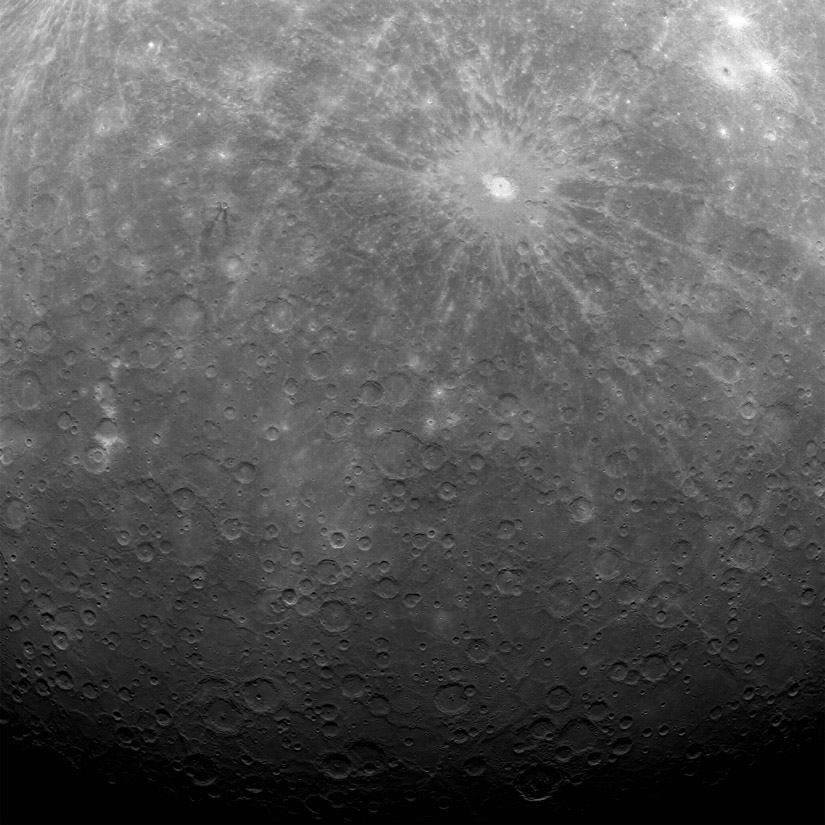
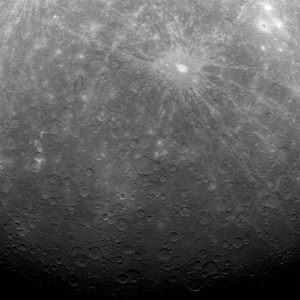
You’re looking at an important piece of history when you look at the above photograph. That’s the first ever image of Mercury taken from orbit. NASA’s Messenger spacecraft successfully entered stable orbit around the solar system’s smallest planet, and yesterday morning we got the first images taken from said orbit. The spacecraft has taken other images of Mercury as it approached, but Messenger just recently actually entered a permanent/stable orbit, and will remain there for at least a year, studying this hot, battered planet in unprecedented detail. This is also the first time any spacecraft has orbited Mercury to begin with. (Via Discovery News)
In some other space-related news, NASA decided to pull the plug on James Cameron’s idea to install a 3D camera on the next Mars rover mission, Curiosity. Honestly, I love this idea, as it would have allowed anyone with 3D glasses to watch cinema quality footage from the surface of Mars. When you really think about that, it’s absolutely mind-boggling: 3D video footage from another planet. However, NASA felt that since this rover is already way over-budget, the risk of failure was too great because the cameras haven’t been thoroughly tested. I’m certain that this technology will end up on another NASA mission to Mars in the future. So just wait. In another 5-10 year’s we’ll be looking at HD footage from Mars in 3D. NBD… (Via i09)

Credit: NASA
Space Shuttle Discovery is ready for launch later today (4:50pm Eastern/3:50 Central) on its final trip to space. This mission has been delayed extensively- it was originally scheduled to launch in November of last year, but fuel leaks and then tiny cracks discovered on the external fuel tank caused major delays. The shuttle had to be returned to the massive vehicle assembly building (VAB) for repairs that took several months. But so far all is good for the launch today. The shuttle is carrying an additional storage module (essentially a storage closet in space) to the ISS, along with an external logistics platform and a humanoid robot called Robonaut 2. Robonaut 2, known as R2 (ha!) is basically an experiment to allow engineers to determine how the robot will work in space, and how to best control it from inside the ISS. The end goal is to have a humanoid robot that can venture outside the space station and assist spacewalking astronauts with repairs and upgrades. The robot will be controlled by an astronaut inside the space station via some sort of virtual reality-like interface.
As I said, this is the last flight of Discovery. The only confirmed remaining flight is that of Endeavour, scheduled for launch in April. This mission will carry a very important piece of scientific equipment called the Alpha Magnetic Spectrometer to the ISS. The AMS will help physicists answer some of the most daunting questions in cosmology. An additional flight of Atlantis is likely, though not 100% confirmed. It would launch in June and be the absolute final flight of the Space Shuttle program.
Science funding standoff/solar flare headed for earth
February 15, 2011

Credit: NASA
First of all, I must make the point that these solar flares and coronal mass ejections we’re talking about will NOT harm us. At most, these can cause disruptions with satellite communications, but nothing more. On Sunday the sun belched forth an M-class (medium) solar flare with earth in the crosshairs. The stream of charged particles from the eruption is expected to reach earth sometime late tonight, and could create auroral displays visible as far south as the great lakes area. The sun is capable of flares much more powerful, that would create auroras visible all the way down here in TN, but they’re rare. I do expect there to be one or two of that magnitude in the next few years, however, as the sun is climbing toward its next period of maximum sunspot activity, known as solar maximum. It is possible that tonight’s flare could be more powerful than expected, and the resulting aurorae visible this far south, but it’s highly unlikely. If you’re in Canada or the northern US, however, I recommend going outside and looking north tonight. You just might get a treat. (Via space.com and spaceweather.com)
UPDATE: Apparently this same sunspot region produced another, more powerful flare last night. This time it was an X-class flare, though still not powerful enough to cause aurorae visible this far south. (Via Bad Astronomy)
Obama’s proposed budget for 2012 is basically in direct opposition to the Republicans’ ideas. The biggest area of contention will no doubt be science and education spending. Obama wants to boost funding for most everything science-related, which I applaud of course. But of course, Republicans want to make huge cuts in most everything science-related. It’s incredibly sad that most Republicans these days take such anti-science, anti-reality stances on issues. These proposed budgets are simply the beginnings of what will likely be a long, knock-down drag-out battle between the White House and Congress, and I hope there can be some concessions that will allow us to continue to grow in the areas of education and technology without vastly increasing the national debt. Granted, even a modest cut in the defense budget would probably take care of all these problems, but will that ever happen? Hell no. (Via NewScientist) Also, check out this nice infographic created by LiveScience.
Planetary scale/arctic oscillation/what is 4G?
February 2, 2011
Some cool science-related stuff I’ve come across the past few days:
- Let’s be frank, the climatologists were absolutely dead wrong in their prediction of a warmer-than-average winter in the eastern US for 2010/2011. Their forecast was based on the fact that historically, La Nina winters are warmer in the eastern US. We are definitely in a La Nina winter, so what the hell has been going on? The fact is, the global climate is VERY complex, and our computer models for both short-term and long-term forecasting are still struggling to get a grasp on what’s really going to happen. The main culprit for our cold winter this year is the Arctic Oscillation. This is another large-scale weather pattern that is fairly unpredictable over the long-term, and has so far overpowered any effects the La Nina pattern has had on the southeast US. The Nashville office of the National Weather Service has been posting fairly frequent updates about this situation, so I recommend reading the latest one to get the detailed explanation you may or may not be desiring. It would appear that winter will be re-establishing its grip on TN for a few more weeks at least.
- In the past year all the major mobile phone service providers have been touting their new 4G networks. But honestly none them have speeds even close to what was traditionally defined as “4G.” The International Telecommunication Union has a set of standards for what speeds can be considered 2G, 3G, 4G, and so on. 4G used to be defined as download speeds of 100 Mbps to 1Gbps. Those kinds of speeds won’t be attained for 4 to 5 years, by most estimates. In December of 2009, the ITU changed the rules on what can be called 4G, which allowed all mobile phone service providers to instantly start labeling their slightly improved wireless broadband speeds as such. Most of these speeds are probably better described as “3.5G” or “3G+” but I honestly don’t care. I just don’t want people to think that the speeds they’ll experience on their mobile browsers is somehow leaps & bounds faster. This information came from an article on Wired that I recommend if you want more detailed info.
- I came across this amazing video clip on Universe Today on Monday, but am just now getting around to posting. The sense of scale when talking in astronomical terms is very difficult for a human mind to comprehend, so when things like this come along that really help illustrate that sense of scale, I’m fascinated. This video clip shows what several different planets, including another earth, would look like in the night sky if they were as close to us as the moon. Just wait until Jupiter shows up. (According to the comment from the creator below the video, this is actually what it would look like through a weak pair of binoculars… so what you’re seeing isn’t meant to depict the entire night sky, only about 62 degrees of it.) Be sure to click on the HD button and make it full screen.
Milestone in the search for earth-like exoplanets: Kepler-10b
January 11, 2011
A major milestone has been achieved by the Kepler Spacecraft- the smallest exoplanet found thus far. Kepler-10b is a small, dense, rocky world only 1.4 times the size of earth. It’s not earth-like, but it is earth-sized. This planet orbits its parent star very close- even closer than Mercury is to our sun, and it’s tidally-locked- meaning the same side always faces its star. It’s so hot that most of its surface is probably molten, and the star’s point-blank radiation would have long since “blown” away any atmosphere it might’ve had, so there’s no way it could support life. Still, this is a major milestone simply because it’s such a small planet. Detecting planets using the transit method is very difficult to begin with and the smaller they are, the harder they are to see. I’ve said this many times before, but it is literally only a matter of time, possibly only months, until Kepler uncovers a true earth-twin. That will create a fundamental shift in the mindset of the entire astronomy community from “are we alone?” toward the direction of “what are they like?”
(Via Universe Today, Bad Astronomy, and NASA)
NYE plans and some good 2011 lists
December 31, 2010
I’m not going to attempt to rundown all the party possibilities for tonight in Nashville. Just head over to the Nashville Cream and check out their NYE flow chart. There’s really nothing better for determining your course of action for tonight. Whatever you do, be safe and if you plan on drinking, arrange for a DD or a cab or Zingo or SOMETHING.
Instead of creating or linking to any “best of” lists about 2010, I thought I’d round up a couple of articles about what to expect in the science world in 2011.
Discovery News: The Biggest, Boldest, and Baddest Space Missions of 2011
Live Science: The Top Science Breakthroughs That 2011 May Bring
That’s it. I’m out. See you in 2011.
Space X successfully launches & recovers Dragon Capsule
December 8, 2010
 This morning Space X launched the first full version of their Dragon capsule atop a Falcon 9 rocket. The company’s rocket underwent a successful test launch back in July, and this launch successfully put their Dragon capsule into orbit. The capsule orbited earth for about 3 1/2 hours, then re-entered the atmosphere and splashed down in the Pacific Ocean, where it will be recovered later this afternoon. This was the first successful commercial spaceflight involving re-entry and recovery. The Dragon capsule is under contract to NASA to carry cargo to the International Space Station. Space X is in a battle to also win a contract from NASA to ferry astronauts to and from the ISS once the Space Shuttle is retired next year. A slightly different version of the Dragon capsule would be used for this, atop the same Falcon 9 rocket. This test’s success puts Elon Musk’s Space X much closer to that goal.
I am quite confident that Space X, or whatever other commercial spaceflight company that wins the NASA contract, will be able to cheaply and safely get our astronauts to and from the ISS. There is absolutely no reason NASA should devote more than basic oversight and money to this task. What NASA needs to focus its efforts on now is going beyond the ISS- to asteroids, to Mars, and even farther than that.
In other news, Mozilla has adopted two Red Pandas (aka firefoxes) and is streaming their activities live at http://firefoxlive.mozilla.org. What’s most awesome about this is that they’re being kept at the Knoxville Zoo, right here in Tennessee. I DARE you to watch the videos of them and not smile. (Via Candice Burnside)
Some science news tidbits/NASA hasn’t found aliens!
December 1, 2010
It’s been a while since I posted much of anything science-related. Honestly I’ve been veeerrrry busy. Fucking slammed is a good way to put it. But here are some important bits of news/etc… to come out of the science world recently.
- First off, there’s been rampant speculation on some news blogs in the last day or so regarding an upcoming NASA press conference (scheduled for tomorrow afternoon) that will “affect the search for extraterrestrial life.” Of course many are taking that to mean that NASA has found aliens. That almost certainly NOT the case, and I must direct you to the ever-reliable ambassador of reality, Dr. Phil Plait of Bad Astronomy, for much more reasonable speculation on what NASA will be announcing tomorrow. Also, as always, Universe Today is on top it as well. The announcement will probably involve the discovery of a new way or process by which life could exist on Saturn’s moon Titan. So chill out, and don’t believe the sensationalist news sites that are claiming NASA has discovered aliens.
- The Large Hadron Collider has been busy slamming lead ions together for the past month or so. They had been in a “recess” of sorts since their last set of collisions involving single protons. Now they’re slamming much heavier lead nuclei together in an effort to recreate the conditions that physicists think existed just milliseconds after the Big Bang. (On an atom-size scale, of course.) They got what they were looking for, though it was a bit surprising. The leading theory was that a superheated blob called a quark-muon plasma existed, and that it acted much like a gas. However, this experiment showed that the quark-muon plasma actually behaved more like a perfect liquid with no viscosity. This collision was the most energetic heavy ion collision ever achieved on earth, 13 times more powerful than the previous record set by the Relativistic Heavy Ion Collider in Brookhaven, NY, but it’s only about half of the LHC’s full capacity. Who knows what we’ll find when the LHC ramps up to full capacity over the next few years. (Via NewScientist)
- We have now officially discovered over 500 exoplanets in our galaxy. Sort of. The news was announced, but there is really no way to put a “500” label on one particular planet. The problem is that the line between “confirmed” and “unconfirmed candidate” is a bit unclear, and many times in the past previously “confirmed” planets have been retracted as new, more accurate data has been gathered to prove they were in fact something else that’s not a planet. But the number is sufficiently past 500, so we can officially be happy that just 20 years after the discovery of the first exoplanet, we’re now past the 500-mark. With NASA’s Kepler spacecraft on the hunt, and already having produced over 700 exoplanet candidates, that number will soon start to rise very quickly. I’d say the next exoplanet milestone we’ll be celebrating is 1,000, along with the discovery of a true earth-twin. (Via Universe Today)
Eye-gasm: virtual tour of Space Shuttle launchpad
November 2, 2010

Screenshot from NASA Tech virtual tour
So yesterday’s post was a bit of a downer… in some ways. Let me now point you in the direction of something totally awesome: a virtual tour of Space Shuttle Discovery on launch pad 39A. With the final liftoff of Discovery scheduled for tomorrow, I thought it perfect today to share this website I discovered via Universe Today. NASA’s Jim O’Connor runs the NASA Tech website and does 360 degree hi-resolution photographic virtual tours, and they’re nothing short of amazing. While virtual tours are nothing new, getting this kind of view (and from as many viewpoints) of a space shuttle is as close as most of us will ever get to actually seeing the full assembly up-close and in-person. It really helps you grasp how big the whole thing is… as much as one can without actually being there. Right now there are several different views of the space shuttle, all of which can be rotated a full 360 degrees. While the website itself is rather hideously designed, the awesome views offered by the virtual tours make up for it. I’d say my favorite is the one from under the orange external fuel tank.
In other news: GET OFF YOUR ASS AND VOTE TODAY!

 steve cross loves music and science