Mars Rover Curiosity may have made an “earthshaking” discovery
November 21, 2012

Curiosity’s amazing self-portrait from a few weeks ago. Credit: NASA/JPL
NASA scientists have created lots of buzz over the past two days because of an NPR story in which Curiosity’s chief investigator John Grotzinger is quoted as saying the latest round of data from Curiosity’s soil analysis instrument is “gonna be one for the history books.” That’s all the information we’ll get, though, at least for a few weeks. While the scientists are very excited about what they’re seeing, they have to run multiple tests and replicate the results in order to be sure the initial interesting result is not a fluke or a glitch. The instrument in question (SAM) looks for organic molecules in the Martian soil, which are the basic building blocks of life as we know it. While none of the instruments on Curiosity can directly detect the presence of life on Mars, they CAN detect basic organics. Even a confirmation of organic molecules would be a huge, MONUMENTAL discovery.
In the past, scientists that have “blown their load” by prematurely announcing exciting results have been burned by it, so this team really wants to be sure of the accuracy and interpretation of their data before going public. One needn’t look further than NASA’s Martian meteorite fossil fiasco in 1996, or their arsenic-based life announcement in 2010 to know that letting your excitement/amazement at your discovery get in the way of un-biased, fact-based analysis can be disastrous.
I certainly hope that the results they’re guarding/confirming point to organic molecules in the soil they’ve analyzed. Curiosity’s findings thus far prove that large amounts of water once flowed on the surface, right where the rover is exploring. It would make sense to me that some form of basic life once existed there. It also wouldn’t surprise me if one day we discover that the DNA from life there mixed with DNA from life here, and that we’re all part Martian, as the idea of panspermia suggests. Those discoveries are likely years or even decades away from happening, but this is still a very exciting time for science!
This will be my last post before Thanksgiving, so have a happy one!
Happy Birthday Edwin Hubble (and me)
November 20, 2012
 Today I turn 31. Somehow I’ve managed to go this long without knowing that I shared a birthday with the famous astronomer Edwin Hubble (after whom the Hubble Space Telescope is named). This is cool! Even though I also share my birthday with Joe Biden, Mike D (of the Beastie Boys), and Robert F. Kennedy, by far the coolest is Edwin Hubble. If this is not proof of the immensity of my nerdiness, I don’t know what is.
Hubble was a pioneer in the field of extragalactic astronomy. His work, along with that of his colleagues and observations from other astronomers, led to the realization that the universe is continuously expanding. This is know as the metric expansion of space, and is a key component of the Big Bang Theory. Yeah, pretty serious stuff. I feel pretty cool to share a birthday with Mr. Hubble. Were he still alive, he would be 123 years old.
Science Friday: Explore the Milky Way Galaxy with Chrome
November 16, 2012

Michael Eades mentioned this yesterday, but I didn’t get a chance to check it out fully until today. The makers of Google Chrome are doing some very cool experiments with their browser, pushing the limits of what’s possible. This scalable, true-to-scale visualization of our home galaxy, centered on our own Sun, is simply phenomenal. It’s one of the coolest things I’ve seen on the internet in quite some time. Bravo, Chrome-people. Bravo. Do yourself a favor and check it out now.
Neil deGrasse Tyson at Vanderbilt Nov. 13th
November 7, 2012
 I don’t announce many non-music events on this blog, but this is one big exception: Neil deGrasse Tyson will be speaking at Vanderbilt University’s Langford Auditorium next Tuesday, Nov. 13th. This guy is a total badass. He is one of the few true “real science” celebrities, and he’s also one of my personal heroes. He’s been on TV countless times- hosting shows on PBS, Discovery Channel, Science Channel and more, as well as guest appearances on The Daily Show and Colbert Report many times. I have no idea what he will talk about, but mark my word it will be entertaining and informative. The guy always manages to succeed in convincing the masses that nerd stuff is cool, and is thus an invaluable ambassador of science to the public.
 I strongly suggest getting your ticket now via any Ticketmaster outlet. They’re only $5 for non-Vandy students, and $10 for general public. (And free if you’re a Vandy student, staff, or faculty member!)
UPDATE: I didn’t realize this event was already sold out! So, still awesome and I hope you got tickets in time!
Here’s the official Vanderbilt link for more info.
See you there!
Zap! Curiosity shoots soil on Mars with laser
October 24, 2012

Credit: NASA/JPL
This bizarre-looking animation is not some kind zit popping (which is the first thing that came to mind when I first saw it), but in fact the hole left behind in some Martian soil after the Curiosity rover zapped with a high-powered laser in order to study its chemical composition. Curiosity has been steadily traveling across its home, Gale Crater, and doing lots of good science along the way. This latest experiment zapped the soil 30 times to heat it up to a temperature so hot that it glows. Each element glows at a specific color of light when heated to those temperatures, and an instrument called a spectroscope reads those colors emitted and can discern exactly what elements the glowing material is made of. Curiosity also recently took several scoops of soil from the surface which will be delivered to various onboard instruments this week, which will directly examine its mineral makeup. I’m looking forward the release of those results, as they could tell us whether or not Mars could’ve supported life in the past. But I couldn’t resist posting this bizarre animated GIF… just keep staring at that for a while.
(Via Bad Astronomy and NASA)
Our nearest galactic neighbor Alpha Centauri has a planet!
October 17, 2012
 Very exciting news in the world of planet hunting! Our nearest star (that’s not our own sun) Alpha Centauri has an Earth-mass planet orbiting it! The planet is 1.13 times the mass of Earth, but only takes 3.24 days to orbit the star. That short orbital period means it’s VERY close to its parent star Alpha Centauri B, and probably has a surface covered in hot molten lava- not a pleasant place. The Alpha Centauri system is famous because it’s so close to us and has been included in many sci fi movies and stories. It’s a triple-star system only 4.3 light years away, and if it does turn out to have a habitable planet, it would no doubt be the destination of our first interstellar travels, if and when we ever develop the technology for it. This planet was found using the radial velocity method, which observes the faint wobble that an orbiting planet exerts on its parent star. Apparently this wobble was so faint and hard to detect that its discovery is somewhat of a milestone in the art of planet hunting. Scientists also think that this discovery increases the chance that we will find a habitable world in the Alpha Centauri system. For more info check out Bad Astronomy or New Scientist.
Just a quick roundup of some news and updates in the science world:
- Felix Baumgartner’s supersonic, record-setting skydive attempt was delayed until Tuesday morning due to weather concerns. The balloon launch is scheduled for around dawn, so I’ll try to tune into the interwebs tomorrow morning to see how it goes. More at Discovery News.
- Space X successfully launched its first official, non-demonstration mission to the ISS last night. The launch was successful despite the Falcon 9 rocket losing one of its 9 main engines about 90 seconds into the launch. The faulty engine was immediately shut down and the onboard computer recalculated the flight trajectory, adding the necessary burn time to get its Dragon capsule to the correct orbit to rendezvous with the ISS. Phil Plait at Bad Astronomy has the full deets.
- The Mars Rover Curiosity successfully scooped up a sample of soil and agitated it in a bin this past weekend. Instruments on board will soon run a series of tests to determine if the soil could have supported microbial life in the past. Check out this video created from a couple hundred photos taken of the sample as it was being agitated.
Rocketfest: I met Phil Plait!
September 5, 2012

SO MUCH NERD HAPPENING RIGHT HERE
This past Monday (Labor Day) I had the pleasure of meeting someone you’ve seen me reference approximately 8,956 times on this blog- the one and only Dr. Phil Plait, a.k.a. the Bad Astronomer. As I mentioned last week, the U. S. Space & Rocket Center in Huntsville, AL held a fundraising event called Rocketfest for the Space Camp Foundation, an organization that creates scholarships for kids to go to Space Camp. If you don’t know what Space Camp is, then you need help. Above is photographic proof of the insane amount of nerdery that occurred. Just look at our shirts!
As a music snob of sorts, I had a hard time with the musical performances, though Molly Lewis’ anti-folk leanings reminded me of Jeffrey Lewis at times. That’s definitely a good thing. Phil Plait gave a short presentation on the Mars rover Curiosity, and while it was all stuff I’ve already seen and/or know about the mission, his passionate and charismatic delivery was the star of the show for me. He’s one of the best ambassadors of science to the general public I’ve ever seen, right up there with Adam Savage, and I sincerely hope he continues to become more of a public figure.
The whole point of the event was to raise money for Space Camp scholarships, so if you care about the future of human race, make a donation now. I say that because our future depends on the kids of today becoming more interested in STEM and thus becoming the scientists and engineers that will continue to innovate and improve our technology. Programs like Space Camp are what inspire kids to enter those fields. I wasn’t lucky enough to get to go when I was a kid, but I sure as hell want my kids to go someday. I will probably be able to afford the tuition, but some families aren’t as fortunate, and those kids deserve the chance to go just as much as the fortunate ones.
I now step down from my soapbox. 🙂
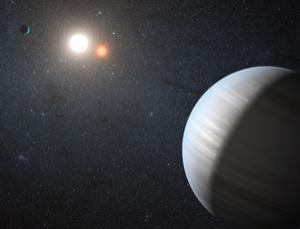
Artist interpretation of Kepler 47c. Credit: NASA/JPL-Caltech/T. Pyle
It’s been a while since we had any juicy exoplanet news. That changed yesterday as a new breakthrough was announced in exoplanet science. For the first time astronomers have confirmed multiple planets orbiting a binary star. The star is about 5,000 light years away and what really makes this discovery interesting is that one of the two planets orbits in the habitable zone, where liquid water could exist on its surface. The catch is- the planet is a gas giant, similar to Jupiter and Saturn, but more the size of Uranus. However, planets like that almost always have many moons, some of which could have an atmosphere and even support life, just like the Forest Moon of Endor, home of the Ewoks in Star Wars. Pretty exciting stuff! Read more about it at NewScientist.
 In other news, if you’re anywhere in the southeast and looking for some nerdy fun this Labor Day, look no further than Rocket Fest at the U.S. Space & Rocket Center in Huntsville, AL. This event just popped onto my radar today via Bad Astronomy, and low & behold Dr. Plait himself will be one of the guest speakers! It should be no secret that I’m a big fan of him and and his blog. This is a fundraiser open to anyone, any age, and the proceeds go to the scholarship fund for Space Camp, and the U.S. Space & Rocket Center Foundation. Honestly what excites me the most about it (besides seeing Phil Plait speak) is the fact that you can get a signed print of that AWESOME poster for a mere $20 donation. I’m not sure yet if I’ll be there, but I had to mention it because it’s all sorts of awesome!
Scientists create the iSquid/more eye candy from Mars
August 29, 2012
From the department of Holy Fucking Shit Nature Is Awesome: Scientists have hooked up squid skin to an iPod and made its pigment cells dance in time to Cypress Hill. They took the electronic waveform of the music and turned it into tiny electric impulses that caused the pigment cells, called chromatophores, to react in time with the music. The result is utterly fascinating:
(Via Kottke.org)
The MSL team at NASA has been as busy as ever testing, calibrating, and tweaking Curiosity’s cameras and instruments. A lot of great things have been accomplished over the last week or so, but two things are most interesting to me. The first recorded song ever to be beamed back from another planet was a song specially composed and recorded by will.i.am of the Black Eyed Peas. The song was called “Reach for the Stars.” While I’m not really a Black Eyed Peas fan, I’m really happy that such a big-name pop culture figure is trying to get kids more involved and interested in Science, Technology, Engineering, and Math (STEM). The other bit of news from Curiosity that really impressed me is this new image from the rover’s 100mm MASTCAM:

Click to enlarge. Seriously, you want to see this full size! Credit: NASA/JPL
This photo, to me, is much more interesting to look at than the other, wider images taken thus far. The reason is that it’s using a 100mm telephoto lens, which makes the scale and depth of the scene more prominent. Also, the photo was taken near sunrise or sunset when the angle of sunlight was low, which makes the jagged rock formations on Mt. Sharp more prominent and dramatic. Notice how there are many flat layers of rock exposed on the side of the mountain? They look just like the layers of bedrock along the sides of canyons and mountains here on Earth! The layers you see on Earth were formed by water, when sediments collected on the floor of oceans and lakes and eventually hardened into rock over millions of years. Therefore, scientists are pretty sure the rock layers seen in this photo on Mars were formed the same way, at the bottom of bodies of water on the surface millions of years ago. The big question we still have to answer is, what caused the water to disappear? Also, was there any life in or around that water millions of years ago? I can’t think of anything more exciting than answering those questions about Mars’ past.

 steve cross loves music and science