We’re going to Mars again in 2016/More Curiosity updates
August 23, 2012
NASA announced that it has selected the InSight Mars lander for its next Discovery mission. (Discovery missions are NASA’s lowest cost tier of science missions, such as Kepler, Dawn, Messenger, Mars Pathfinder, and more.) You may be thinking, “ANOTHER mission to Mars? What for?” Well, despite all the awesome science that Curiosity will do, it can’t tell us much about the deep interior of Mars, or what Mars’ seismic activity is like. The InSight lander will be a stationary robot much like the Phoenix lander. In addition to measuring seismic activity, it will deploy a probe that will drill deep below the surface to measure the flow of heat inside Mars. These measurements will help scientists understand how Mars formed and what happened in the past that changed the surface from one of flowing water (and possibly life) to the barren dry wasteland it is today. (Via Universe Today)

Click to enlarge. Credit: NASA/JPL
Curiosity completed its first set of driving maneuvers on Mars. This image was the first that showed the wheel tracks, confirming that the rover drove successfully. This was only a test of Curiosity’s driving systems, the first of several. Tests of every science instrument and every other system on the rover will continue for at least a month or so before they’ve established a solid baseline for how everything behaves now that it’s actually on Mars. Only then can the scientists begin run the real experiments the rover was designed to carry out. Science is sometimes very tedious and slow, but the results and knowledge gained is very much worth it.
Mars Curiosity updates and images
August 15, 2012

The base of Mt. Sharp, Curiosity’s main destination. Credit: NASA/JPL
NASA’s Curiosity rover has been one resounding success after another, and every step of preparation and equipment testing has gone perfectly. The latest success was an upgrade to the rover’s software programming, changing its computer from landing mode to roving mode. The process took 4 days, but went swimmingly. For more details on that visit this Discovery News article.
There have been enough high resolution images made available from the rover that photographer Andrew Bodrov was able to create this absolutely STUNNING 360 rotating panorama of the rover’s surroundings. Seriously, this is one of the coolest things I’ve seen in a while. Brodov used images from NASA’s other rovers Spirit and Opportunity for reference to add-in the sun and sky components. (Via Universe Today)
Keep your browser on NASA’s JPL website for the latest images from this amazing mission.
It’s a great day to be a human. We just, you know, built a nuclear powered 1-ton robot, sent it into space a huge rocket on a trip to another planet, and landed it there with a hovering jetpack skycrane. Oh, and the whole hovering jetpack skycrane thing was all automated. NO BIG DEAL.
Everything went absolutely perfectly. And we even got back images from the rover just minutes after touchdown. Not only that, but I’ve seen tweets that the Mars Reconnaissance Orbiter was able to capture images of the capsule descending during its parachute phase. Those images should be out later today. In the meantime, here is the first image of the rover’s shadow. In the coming days we’ll have many amazing, full-color, high-resolution images of the surroundings.

UPDATE: The Mars Reconnaissance Orbiter did in fact get the shot of the capsule and parachute! Just consider this a victory lap for NASA. Check it out:

These are both Mars-related stories that popped up across the blogosphere over the past week:
The first bit of news is that NASA’s Mars Science Laboratory (MSL) mission is getting ever closer to its destination, and the dreaded “Seven Minutes of Terror” entry and landing sequence. They recently produced a video that does a pretty good job of conveying just how hard it is to land anything on Mars, and especially how insane this particular landing sequence is. It’s CRAZY HARD to do what they’re attempting to do. I’ve seen many other animations of this many times over, and it STILL blows my mind just how tedious and difficult this is from a scientific and engineering perspective. Seeing the video is essential, so here it is. Just watch:
The second bit of Mars-related news is a little crazier and far-fetched. A group of private investors are pooling their resources and claim that we can have humans on Mars by 2023. This project is called Mars One, and I have to be honest… the whole thing sounds utterly insane. They want to create such a huge media spectacle that the public interest and avenues for profit are such that they can raise the massive amount of cash it’ll take to make this happen. The craziest part of the whole thing is that it will be a one-way mission for the people who actually go to Mars. I think the ethics of such a thing are mostly subjective- I have no problem with a one-way mission if the people going are truly, honestly 100% dedicated to it. I think it’s honorable, and who am I to judge them for making such a profound decision. Neil Armstrong, Buzz Aldrin, and the rest of the Apollo astronauts all knew the extremely high risks involved with what they were doing. They accepted it and went on to accomplish arguably the greatest feat in the history of mankind thus far- walk on the moon. I hope they pull it off, I really do, and without all the oversight and red tape of a government agency like NASA, the likelihood of this happening so soon is greater. But still. 2023 is REALLY REALLY soon to put humans on Mars. Here’s their promo video:
Crazy? Or just crazy enough to make it happen?
Exoplanets: xkcd scores a home run
June 21, 2012
I’ve written a lot about exoplanets, planet-hunting missions such as Kepler, and various other topics related to the search for other worlds in the universe. Never have I seen any one image that could really sum up my feelings about it. But that time has come, and the brilliant Randall Munroe who does the well-known nerdy web comic xkcd is the man who did it. I can’t really say any more- just look and read for yourself. Be sure to click through to enlarge it enough to read the small text.


Success! Astronaut Don Pettit successfully captured SpaceX’s Dragon capsule today at 9:56am EDT with the space station’s robotic arm. They will now bring the Dragon capsule in and dock it with the ISS. This is an historic moment- the first time a commercial spacecraft has ever docked with the ISS. Hopefully within a few years, these amazing private spaceflight companies such as SpaceX can fully take over the duties of ferrying cargo and people to and from the ISS. More at NASA.gov.
(Fast forward to about 2:30 to get to the actual launch.)
SpaceX successfully launched their Falcon 9 rocket, carrying a Dragon capsule filled with supplies and experiments bound for the International Space Station this morning at 3:44am EDT. This mission is far from complete, however, and with the capsule now in orbit the company must also prove their capsule can be docked with space station, unloaded, reloaded with used experiments, and splash back down safely in the pacific ocean. This flight is historic because it will be the first private, non-NASA rocket to complete a full mission to the ISS.
SpaceX has thus far been the leader among the various private companies vying for the top NASA contract to ferry cargo and astronauts to the ISS. The Dragon capsule will catch up to the ISS and perform a few maneuvers before slowly and incrementally approaching until the crew of the ISS can latch onto the capsule with the station’s robotic arm. They will then bring it in for docking using that arm this Friday May 25th. I really hope this mission is successful because as I’ve said all along, I’m a big fan of private companies taking over the low earth orbit duties for NASA. Keep your eye on the NASA website for updates. (Video via Universe Today)

Credit: Planetary Habitability Laboratory at UPR Arecibo, NASA, EUMETSAT, NERC Satellite Receiving Station, University of Dundee.
As you probably already know, there was an annular solar eclipse that was visible to parts of the Pacific rim last night/this morning. Because of the international dateline, I had the days mixed up and thought it was happening today (Monday May 21st) for the western U.S., when in fact for us it was at sunset last night. But it was Monday May 21st when it began for areas like Japan, because for them it happened early in the morning. Confusing right? It’s like the eclipse time-traveled. Anyway, the above photograph gives you a different perspective on it. The dark dot over the northern Pacific Ocean is the shadow of the moon! (Photo via Universe Today)
In other space-related news: SpaceX scrubbed the launch of their Falcon 9 rocket early Saturday morning due to a faulty check valve in one of the nine Merlin main engines. Their system has a computer that runs a full diagnostic check on everything right as the engines fire, and if even the slightest problem is detected the system shuts off everything immediately. Engineers are working diligently to get the valve replaced and run diagnostics with the rocket still on the launch pad. The new target launch date is May 22nd at 3:44am Eastern Daylight Time. I hope this all works out- I’m a fan of commercial spaceflight and feel that it is essential that NASA be able to rely on private companies to handle all their low-Earth orbit operations so that it can focus its main efforts on exploring asteroids and Mars. For more info see SpaceX’s website, and NASA.
Space X ready to launch historic mission May 19th/Andy Warhol gets a crater named after him
May 17, 2012
Friends/readers- my apologies for being a bit behind on the blog this week. I’m juggling a lot this week and have been stretched pretty thin. But here are a couple of tidbits I’ve rounded up that piqued my interest.
Credit: SpaceX
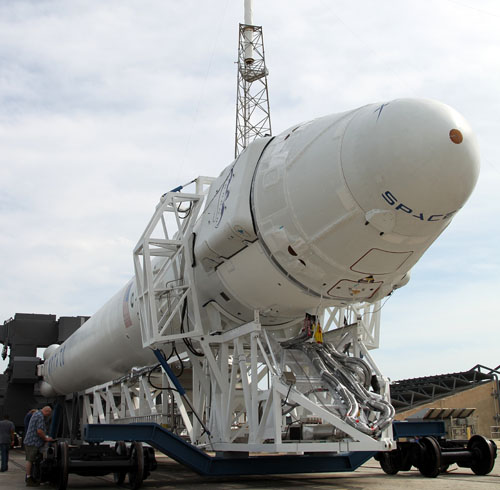
The current leader in the commercial spaceflight race for ferrying NASA’s astronauts and supplies to the International Space Station is Elon Musk’s SpaceX. They decided to combine the next two missions into one sometime last year, but the combined mission has faced several delays recently. Originally scheduled to launch late last year, this mission will be the first commercial mission to launch and dock with the ISS. That’s why this flight is so important and why they are double and triple checking to make sure they’ve dotted all their i’s and crossed all their t’s. If all goes well the Falcon 9 rocket will blast off from Cape Canaveral at 4:55 AM EDT Saturday morning. For more visit NASA or Bad Astronomy.
In other space-related news, NASA’s Messenger mission has been busy orbiting and making detailed maps of planet Mercury. Having no atmosphere, Mercury’s blistering surface is nothing but craters, and thus the International Astronomical Union (IAU) has been busy naming those craters. Andy Warhol was the latest celeb to get a crater named after him, and to celebrate, the mission managers created this image of the Warhol crater in the style of the pop art screen prints he’s famous for:

Credit: NASA/Johns Hopkins University Applied Physics Laboratory/Carnegie Institution of Washington

Credit: Google/NASA Meteor Watch
California and Nevada residents may have been terrified by the loud sonic boom that shook their houses Sunday morning, but now that we know what caused it, they should feel privileged to have experienced such a rare event. We now know that the cause was a fairly large meteor that entered our atmosphere with the energy equivalent to a 5-kiloton explosion. I’ve read other estimates for the energy, but that is the official number from NASA’s Meteoroid Environments Office. That puts it entering our atmosphere at a blistering speed of over 33,000 mph. This meteor was about the size of a minivan, so it was easily visible during the daylight, and that fact that it caused a massive sonic boom means that it made it all the way down to the troposphere, the lowest level of atmosphere, or the level in which clouds and weather occur. Most meteors are much MUCH smaller, and even if they did cause a sonic boom, they burn up far too high in the atmosphere for us to hear it, not to mention that that the air up there is much thinner and doesn’t carry sound waves as well. Because of this meteor’s size and density there’s a decent chance that some fragments of it may have made it to the ground. Once they hit the ground they’re called meteorites, and there are people who make it their living to hunt for them. The rarity of this event is why I think the people who got to see it or hear it are very lucky. I’d give anything to witness something like that. Meteors of this size only occur about once a year, and the simple fact that earth is about 75% covered in water means that us land-dwellers only have a 25% chance of seeing one when they do hit. (Other sources: Universe Today and Discovery News)

 steve cross loves music and science