Some science news tidbits/NASA hasn’t found aliens!
December 1, 2010
It’s been a while since I posted much of anything science-related. Honestly I’ve been veeerrrry busy. Fucking slammed is a good way to put it. But here are some important bits of news/etc… to come out of the science world recently.
- First off, there’s been rampant speculation on some news blogs in the last day or so regarding an upcoming NASA press conference (scheduled for tomorrow afternoon) that will “affect the search for extraterrestrial life.” Of course many are taking that to mean that NASA has found aliens. That almost certainly NOT the case, and I must direct you to the ever-reliable ambassador of reality, Dr. Phil Plait of Bad Astronomy, for much more reasonable speculation on what NASA will be announcing tomorrow. Also, as always, Universe Today is on top it as well. The announcement will probably involve the discovery of a new way or process by which life could exist on Saturn’s moon Titan. So chill out, and don’t believe the sensationalist news sites that are claiming NASA has discovered aliens.
- The Large Hadron Collider has been busy slamming lead ions together for the past month or so. They had been in a “recess” of sorts since their last set of collisions involving single protons. Now they’re slamming much heavier lead nuclei together in an effort to recreate the conditions that physicists think existed just milliseconds after the Big Bang. (On an atom-size scale, of course.) They got what they were looking for, though it was a bit surprising. The leading theory was that a superheated blob called a quark-muon plasma existed, and that it acted much like a gas. However, this experiment showed that the quark-muon plasma actually behaved more like a perfect liquid with no viscosity. This collision was the most energetic heavy ion collision ever achieved on earth, 13 times more powerful than the previous record set by the Relativistic Heavy Ion Collider in Brookhaven, NY, but it’s only about half of the LHC’s full capacity. Who knows what we’ll find when the LHC ramps up to full capacity over the next few years. (Via NewScientist)
- We have now officially discovered over 500 exoplanets in our galaxy. Sort of. The news was announced, but there is really no way to put a “500” label on one particular planet. The problem is that the line between “confirmed” and “unconfirmed candidate” is a bit unclear, and many times in the past previously “confirmed” planets have been retracted as new, more accurate data has been gathered to prove they were in fact something else that’s not a planet. But the number is sufficiently past 500, so we can officially be happy that just 20 years after the discovery of the first exoplanet, we’re now past the 500-mark. With NASA’s Kepler spacecraft on the hunt, and already having produced over 700 exoplanet candidates, that number will soon start to rise very quickly. I’d say the next exoplanet milestone we’ll be celebrating is 1,000, along with the discovery of a true earth-twin. (Via Universe Today)
Astrology=Myth
November 1, 2010
Time for some good old-fashioned debunking.
It seems like Astrology is one of those old myths that manages to pervade everyday language even with some of the most well-educated people. I hate to burst anyone’s bubble, but it simply is a load of crap. The biggest reason, and the only one I will spell out in this post, (you will get links to more thorough debunking articles later) is that the 12 “houses” of the zodiac are not constant. Our earth’s axis of rotation wobbles, just like a top’s axis of rotation slowly wobbles when you spin it on a table. This phenomenon, called precession, causes the zodiac to slowly change over many years. In fact, there are now 13 constellations that fall within the zodiac, not 12. The Babylonians created the 12 sign zodiac we’re all familiar with, but that was thousands of years ago. The zodiac has shifted so that there’s a good chance that when you were born, the sun was not in the constellation that corresponds with your astrological sign based on the calendar. Said calendar is based on how the Babylonians observed the sky thousands of years ago. It is not the same today!
Modern astrologers have turned this pseudo-science into a huge moneymaking scam that is no different than that of psychics and other scam artists that use misdirection and mentalism techniques to screw people out of their money. They use vague predictions that could be applied to almost anyone or anything, and they use the fact that people always remember the few things they get right, and not the many things they got wrong. The logic people use when they claim that an astrological prediction was right is appalling. “My horoscope said I’d come into money today, and I found a dollar on the ground! It was right!” The predictions made by astrologers have never EVER stood up to actual scientific research. They get no more predictions correct than a person making random chance guesses would.
One more point- the idea that the position of the planets and sun when we were born could have any effect on our personality is totally absurd. How? There are 4 forces in nature- electromagnetism, gravity, the strong nuclear force, and the weak nuclear force. None of them can affect you based on the positions of the planets/sun when you were born. This is scientifically proven fact.
I don’t have a degree in science, but I do consider myself an amateur scientist and a skeptic, and I follow the writings of extremely smart scientists who do have degrees in what they write about, and I can be damn sure that I can trust them. Go read their more thorough debunkings of astrology here, here, and here.
Doubt cast on Gliese 581g planet
October 13, 2010

Credit: Lynette Cook/NSF
Planet hunting is a delicate and tedious science. A very strong emphasis is placed on multiple teams of astronomers being able to replicate the results of the first team to announce any kind of discovery. If another team is unable to replicate the findings of the first, it casts a serious shadow of doubt on the validity of the initial findings. That’s exactly what is happening with the Gliese 581g exoplanet that was announced just last week. Sadly, a team that works directly with the HARPS detector on the 3.6m telescope at the La Silla Observatory in Chile has been unable to confirm the existence of Gliese 581f or g. They have access to more data than the team who initially announced the discovery, and they can’t find a clear enough signal in the background “noise” of the observations to confirm this planet. As more teams run computer models and look at observations from other telescopes with radial velocity planet-finding instruments, maybe we’ll get a clearer picture of whether these two planets actually exist. (Via Universe Today via Dynamics of Cats blog)
Don’t worry though, the Kepler mission will undoubtedly start popping out earth-twin discoveries in another year or so, mark my word.
Breaking news: new earth-sized planet found in Gliese 581 system
September 29, 2010

Image via Wikipedia
Our old friend Gliese 581 just keeps getting more and more interesting. Astronomers have discovered yet another VERY interesting planet orbiting this star. The star itself is a red dwarf- much smaller and cooler than our own sun, which mean it’s habitable zone is much closer than that of our sun. This new planet is only about 3 times the mass of earth, and it is within the star’s habitable zone!
Clearly this is exciting, but it’s still not a true “earth-twin” because we have no way to determine if the planet even has an atmosphere. It was discovered the same way all 5 other planets in this system have been discovered- the radial velocity, or “wobble” method in which astronomers measure the planet’s tug on the star as it orbits. I’m assuming the planet does not line on the plane of our line of sight to the star, otherwise we’d have transit observations to go along with these RV observations. Also, because it is so close (it orbits in only about 37 days) it’s probably tidally locked. This means the planet rotates at the same rate it orbits the star, resulting the same face of the planet always facing the star, exactly how or own moon always faces us with same side. Thus, one side of the planet would be much hotter than the other, and this is big mitigating factor in the likelihood of the planet harboring life.
The big deal here is simply that there is a somewhat earth-like planet orbiting a star right at our galactic doorstep. The Gliese 581 system is only about 20 light years away. Statistically, if earth-like planets were rare in our galaxy, the chances of one being so close to us would be VERY VERY low. So having one at our doorstep means that earth-like planets must be pretty common in our galaxy, VERY common, in fact. I have a strong feeling that as more data from the Kepler mission comes in, they’re going to start popping up everywhere, and that’s exciting.
I could go on and on, but what I’ve presented thus far is a condensed version of the Bad Astronomy post that just went up, so head over there to get the full details. As always Phil does a great job presenting the facts in laymen’s terms.
Ask your congressman to vote YES on NASA Authorization Act of 2010 TODAY
September 29, 2010
It is imperative for the future of NASA that you IMMEDIATELY call your congressman’s Washington office and ask they vote YES on S. 3729- NASA Authorization Act of 2010! If you’re in Nashville then your congressman is Jim Cooper and his # is 202-225-4311. The bill is up for a vote TODAY and the session ends this Friday, so if they don’t pass the bill now, NASA will have NO BUDGET for the next fiscal year, which also starts Friday. Phil Plait explains quite well on his blog why you should do this, but honestly, time is of the essence, please take my word for it: it is IMPERATIVE that this bill get passed! If you’re not in Nashville and read this in time, use this link to find you representative and CALL HIM/HER NOW.
I’m back, here are some cool links
September 21, 2010

Eating lunch with the Darlins in the Bronx.
So I’m back! It was a blast and I’d do it all again in heartbeat. I don’t have time to give a full rundown, but quite possibly the most memorable moment was realizing that a tornado was hitting Brooklyn while Those Darlins were soundchecking in Bowery Ballroom. Here’s the official weather report from the NWS. Needless to say, tornadoes are pretty rare in NYC. Thankfully we were in Manhattan while all this was happening. Those Darlins have some great new songs on their new record, and their setlist for this tour is mostly those new songs, peppered with the favs from their debut, and the free single “Nightjogger” which you can download at the Nashville Cream. Basically they’ve taken on a bit more of a pure rock & roll character, and drummer “Sheriff” Linwood Regansburg has taken on a much more prominent role in the songwriting, and even sings on one of the new songs, though they’re not yet playing that song live. Stay tuned for more on them and more on the results of my photo documentary project.
Meanwhile, here are some awesome things I came across while catching up on all my RSS feeds:
Vaccines absolutely, beyond a shadow of a doubt, do NOT cause autism. A new study explored every possible way that thimerosal containing vaccines (TCVs) could be linked to autism and there was none. Absolutely no connection whatsoever; the same findings as the many other studies that have been done to investigate the claims of the anti-vax crowd. In fact, the result hinted that the administration of TCVs between birth and 7 months may actually reduce the risk of autism. It’s very simple, get your kids vaccinated! If you don’t, you are a threat to public health. Vaccines are one of mankind’s greatest scientific breakthroughs and have saved countless lives. There will always be a miniscule (and utterly negligible) risk of a bizarre allergic reaction or other complication, as there is with any medication or vaccine, but that risk is far, far, FAR outweighed by the benefits. And those risks have now been proven once and for all NOT to include autism.
A pair of astronomers have made an official prediction that the discovery of the first truly earth-like exoplanet will happen in less than a year– May of 2011. They used a well-known methodology called Scientometrics to make this prediction. I’d venture to say that to me, nothing in the field of astronomy, or even science in general, is more exciting than the very likely possibility of life on other planets. The discovery of the first true earth twin is a major step in that path. I really hope this prediction comes true.
Five awesome facts about NASA’s next robotic mission to Mars, the Mars Science Laboratory (a.k.a. Curiosity) which will launch in late 2011.
23 amazing photographs from the 1940s and 50s of nuclear bomb tests conducted by the US Military. This New York Times photos series is utterly fascinating, mainly because of images 5 through 7. Most of us have seen plenty of images of the mushroom clouds created by nuclear blasts, but those 3 images are unlike anything I’ve ever seen before. They were taken with a super high-speed camera and literally captured the blast at the very instant the explosion began. If I saw this image out of context I would probably think it was a microscope image of some sort of virus. The amazing irony here is that both a virus and an atomic bomb are incredibly destructive, yet in such completely different ways.
The actual scale of the observable universe, from the smallest possible thing the largest possible thing, is utterly impossible for the human mind to comprehend. Mathematicians came up with the concept of “orders of magnitude” to help with this, but I say it’s still impossible for any human to really grasp. But this fun little interactive Flash animation is pretty cool way of displaying the concept. (Via Dr. Neil deGrasse Tyson’s Twitter)
Energy and space science rant
September 2, 2010
 Rant time.
In case you haven’t been paying attention to the news, there was ANOTHER FUCKING OIL RIG EXPLOSION IN THE GULF. Which is why I’m going to now rant about how terrible fossil fuels are. There is nothing good about them as an energy source. They are filthy/pollute the environment, they’re inefficient, and most importantly they are FINITE. We will run out of them. Thankfully this particular explosion doesn’t seem as though it will cause more oil to gush into the Gulf of Mexico, but they aren’t sure yet. I firmly believe that every nation and every energy company in the world should be focusing 100% of their efforts on ways to eliminate the use of fossil fuels as an energy source as FAST AS POSSIBLE. As long as the world is still relying on them, we are speeding straight down a highway that ends with world wars the likes of which have never been seen, and possibly the end of the human race. Our use of fossil fuels will either lead to so much pollution that the entire ecosystem will collapse, or they will become so scarce that the entire world will go to war fighting over them. The very survival of our species could rely on finding a way to 100% renewable energy. Whether it be from the sun, the wind, the ocean, whatever… 100% renewable and clean energy as soon as possible MUST be the absolute goal, and we must stop at nothing to get there. There are lots of other uses for oil than energy, and dare I say those are probably a necessary evil, at least for a while- virtually all plastic is made from it, along with a host of other things, but those pale in comparison to how much is used for energy. I have no doubt technology will get to a point where we don’t need oil for manufacturing either, but energy should be our #1 priority.
Now for my space rant:
A group of spaceflight’s elite sent a letter to Congress yesterday urging the House Science & Technology Committee to revamp its NASA authorization bill. The group, composed of former astronauts, space industry veterans, and former NASA officials, are asking Congress to make their version of the bill look more like the Senate version, which is much closer to Obama’s initial budget recommendation which was announced in February. Unfortunately middle TN’s own Bart Gordon is the head of said committee. Yo Bart- I expect more from you than this. Look at the facts- Obama is right! I’ve said this many times on here before and I’ll say it again: NASA needs to focus its efforts on exploration beyond low-earth orbit and the moon. The private spaceflight industry is more than capable of taking over the job of getting our astronauts to and from the International Space Station, and can be capable much sooner than NASA could using its currently-under-development Constellation Program. But they need the help of NASA in the form of $$$. Less $$$, mind you, than we would spend on Constellation. We will never see the kind of innovation and progress again that we saw from NASA in the 1960’s unless their goals are ambitious and lofty. Putting a man on an asteroid and eventually on Mars should be the new main goal of NASA’s manned spaceflight program, and exploring the moons of Jupiter and Saturn should be the main goal of the unmanned (robotic probe) programs. Those are the kind of ambitious goals that will bring back the kind of innovation and tenacity of the 1960’s. Only this time it will be scientifically driven, not driven by a race to get to the moon before the Russians.
Rant: over.
NASA’s Kepler Mission discovers multi-planet system in Milky Way
August 26, 2010

Credit: NASA/Ames/JPL-Caltech
NASA’s Kepler Mission released its first official findings today at press event. These are the first fully confirmed exoplanet discoveries by the mission, and there will be many more confirmations coming down the pipe no doubt. This system isn’t quite as exciting as I’d hoped… on Tuesday I read that NASA was planning a press conference to announce Kepler’s findings so naturally I was hoping they’d found a planet similar to earth, but I seriously doubted the news would be that exciting. I’d say it’ll be at least another year before any earth twins are confirmed, because obviously an earth twin would have an orbital period close to 1 earth year, and multiple transits would be needed to confirm it as a planet.
The system discovered is the first multi-planet system confirmed using the transit method (measuring the dip in light seen from a star as a planet crosses between us and the star). It has two Saturn-sized planets and possibly one “super earth,” a planet roughly 1.5 times the size of earth. This smaller planet has not been confirmed, however, so it’s still just an “exoplanet candidate.” Furthermore, they say the smaller planet is VERY close to the star, completing an orbit in only a matter of days. This means the planet would be scorchingly hot and quite unsuitable for any kind of life. While not the “holy grail” of planet-hunting, these findings confirm that the techniques and devices being used to hunt for exoplanets are indeed working, and that we’re well on our way toward finding that illusive earth-twin. (Via NASA)
Facts and myths about the Kepler exoplanet cadidates
July 29, 2010
Screenshot from Sasselov's talk
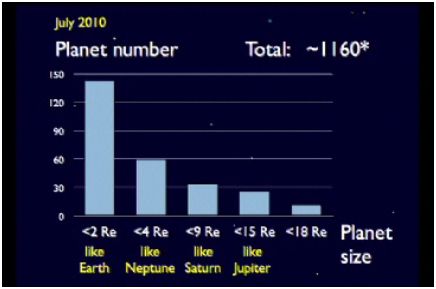
So there’s been a bit of a media buzz lately about the possibility that the Kepler space observatory may have discovered 100’s of earth-like planets orbiting other stars in our galaxy. Recently at a TED talk, one of the chief investigating scientists on the Kepler team, Dr. Dimitar Sasselov, mentioned that the team had found “candidates” for “earth-like” worlds, “that is, having a radius smaller than twice Earth’s radius.” Many mainstream media outlets have twisted this into reports saying that we’ve found 100’s of earth-twins (having an atmosphere, liquid water, etc…) orbiting other stars.
First of all, we HAVE NOT confirmed ANY of these as exoplanets yet. It will take considerable follow-up observations by other telescopes to confirm these as exoplanets, and not glitches or other phenomena that look like a transiting exoplanet. Also, the phrase “earth-like” as he used it simply means that it’s similar in size to earth. Just because an exoplanet is similar in size and composition to earth does not mean it is habitable. In fact, most of the exoplanet candidates have fast orbits and are very close to their parent star (which is why they were detected so quickly). This would make them much more akin to Mercury or Venus- both of which are far too hot to sustain life. The true earth-like exoplanets (that are in the habitable zone, have a similar radius, and could potentially harbor life) will take at least another year to discover, simply because they have longer orbital periods- closer to 1 year. Most of this information was culled from Dr. Sasselov’s NASA blog post in which he clarifies what he was saying in his talk. For even more info, check out Universe Today.
Don’t get me wrong, I’m incredibly excited about this mission, but I’m not going to pop the champagne cork until those scientists issue an official press release saying something like, “YES, we have definitely PROVEN that planet earth is not unique, and our galaxy is filled with small, rocky planets orbiting within the habitable zone of their parent stars.” That is a day I’ve dreamed of ever since I was a little boy fascinated by astronomy programs on the Discovery channel and the X-Files. There has been tons of speculation on this matter, but until now there was no solid, observational evidence to PROVE it.
Dr. Phil Plait gets own TV show on Discovery
July 23, 2010
 Pardon me while I totally nerd-out for a minute… but I must share some news that made me very happy this morning. I first saw this in a tweet from Dr. Neil de Grasse-Tyson. Dr. Phil Plait- astronomer, author, blogger, and relentless promoter of real science and reality in general- is getting his very own show on the Discovery Channel. I’ve been a big fan of his ever since discovering his blog Bad Astronomy. He’s been mentioning a so-called “sooper seekrit project” in his posts for about a year now, and this must be what he was referring to. I get the feeling that there was some sort of miscommunication between him and the powers-that-be at Discovery, because all the tweets and mentions about this new show lead back to this YouTube video, which is basically a promo commercial/sneak-peek at the new series. However, he hasn’t yet mentioned it on his blog or even tweeted about it *update: he finally mentioned it on his blog here. Turns out it will only be a 3-part series… :(* . This doesn’t surprise me given the fact that he’s currently at Comic-Con. It looks like the show is going to take on a Mythbusters-esque vibe but mostly focusing on all the myths and junk science surrounding various doomsday/disaster scenarios such as asteroid impacts, comet impacts, gamma-ray bursts, and hopefully the ridiculous 2012 Mayan calendar myth. I honestly wouldn’t be the slightest bit surprised if Jamie and Adam of Mythbusters are producers of this show… or somehow otherwise involved with it.
No idea when this show will air, *the show will probably air this fall* but I’m definitely looking forward to it. Congrats, Phil!

 steve cross loves music and science