Senate and House pass bills for future of NASA
July 22, 2010
 The Senate and the House of Representatives have both passed their own versions of Obama’s proposed budget for NASA. As I’ve mentioned here before, Obama’s plan to abandon the Constellation program and leave American access to low earth orbit in the hands of the private sector was met with a good bit of criticism, both from Republicans and Democrats alike. Though I supported (and still support) his initial plan, I figured we would end up with some sort of compromise in the end. Not surprisingly, that’s where we’re headed now that the Senate and House versions have come out. I don’t have the time nor the willpower to type out the gritty details of the differences, but in a nutshell, the Senate wants to extend the space shuttle by another mission or two, slash funding for commercial space companies in half, accelerate the development of a heavy-lift rocket based on current shuttle booster technology, and slash funding of research into advanced technologies. For a more detailed comparison between Obama’s plan and the Senate plan, check out this article on Universe Today.
The House plan, which was issue by the House Science and Technology Committee (chaired by TN’s own Bart Gordon) is even worse. They want to slash funding for development of commercial access to low earth orbit by MUCH more than the Senate version, and like the Senate they want to speed up development of a heavy-lift rocket. The biggest problem is that the House version essentially brings back Constellation. For more detailed info on the House version, check out this article on Space.com.
I’m by no means a politician or an economics expert, but I’m firm in my belief that if NASA keeps focusing money and effort on access to LEO/the ISS, then we are spinning our wheels and making no progress. NASA cannot keep funding and worrying about getting our astronauts to and from the ISS AND worry about/fund our exploration into the rest of the solar system at the same time.
Humidity myths/other science-y tidbits
June 29, 2010
 If you live in TN, or even the southeast at all, you know damn well that it’s been hot and humid as hell lately. The entire southeast has been a sauna for several weeks in a row. You always hear people say stuff like, “man, it’s 90 degrees and 90% humidity out there!” Anyone with half a brain knows that’s a VAST exaggeration, but honestly the concept of humidity is a rather confusing one, and even some meteorologists don’t explain it very well. I’m not going to attempt to fully explain it because it’s already been done quite well at this Cincinnati meteorologist’s website. Please click through that link if you want a very detailed, but still in layman’s terms, explanation. Read on if you want my extremely condensed version.
Basically, in terms of actually knowing how much water vapor is in the air, relative humidity sucks. In order to really know how humid it is, and how uncomfortable you will be, look at the dew point. The dew point is simply the temperature at which the water vapor in the air will begin to condense. The higher the dew point, the more H2O is in the air. According to most charts that I’ve found, dew points in the 40-50 degree range feel very dry, like you would feel in a desert… Dew points between 50-60 degrees generally feel comfortable, dew points between 60-70 degrees are generally uncomfortable, and dew points 70+ degrees are utterly oppressive. Yesterday afternoon our dew point in Nashville was hovering around 70-72 degrees. Relative humidity takes into account the air temperature as well as the dew point, and the relationship between temperature and RH is inverse. That means that as the air temp goes up, the RH goes down. Of course the relationship between dew point and RH is converse. Again, if you want a really good, albeit long explanation then visit this website. Fortunately, TN is in for a bit of a relief from the oppressive conditions we’ve been enduring. Cold fronts during the summertime aren’t exactly “cold” though they do normally bring slightly cooler temps, but the main thing they usually bring is a drier airmass. The typical summer weather pattern in the southeast US often involves hot and humid air from the Gulf of Mexico being blown northward across the southeastern states, creating the conditions we’ve been experiencing the past few weeks. Sometimes, however, an airmass that originates over the northern US and Canada will make its way southward. That’s exactly what’s happening today, and the dew point is already falling (this morning it was 68, and right now at lunchtime it’s all the way down to 61!). This airmass is drier because it originated over a large area of land, rather than water. All forecast I’ve seen are in agreement that the dry weather will persist for at least a week, if not more, though the temps will creep back up into the 90s by this weekend. But 90 degree temps with a dew point of 60 is hella better than 90/70!
I must mention a couple of science news tidbits that pinged my radar today and yesterday…
The Obama Administration has announced a new national policy for aerospace that supports and guides the plans for NASA that were announced back in February. This is more of an over-arching “this is where we’re headed” type of policy, and it needed to be implemented to be in line with Obama’s NASA plans. Again, I fully agree with his desire to cancel the Constellation program, rely on the private space industry for low-earth orbit, and focus NASA on exploring beyond the moon. With this new policy, NASA basically has no choice but to use the plan unveiled in February. Hopefully this will get some of the opponents of Obama’s plan in Congress to STFU. But that’s probably a pipe dream. (Via Space.com)
The Large Hadron Collider in Geneva continues to creep closer and closer to its final goal of having the most intense proton collisions ever. Right now, Fermilab still holds the record for highest beam intensity, but the LHC just set a new record for overall number of proton collisions. It will be several more years before they have the LHC running at full capacity, but I have no doubt it will pay off. (Via Discovery News)
 A massive grin sprawled across my face as I read this Nashvillest post about the upcoming “Way Late Play Date” nights at the Adventure Science Center. “Best idea ever” is an understatement. It’s been at least 15 years since I’ve been to that place- then it was called Cumberland Science Museum I believe- and I’ve wanted to go back ever since moving to middle TN in 2000. I’m quite sure I’m not the only one who’s wanted to go but felt like I’d get in the way of all the kids if I went without having my own kids. Some genius in their event planning dept. must’ve realized this and come up with the idea for this event. It’s a 21+ event, which will include 2 alcoholic drinks in the $15 ticket price. Booze+science is a winning combination in my mind. I just really hope some dumbass doesn’t get wasted and then hurl while in the moonwalk simulator. Oh, and you can also get a discount by buying 2 tickets together for only $25. The dates are June 24th and July 27th. Embrace your inner nerd and get tickets here before they sell out! (Megan & I will be there June 24th.)
I’ve written many blog posts about NASA’s Kepler Mission here early last year around the time it launched, but it’s been a while since I mentioned it. The spacecraft has been silently staring into the heavens looking for minuscule dips in stars’ brightness which may indicate a transiting planet orbiting said star. Now that it’s been over a year since its first observations, NASA is obligated by law to release the data to the public for further scrutinization. Astoundingly, Kepler has produced a list of 750 candidates for exoplanets. This is a massive list, considering the current list of known exoplanets is at about 450. I say “candidates” because these are not confirmed exoplanets yet, they are data sets that could indicate exoplanets, but those stars need further review and observation by other telescopes to confirm that the dips in their brightness was definitely caused by a transiting planet. This could take years, because in some of the cases, another transit will have to be observed to confirm that it’s indeed a planet. Nevertheless, this is very exciting news, and I have absolutely no doubt that at least one of these candidates will turn out to be the holy grail of planet-hunting: an earth twin. Read more about this at Universe Today, and even more at the NY Times.
Now behold the most badass kid ever. He had his tooth pulled by a rocket. (You may think this is a bit cruel, but I’m positive that the tooth was a baby tooth that was on the verge of falling out anyway.) (Also via Universe Today)
No aliens on Titan
June 9, 2010

Actual image of surface of Titan taken by the Huygens probe which landed on Titan in 2005.
Lately the media has been buzzing about the possibility of methane-based life on Saturn’s moon Titan. As usual, when scientists include the words “interesting,” “odd,” “life,” “extraterrestrial,” and “discovery” in the same press release, the media starts creating misleading headlines that make people think we’ve discovered extraterrestrial life. Chill out, folks, that’s not the case here. Basically what they found is that, in the hydrocarbon lakes on Titan’s surface, there is much less acetylene than expected, based on other measurements taken by the Cassini probe, currently orbiting Saturn. They also found via a computer simulation modeling the atmospheric conditions on Titan (not direct measurement) that there is also much less hydrogen at the surface than there should be. These are intriguing results, and deserve much further study, but methane-based life on Titan is just one of many possible explanations, the rest of which are non-biological. Good articles explaining this further can be found at Universe Today and Bad Astronomy, but the best explanation comes from Chris McKay at the NASA Ames Research Center. He’s one of the astrobiologists working with the Cassini mission, and states the facts very clearly (at least if you’re vaguely familiar with biology and/or organic chemistry. For a little bit more “laymen’s terms” explanation, I recommend reading either the Universe Today or Bad Astronomy articles.
Mars500 mission/ISS flyovers/Moon Zoo
May 12, 2010

Credit: NASA
Space Shuttle Atlantis is set to liftoff for its final scheduled flight this Friday at 2:20pm EDT. This will give some parts of the US an opportunity to see both the ISS and Atlantis streaking overhead at night. They will appear as simply a relatively fast-moving bright dot in the night sky. The ISS is so large now that its reflective surface allows it to be one of the brightest visible objects in the sky, even brighter than Venus. You can use Spaceweather.com’s simple satellite tracker web-tool to see when the ISS (and other satellites) will be doing a flyby of your area. Here’s the list for Nashville this week/end.
The European Space Agency is in the final phase of a large experiment designed to study the physiological and psychological effects of a small group of people being isolated for extended periods of time as they would be on a mission to Mars. This final phase is called Mars500, and is about to subject 6 crew members from all over the world to 520 days of a simulated Mars mission. They’ve gone to great detail to make the simulation as realistic as possible, with outside communication on a 40-minute delay, and with random interruptions. This all sounds a bit crazy, but it’s absolutely essential to understanding how humans will behave and interact in such isolated conditions. I have no doubt that this research will contribute to the success of mankind’s first manned mission to the red planet. The participants were all, of course, eager and willing to put themselves through this. (Via ESA website)
NASA is asking for help from the general public in identifying “scientifically interesting” features on the surface of the moon. The recent Lunar Reconnaissance Orbiter has taken extremely high-resolution images, and there’s so much real estate to cover that NASA scientists can’t possibly go through it all in any reasonable amount of time. So, they created a website through the Zooniverse project called Moon Zoo where people can take a virtual tour of the surface of the moon, seeing details potentially as small as astronaut footprints from the Apollo missions! The surface feature identification tasks they need everyday people to do are still too complex for even a supercomputer to manage. This idea follows a long line of crowd-sourcing computing projects that began with SETI@Home in the late 90’s. A brilliant idea if you ask me. (Via Space.com)
On a personal note: I just bottled a batch of Belgian Blonde Ale and it should be ready to drink in a week or so. This stuff is 7.3% ABV so it’s venturing into the realm of high-gravity beer. Contact me if you want to try some. Next batch: a British ESB/American Pale Ale hybrid that should be interesting.
 Today President Obama will speak at the Kennedy Space Center and unveil his updated vision for space exploration to the public and to NASA. The original plan he put forth in Feb. was met with harsh criticism because it canceled the entire Constellation program and left the job of getting astronauts to the International Space Station and low-earth orbit entirely in the hands of private industry after the scheduled termination of the Space Shuttle program in 2015. A few days ago intentionally-leaked information hit the blogosphere and rumors abound about what his updated plan will look like. The biggest rumors are that he’ll be injecting an additional $6 billion over the next few years specifically targeted at development of a heavy-lift launch vehicle. This rocket would primarily be for getting parts of a larger spacecraft into orbit, and no doubt that larger spacecraft will be intended to take humans to Mars and other solar system destinations. The other big rumor is that he wants to bring back one component of the gutted Constellation program- the Orion crew capsule. Instead of being the primary method of getting US astronauts to the ISS, however, it will simply serve as a US escape capsule attached to the ISS. This would alleviate the problem of US astronauts relying on the Russian Soyuz capsule as an escape pod. More on these rumors can be found at Universe Today and Space.com.
I will be watching the live coverage of Obama’s speech on NASA’s website. The streaming video starts at 12:30pm CDT, and Obama’s speech is scheduled for 1:40pm CDT. I’m looking forward to seeing just what he has in mind and how well he sells the idea to the skeptics and naysayers.
For the record, as I’ve said before, I’m totally behind his plan, and not just because I’m a liberal and I voted for him. NASA has gotten into a rut ever since the Apollo era, mostly due to political bullshit. They’ve done some awesome stuff, but the drive to explore new horizons has largely been lost. With the budding new private spaceflight industry there’s no reason why NASA can’t utilize them to do the simple, routine tasks of getting us to the ISS and low-earth orbit. NASA would be spinning its wheels and wasting money to focus on that task. To fulfill its original purpose, NASA need to focus its efforts getting us further into our solar system- Mars, asteroids, and robotic explorations to places like Saturn’s moons Titan and Enceladus, and Jupiter’s moon Europa, all of which have exciting potential as homes for microbial extraterrestrial life.
So tune in to Obama’s speech at 1:40 today, and in the meantime, check out astronomer Neil Degrasse Tyson’s comments on NASA’s future, from a recent Q & A session at the University of Buffalo.
(Via Bad Astronomy)
Credit: NASA
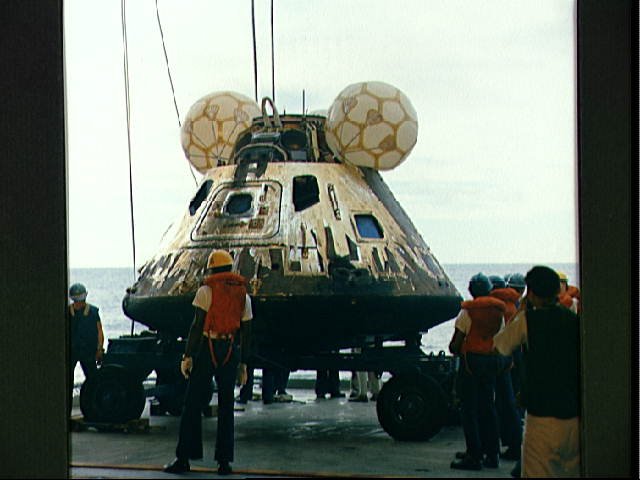
Universe Today is currently running a pretty cool blog series called “13 Things That Saved Apollo 13.” They talked to NASA engineer Jerry Woodfill who came up with 13 key things that led to their survival. Yesterday’s post was part 2 of the series, focusing on the hatch between the Command Module and lander that wouldn’t shut initially. This malfunction actually turned out to be a blessing, because if they’d been able to shut it, it would’ve slowed down the later efforts that were vital to their survival. I look forward to the rest of this series.
One day over the weekend my girlfriend pointed me to an article about an east TN father who asked the Knox County schoolboard to remove a biology textbook that uses the phrase “the biblical myth that the universe was created by the Judeo-Christian God in 7 days” (regarding creationism) from its curriculum. That sounded like just the type of thing Dr. Phil Plait of Bad Astronomy would pick up, and sure enough he did. Thankfully the board and review committee is standing behind the book and it will remain in the curriculum. Let me re-iterate how important it is that creationism stay out of public school curricula- IT IS UNCONSTITUTIONAL. These are public schools! The separation of church and state is crucial to our democracy and teaching anything from the Bible as a viable scientific theory in public schools is a clear violation of that. This book states that the story of creation in the Bible is a myth, and by strict definition that is completely true. I would even say that the statement doesn’t go far enough. It should go on to say that creationism is simply not true. Decades of research and cold, hard scientific evidence have proven beyond any and doubt that our planet and solar system is roughly 4 billion years old. The stories in the Bible are parables that have absolutely no scientific basis. Let’s keep them out of scientific discourse in the classroom, because they are NOT SCIENCE.
Blended iPad/Iceland Volcano
April 8, 2010
I’d forgotten that the Blendtec blender existed. Of course they had to do a demo with an iPad. Sure enough, it blends….
Be sure to check all the other blendable things on their channel.
In case you’ve been under a rock, the Eyjafjajokull (don’t even begin to try to pronounce that…) volcano has been erupting in Iceland for well over a week now. Coincidentally, the sun decided to send a rather strong geomagnetic storm our way last weekend. We all know what happens during geomagnetic storms- aurora borealis. Since Iceland is at such a high latitude, it almost always gets to see these aurorae, and when you combine that with a rather docile volcanic eruption, you get photographers hanging out there and taking eye-gasm photographs like this: (Via Live Science)
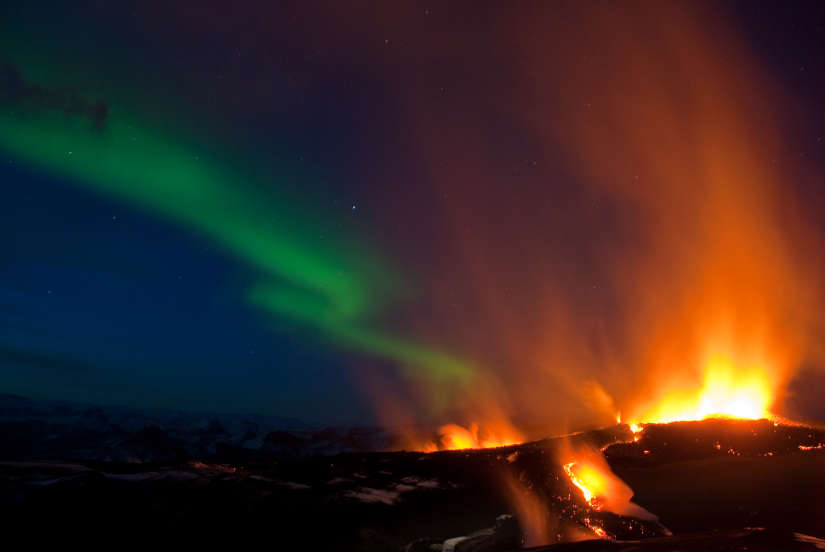
Photo by Albert Jakobsson
I haven’t posted any real mind-benders on here in quite a while, so here goes:
An Indiana University theoretical physicists is proposing that our universe might actually exist inside a wormhole, inside a black hole that exists in a much bigger universe. If that isn’t a total mind-fuck, I don’t know what is. But it’s really cool to think about if you can wrap your brain around it. The only way I can do that is to reduce our space-time to 2 dimensions and visualize like they do in all those discovery channel shows that talk about black holes and wormholes. You know- the old bowling ball on a sheet analogy. If you dare, read the full article at Universe Today. And see the 2D visualization.
New views from space station/cold weather and global warming rant
February 18, 2010
Warning: I’m about to rant.
If I hear one more person say “look at this winter and all this snow… global warming… yeah right” I’m going to punch them in the fucking face. If you believe for one second that this winter’s excessive snow and cold weather in the southeastern US proves global warming is a myth, then you are simply solidifying your incredible ignorance and utter stupidity. There is a big difference between the terms “weather” and “climate.” Weather refers to the day-to-day changes in precipitation, temperature, barometric pressure, wind, etc… Climate refers to long-term, general trends in weather. We’re talking decades and centuries. That’s why global warming is referred to as “climate change,” not “weather change.” We will still have variations in seasons, even as global warming continues. Some winters will be colder and snowier than others, and some summer will hotter and drier than others. Some springs will be stormier, and some falls will have more hurricanes. These small-scale variations can be affected by long-term climate change, but there are many MANY other factors that come into play with small-scale weather events. One thing you may not realize about this winter (if you’re from anywhere east of the Mississippi) is that while we’ve had a cold, snowy winter in the east, most areas in the American west have had a very warm, dry winter. This is why there have been so many problems with Olympics. The mountains around Vancouver have not had as much natural snow as usual, and it’s also been warmer than usual. The direct reason for this winter’s weather is best described as a perfect combination of El Nino and the Arctic Oscillation. The AO is in a more negative phase this year than it has been in decades, which means the cold air at the northern latitudes is dropping farther southward into the US. This, combined with the very active and moist southern jet stream (which resides mostly over Mexico, Texas, and into the Gulf states), has resulted in a snowy winter for the southeastern US. This does NOT mean global warming is false! The average GLOBAL temperature is still warmer than normal. All this is explained in a much-less rant-y fashion at the Weather Underground blog. More details about the negative AO can be found in this AccuWeather article. Hey, Sen. James Inhofe, you just proved your massive ignorance and incompetence with your little igloo stunt next to the Capitol.
Rant over. Now for some much more pleasant science goodies…
The latest shuttle mission to the ISS, still in progress, delivered the new Tranquility node with a huge 7-panel window called Cupola, which was officially opened on Wed. Check this article on Universe Today for more details and to see pics of it. Look for many spectacular photos from this window to be released soon.
What would normally be a fairly unimpressive, routine rocket launch turned into a spectacular event last Thursday. NASA’s Solar Dynamics Observatory satellite launched on top of an Atlas V rocket. What makes this so special is the amazing coincidence of the rocket’s sonic boom (created as it surpasses the speed of sound) with its passage through the cirrus cloud layer. The weird looking ripples you see at about 1:50 into the video below are REAL. It looks like some kind of computer effect, but it’s NOT. There are still shots of them as well. What’s even more amazing is that another atmospheric phenomenon called a sun dog was happening at the time as well, and it appears that the sonic boom disrupted the ice crystals in the cloud, destroying the sun dog. All this via Bad Astronomy.
Snowpocalypse: Part Duex/NASA rumors
January 28, 2010
Here we go again. I recommend investing in Kroger stock this year, because they’re gonna get a big boost in sales in TN from all these “snowstorms” wherein a meteorologist utters the word “snow” and 75% of the population immediately clears the milk, bread, and egg isles. (Apparently people only eat french toast during snowstorms?) As usual, I’ve been monitoring the progress of the forecast and find it interesting that the NWS hasn’t issued the winter storm warning yet, only a watch. I’m sure the warning will come, but it’s kinda funny that they’re hesitating, no doubt because of the giant snow fail from a few weeks ago. (To be fair, some areas around the midstate did get something close to the forecasted amounts, though no one really got the full 2-3 inches that was initially forecast…) This system is a little different than the last one, however. This one will most definitely have enough moisture to generate the 3-5 inches, unlike the last system which had moisture “issues.” The big limiting factor with this system will instead be temperatures. Nashville will literally be right on the dividing line between having an ice/rain mix and having an all snow event. If this system decides to track just 50 to 100 miles further north than the models think it will, that will cause more warm air to advect farther north, and we’ll end up having mostly rain friday changing to a little snow on the backside fri. night into sat. morning. If it decides to track slightly further south, we’ll have all snow, but much less of it, and areas to the south of us could actually see more snow than Nashville does. This system has a little better chance of “success” in giving us a good ol’ fashioned snowfall than the last one, but I wouldn’t place any bets yet.
Big rumors abound in the blogosphere about Obama’s budget proposal due to land in Congress on Monday. The biggest rumor is that it will completely cutout NASA’s Constellation program, which is the rocket system currently under development to not only replace the Space Shuttle, but also put men back on the Moon. I reported many times on the progress of the Augustine Commission and its recommendations for how NASA should proceed given that its current “trajectory” was financially unsustainable. One of the options they proposed was to eliminate the Constellation program and let commercial spaceflight companies like SpaceX takeover the duties of getting astronauts to the International Space Station and other low-earth orbit missions. I have a feeling that if the budget really does cut the Constellation funds, that’s where we’ll be headed next. Honestly I think it may not be a bad idea, because it would allow NASA to focus more on getting man further out into the solar system, and eventually to Mars. I tend to agree with Dr. Phil Plait’s (the Bad Astronomer) sentiments on the issue (as usual) but I’m not in total agreement with him that we should still go back to the moon. But then again, he’s the astronomer with a Ph.D and I’m not. For even more info, check out Universe Today. Check those blogs again on Monday afternoon, as I’d say they’ll be able to update waaaay sooner than I will once the actual budget info is released.

 steve cross loves music and science