It’s a great day to be a human. We just, you know, built a nuclear powered 1-ton robot, sent it into space a huge rocket on a trip to another planet, and landed it there with a hovering jetpack skycrane. Oh, and the whole hovering jetpack skycrane thing was all automated. NO BIG DEAL.
Everything went absolutely perfectly. And we even got back images from the rover just minutes after touchdown. Not only that, but I’ve seen tweets that the Mars Reconnaissance Orbiter was able to capture images of the capsule descending during its parachute phase. Those images should be out later today. In the meantime, here is the first image of the rover’s shadow. In the coming days we’ll have many amazing, full-color, high-resolution images of the surroundings.

UPDATE: The Mars Reconnaissance Orbiter did in fact get the shot of the capsule and parachute! Just consider this a victory lap for NASA. Check it out:

NASA’s Curiosity Rover lands on Mars Sunday night
August 2, 2012
You’d have to have been under a rock to no know that NASA’s latest and greatest Mars rover is about to land on the Red Planet. It’s been all over the news lately… but here are a few more deets that you may not know, including when and how to watch the coverage.
As usual, Universe Today is on top of the coverage, and this infographic was particularly interesting. They will also be teaming up with Google, CosmoQuest, and the SETI Institute to do a live webcast via Google+ to cover the event. Among the cast of hosts is one of my favorite fellow science enthusiasts/skeptics Dr. Phil Plait of Bad Astronomy. That begins at 10pm central time. The actual landing is scheduled for 12:31am central time. For more on the webcast check out the post on Universe Today.
Some random cool facts:
- This is the most complex landing procedure ever carried out by a NASA interplanetary mission.
- The supersonic parachute that slows the lander during the descent phase is a whopping 51 feet in diameter.
- The rover itself is about the size of a Mini Cooper.
- The rover weighs 1,982 pounds (on earth… on Mars it weighs about 747 pounds)
- The rover is powered by a small nuclear reactor.
- Curiosity will land inside Gale Crater, near the base of Mount Sharp, which has layers of exposed minerals that the rover will sample and study.
- The total cost of the mission is $2.5 billion.
These are both Mars-related stories that popped up across the blogosphere over the past week:
The first bit of news is that NASA’s Mars Science Laboratory (MSL) mission is getting ever closer to its destination, and the dreaded “Seven Minutes of Terror” entry and landing sequence. They recently produced a video that does a pretty good job of conveying just how hard it is to land anything on Mars, and especially how insane this particular landing sequence is. It’s CRAZY HARD to do what they’re attempting to do. I’ve seen many other animations of this many times over, and it STILL blows my mind just how tedious and difficult this is from a scientific and engineering perspective. Seeing the video is essential, so here it is. Just watch:
The second bit of Mars-related news is a little crazier and far-fetched. A group of private investors are pooling their resources and claim that we can have humans on Mars by 2023. This project is called Mars One, and I have to be honest… the whole thing sounds utterly insane. They want to create such a huge media spectacle that the public interest and avenues for profit are such that they can raise the massive amount of cash it’ll take to make this happen. The craziest part of the whole thing is that it will be a one-way mission for the people who actually go to Mars. I think the ethics of such a thing are mostly subjective- I have no problem with a one-way mission if the people going are truly, honestly 100% dedicated to it. I think it’s honorable, and who am I to judge them for making such a profound decision. Neil Armstrong, Buzz Aldrin, and the rest of the Apollo astronauts all knew the extremely high risks involved with what they were doing. They accepted it and went on to accomplish arguably the greatest feat in the history of mankind thus far- walk on the moon. I hope they pull it off, I really do, and without all the oversight and red tape of a government agency like NASA, the likelihood of this happening so soon is greater. But still. 2023 is REALLY REALLY soon to put humans on Mars. Here’s their promo video:
Crazy? Or just crazy enough to make it happen?
Mars Science Laboratory launches/other badassery
November 30, 2011
That is video of the final separation of NASA’s new Mars Science Laboratory rover (named Curiosity), sending it on its way to Mars. The probe launched successfully this past Saturday atop an Atlas V rocket, and will reach Mars in August of 2012. If you follow this blog you’ll know that I’ve mentioned this probe excitedly before- that’s because this is the biggest, boldest of all the robotic rovers we’ve sent to Mars. It’s about the size of a small SUV and it will be looking for evidence of conditions that may have been conducive to the development of microbial life, past and present. Important distinction: the probe is NOT searching for life itself, just for evidence that the planet may have been habitable in the past or maybe even the present. August 2012 will be a tense month for NASA and all following this probe’s progess, because the final landing stages are immensely tedious and complex. (See the landing animation below.) For now though, we just sit and wait as the probe zips through space and the engineers make the final adjustments to its trajectory. For some more expert commentary on this mission, check out Bad Astronomy or Universe Today.
Since I probably won’t be posting again until this Friday’s “A Few Good Shows” post, here are a couple more videos full utter badassery:
“Jetman” Yves Rossy flies alongside fighter jets on his jetpack. It doesn’t get much cooler than that…
Nothing like some shirtless 9-year-olds totally nailing “Crazy Train”
NASA’s next Mars rover/why eyes are blue
April 6, 2011
This animation shows how NASA’s next Mars rover, called Curiosity, will get to its destination. The mission is schedule to launch late this year and if all goes as planned, 8.5 months later we’ll start learning more about Mars than ever before. This rover is the first we’ve sent to specifically look for evidence of life, both past and present. This video is the first I’ve seen that shows every aspect of how the rover will arrive on the surface. Getting a probe safely on the surface of Mars is much harder than you might think- it’s actually the hardest aspect of the whole mission. Mars has a very thin atmosphere, so not only does the initial entry NOT slow the probe down nearly as much as a thicker atmosphere like Earth’s would, but also the atmosphere renders parachutes almost pointless, because in order for a parachute to slow the probe to a safe touchdown speed they’d have to impractically massive in size. In both cases, the thin air makes the slowing mechanism much less effective. For Curiosity, NASA came up with this “sky-crane” landing process that is simply amazing. The engineering and technology required to pull this off simply can’t be overstated- it’s both magnificent and terrifying at the same time. I say terrifying because one tiny glitch or mechanical failure could cause the rover to crash into the surface, land sideways, or even miss Mars altogether. Every minute detail of the mission must be executed with absolute precision and perfection. In the current economic climate, failure of a mission this expensive would be a catastrophic blow to NASA’s unmanned mission programs, and we likely wouldn’t return to Mars’ surface again for many years. But with the huge successes of 2004’s twin rovers Spirit and Opportunity and 2008’s lander Phoenix, it’s safe to say NASA is getting pretty good at this. (Via Universe Today)
Another interesting tidbit I felt compelled to share: people with blue eyes (such as myself) don’t really have blue eyes. In fact, our eyes are actually pigment-less, and the same effect that makes the sky blue makes our eyes look blue. In a nutshell, irises have 3 layers and people with brown eyes have pigment in all 3. People with blue eyes have pigment only in the back layer, while the front layers have no color. However, those front layers also have tiny particles in suspension that scatter blue light (due to its shorter wavelength) more readily than other colors. This is the same thing that happens in the atmosphere and causes the sky to appear blue. As we age, those particles tend to get larger and scatter a larger portion of the light spectrum, thus our eyes look less blue and more grayish the older we get. (Via i09)
I’m back, here are some cool links
September 21, 2010
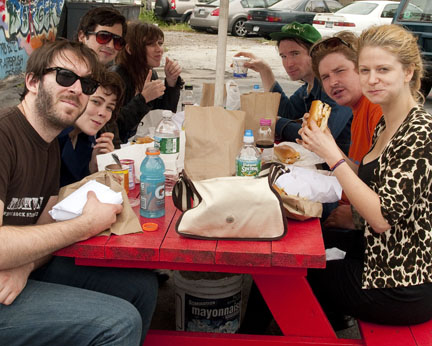
Eating lunch with the Darlins in the Bronx.
So I’m back! It was a blast and I’d do it all again in heartbeat. I don’t have time to give a full rundown, but quite possibly the most memorable moment was realizing that a tornado was hitting Brooklyn while Those Darlins were soundchecking in Bowery Ballroom. Here’s the official weather report from the NWS. Needless to say, tornadoes are pretty rare in NYC. Thankfully we were in Manhattan while all this was happening. Those Darlins have some great new songs on their new record, and their setlist for this tour is mostly those new songs, peppered with the favs from their debut, and the free single “Nightjogger” which you can download at the Nashville Cream. Basically they’ve taken on a bit more of a pure rock & roll character, and drummer “Sheriff” Linwood Regansburg has taken on a much more prominent role in the songwriting, and even sings on one of the new songs, though they’re not yet playing that song live. Stay tuned for more on them and more on the results of my photo documentary project.
Meanwhile, here are some awesome things I came across while catching up on all my RSS feeds:
Vaccines absolutely, beyond a shadow of a doubt, do NOT cause autism. A new study explored every possible way that thimerosal containing vaccines (TCVs) could be linked to autism and there was none. Absolutely no connection whatsoever; the same findings as the many other studies that have been done to investigate the claims of the anti-vax crowd. In fact, the result hinted that the administration of TCVs between birth and 7 months may actually reduce the risk of autism. It’s very simple, get your kids vaccinated! If you don’t, you are a threat to public health. Vaccines are one of mankind’s greatest scientific breakthroughs and have saved countless lives. There will always be a miniscule (and utterly negligible) risk of a bizarre allergic reaction or other complication, as there is with any medication or vaccine, but that risk is far, far, FAR outweighed by the benefits. And those risks have now been proven once and for all NOT to include autism.
A pair of astronomers have made an official prediction that the discovery of the first truly earth-like exoplanet will happen in less than a year– May of 2011. They used a well-known methodology called Scientometrics to make this prediction. I’d venture to say that to me, nothing in the field of astronomy, or even science in general, is more exciting than the very likely possibility of life on other planets. The discovery of the first true earth twin is a major step in that path. I really hope this prediction comes true.
Five awesome facts about NASA’s next robotic mission to Mars, the Mars Science Laboratory (a.k.a. Curiosity) which will launch in late 2011.
23 amazing photographs from the 1940s and 50s of nuclear bomb tests conducted by the US Military. This New York Times photos series is utterly fascinating, mainly because of images 5 through 7. Most of us have seen plenty of images of the mushroom clouds created by nuclear blasts, but those 3 images are unlike anything I’ve ever seen before. They were taken with a super high-speed camera and literally captured the blast at the very instant the explosion began. If I saw this image out of context I would probably think it was a microscope image of some sort of virus. The amazing irony here is that both a virus and an atomic bomb are incredibly destructive, yet in such completely different ways.
The actual scale of the observable universe, from the smallest possible thing the largest possible thing, is utterly impossible for the human mind to comprehend. Mathematicians came up with the concept of “orders of magnitude” to help with this, but I say it’s still impossible for any human to really grasp. But this fun little interactive Flash animation is pretty cool way of displaying the concept. (Via Dr. Neil deGrasse Tyson’s Twitter)
Let’s get the obvious stuff out of the way 1st… Camera Obscura was amazing last night, and we got to chat with TracyAnne for a minute. She seemed to like Nashville and I told her to be sure to come back on their next tour. Let’s hope they do. Oh, and the sound was exceptional too. Mercy has good sound for the most part, but this mix was especially good. Perfect night.
 The Green Wagon is an awesome little store that only opened 6 months ago on Murphy Road in the Sylvan Park area, and just as I expected, the girl who runs it is opening another location on the east side. I must say it’s much sooner than I expected, though! She’s also opening a vegetarian cafe along with it. I’ve been to the current store a few times and it’s pretty awesome. If you haven’t checked it out yet, please do. And if you’re on the east side you’ll no longer have an excuse not to go. Via Nashvillest. Also, thanks to Morgan for pointing out my error regarding the age limit of the Opryland’s Poolapalooza events on yesterday’s post. They are actually all-ages this year.
Some cool sciene-y tidbits today:
The next mission to Mars will be called “Curiosity” thanks to a 6th grader name Clara Ma who won NASA’s essay contest to name the rover. Up until now it’s been called “Mars Science Laboratory.” This next rover will be by far the biggest we’ve sent to the red planet- about the size of a small sedan. Via Bad Astronomy.
Just when you thought Blu-Ray had totally killed the DVD, some scientists in at Swinburne University in Australia have come up with a new 5-dimensional storage technology that may put the DVD back in 1st place. Their idea is to use sophisticated multi-surface gold nanoparticles in the disc. It will not only use the different layers of the disc (as DVD’s currently do), it will also use polarization and the color of the laser light to encode information. The end result will be a DVD that can potentially hold about 7 TERAbytes of data. TERA-bytes. More at the Daily Galaxy.
Remember those crazy devices on Star Trek that doctors could just wave over a patient and tell what was wrong with them? Well, that technology is slowly becoming reality with the invention of a new portable device that identify pathogens in about 5 minutes. The Ostendum corporation has developed a prototype and is currently testing it. Although you still have to take blood or other fluid samples from a patient to use this thing, it’s still pretty damn cool, and will be a HUGE advantage in the battle against pandemics such as the H1N1 (Swine) flu. Via Science Daily.

 steve cross loves music and science