Scientists create the iSquid/more eye candy from Mars
August 29, 2012
From the department of Holy Fucking Shit Nature Is Awesome: Scientists have hooked up squid skin to an iPod and made its pigment cells dance in time to Cypress Hill. They took the electronic waveform of the music and turned it into tiny electric impulses that caused the pigment cells, called chromatophores, to react in time with the music. The result is utterly fascinating:
(Via Kottke.org)
The MSL team at NASA has been as busy as ever testing, calibrating, and tweaking Curiosity’s cameras and instruments. A lot of great things have been accomplished over the last week or so, but two things are most interesting to me. The first recorded song ever to be beamed back from another planet was a song specially composed and recorded by will.i.am of the Black Eyed Peas. The song was called “Reach for the Stars.” While I’m not really a Black Eyed Peas fan, I’m really happy that such a big-name pop culture figure is trying to get kids more involved and interested in Science, Technology, Engineering, and Math (STEM). The other bit of news from Curiosity that really impressed me is this new image from the rover’s 100mm MASTCAM:

Click to enlarge. Seriously, you want to see this full size! Credit: NASA/JPL
This photo, to me, is much more interesting to look at than the other, wider images taken thus far. The reason is that it’s using a 100mm telephoto lens, which makes the scale and depth of the scene more prominent. Also, the photo was taken near sunrise or sunset when the angle of sunlight was low, which makes the jagged rock formations on Mt. Sharp more prominent and dramatic. Notice how there are many flat layers of rock exposed on the side of the mountain? They look just like the layers of bedrock along the sides of canyons and mountains here on Earth! The layers you see on Earth were formed by water, when sediments collected on the floor of oceans and lakes and eventually hardened into rock over millions of years. Therefore, scientists are pretty sure the rock layers seen in this photo on Mars were formed the same way, at the bottom of bodies of water on the surface millions of years ago. The big question we still have to answer is, what caused the water to disappear? Also, was there any life in or around that water millions of years ago? I can’t think of anything more exciting than answering those questions about Mars’ past.
We’re going to Mars again in 2016/More Curiosity updates
August 23, 2012
NASA announced that it has selected the InSight Mars lander for its next Discovery mission. (Discovery missions are NASA’s lowest cost tier of science missions, such as Kepler, Dawn, Messenger, Mars Pathfinder, and more.) You may be thinking, “ANOTHER mission to Mars? What for?” Well, despite all the awesome science that Curiosity will do, it can’t tell us much about the deep interior of Mars, or what Mars’ seismic activity is like. The InSight lander will be a stationary robot much like the Phoenix lander. In addition to measuring seismic activity, it will deploy a probe that will drill deep below the surface to measure the flow of heat inside Mars. These measurements will help scientists understand how Mars formed and what happened in the past that changed the surface from one of flowing water (and possibly life) to the barren dry wasteland it is today. (Via Universe Today)

Click to enlarge. Credit: NASA/JPL
Curiosity completed its first set of driving maneuvers on Mars. This image was the first that showed the wheel tracks, confirming that the rover drove successfully. This was only a test of Curiosity’s driving systems, the first of several. Tests of every science instrument and every other system on the rover will continue for at least a month or so before they’ve established a solid baseline for how everything behaves now that it’s actually on Mars. Only then can the scientists begin run the real experiments the rover was designed to carry out. Science is sometimes very tedious and slow, but the results and knowledge gained is very much worth it.
Mars Curiosity updates and images
August 15, 2012

The base of Mt. Sharp, Curiosity’s main destination. Credit: NASA/JPL
NASA’s Curiosity rover has been one resounding success after another, and every step of preparation and equipment testing has gone perfectly. The latest success was an upgrade to the rover’s software programming, changing its computer from landing mode to roving mode. The process took 4 days, but went swimmingly. For more details on that visit this Discovery News article.
There have been enough high resolution images made available from the rover that photographer Andrew Bodrov was able to create this absolutely STUNNING 360 rotating panorama of the rover’s surroundings. Seriously, this is one of the coolest things I’ve seen in a while. Brodov used images from NASA’s other rovers Spirit and Opportunity for reference to add-in the sun and sky components. (Via Universe Today)
Keep your browser on NASA’s JPL website for the latest images from this amazing mission.
It’s a great day to be a human. We just, you know, built a nuclear powered 1-ton robot, sent it into space a huge rocket on a trip to another planet, and landed it there with a hovering jetpack skycrane. Oh, and the whole hovering jetpack skycrane thing was all automated. NO BIG DEAL.
Everything went absolutely perfectly. And we even got back images from the rover just minutes after touchdown. Not only that, but I’ve seen tweets that the Mars Reconnaissance Orbiter was able to capture images of the capsule descending during its parachute phase. Those images should be out later today. In the meantime, here is the first image of the rover’s shadow. In the coming days we’ll have many amazing, full-color, high-resolution images of the surroundings.

UPDATE: The Mars Reconnaissance Orbiter did in fact get the shot of the capsule and parachute! Just consider this a victory lap for NASA. Check it out:

NASA’s Curiosity Rover lands on Mars Sunday night
August 2, 2012
You’d have to have been under a rock to no know that NASA’s latest and greatest Mars rover is about to land on the Red Planet. It’s been all over the news lately… but here are a few more deets that you may not know, including when and how to watch the coverage.
As usual, Universe Today is on top of the coverage, and this infographic was particularly interesting. They will also be teaming up with Google, CosmoQuest, and the SETI Institute to do a live webcast via Google+ to cover the event. Among the cast of hosts is one of my favorite fellow science enthusiasts/skeptics Dr. Phil Plait of Bad Astronomy. That begins at 10pm central time. The actual landing is scheduled for 12:31am central time. For more on the webcast check out the post on Universe Today.
Some random cool facts:
- This is the most complex landing procedure ever carried out by a NASA interplanetary mission.
- The supersonic parachute that slows the lander during the descent phase is a whopping 51 feet in diameter.
- The rover itself is about the size of a Mini Cooper.
- The rover weighs 1,982 pounds (on earth… on Mars it weighs about 747 pounds)
- The rover is powered by a small nuclear reactor.
- Curiosity will land inside Gale Crater, near the base of Mount Sharp, which has layers of exposed minerals that the rover will sample and study.
- The total cost of the mission is $2.5 billion.
These are both Mars-related stories that popped up across the blogosphere over the past week:
The first bit of news is that NASA’s Mars Science Laboratory (MSL) mission is getting ever closer to its destination, and the dreaded “Seven Minutes of Terror” entry and landing sequence. They recently produced a video that does a pretty good job of conveying just how hard it is to land anything on Mars, and especially how insane this particular landing sequence is. It’s CRAZY HARD to do what they’re attempting to do. I’ve seen many other animations of this many times over, and it STILL blows my mind just how tedious and difficult this is from a scientific and engineering perspective. Seeing the video is essential, so here it is. Just watch:
The second bit of Mars-related news is a little crazier and far-fetched. A group of private investors are pooling their resources and claim that we can have humans on Mars by 2023. This project is called Mars One, and I have to be honest… the whole thing sounds utterly insane. They want to create such a huge media spectacle that the public interest and avenues for profit are such that they can raise the massive amount of cash it’ll take to make this happen. The craziest part of the whole thing is that it will be a one-way mission for the people who actually go to Mars. I think the ethics of such a thing are mostly subjective- I have no problem with a one-way mission if the people going are truly, honestly 100% dedicated to it. I think it’s honorable, and who am I to judge them for making such a profound decision. Neil Armstrong, Buzz Aldrin, and the rest of the Apollo astronauts all knew the extremely high risks involved with what they were doing. They accepted it and went on to accomplish arguably the greatest feat in the history of mankind thus far- walk on the moon. I hope they pull it off, I really do, and without all the oversight and red tape of a government agency like NASA, the likelihood of this happening so soon is greater. But still. 2023 is REALLY REALLY soon to put humans on Mars. Here’s their promo video:
Crazy? Or just crazy enough to make it happen?
Mars Science Laboratory launches/other badassery
November 30, 2011
That is video of the final separation of NASA’s new Mars Science Laboratory rover (named Curiosity), sending it on its way to Mars. The probe launched successfully this past Saturday atop an Atlas V rocket, and will reach Mars in August of 2012. If you follow this blog you’ll know that I’ve mentioned this probe excitedly before- that’s because this is the biggest, boldest of all the robotic rovers we’ve sent to Mars. It’s about the size of a small SUV and it will be looking for evidence of conditions that may have been conducive to the development of microbial life, past and present. Important distinction: the probe is NOT searching for life itself, just for evidence that the planet may have been habitable in the past or maybe even the present. August 2012 will be a tense month for NASA and all following this probe’s progess, because the final landing stages are immensely tedious and complex. (See the landing animation below.) For now though, we just sit and wait as the probe zips through space and the engineers make the final adjustments to its trajectory. For some more expert commentary on this mission, check out Bad Astronomy or Universe Today.
Since I probably won’t be posting again until this Friday’s “A Few Good Shows” post, here are a couple more videos full utter badassery:
“Jetman” Yves Rossy flies alongside fighter jets on his jetpack. It doesn’t get much cooler than that…
Nothing like some shirtless 9-year-olds totally nailing “Crazy Train”

Artist's concept of NASA's new SLS
Today NASA Administrator Charles Bolden and members of Congress announced an agreement to build the most powerful rocket in US history. The launch system (or SLS for space launch system) is intended to take astronauts beyond low-Earth orbit, including asteroids and Mars. The SLS is a derivative of the space shuttle in that it uses 5 space shuttle engines and a fuel tank based on the design of the shuttle’s external fuel tank. There will also be two solid rocket boosters on either side of the main stack. The key difference is that the multi-purpose crew vehicle (MPCV), which is already under construction, will sit atop the entire stack, and will have an escape rocket system that will enable the crew to safely escape almost any type of failure or explosion at any stage during ascent. In many ways this new system is a hybrid of the Apollo-era Saturn V system and the space shuttle. For more info check out the official story on NASA’s website.
This is an exciting announcement, and it’s good to know that many aspects of this new SLS are based on or directly utilize existing technology. This means that the overall cost should be significantly lower than if we’d tried to build something entirely new. I’m glad there was bipartisan agreement that led to this decision being made relatively quickly. The target date for the initial launch of this new SLS is 2017. That seems realistic and I certainly hope it is. Humanity is long overdue to reach beyond low-Earth orbit and explore deep space.

Credit: NASA (Click for full size)
NASA just released some pretty interesting news this afternoon. The Mars Reconnaissance Orbiter (MRO) has been taking photos of the surface of Mars for many years, and scientists have seen what looked like gullies on the surface. But, they had no way to confirm whether those gullies were caused by water or just sand sliding down a slope, or by frozen CO2. There is still no way to confirm for certain that what we’re seeing was caused by flowing water on the surface, but evidence is starting to lean in that direction. These dark finger-like features have been seen changing shape before- but on the colder side of the slope that faces away from the sun most of the day. That would point toward the gullies being caused by frozen CO2. These new images are of features on the warmer sun-facing side of the slopes, meaning the likelihood of them being caused by flowing liquid water is far greater. The most important thing here is to remember that this is NOT confirmation of liquid water on the surface of Mars. It is, however, highly suggestive of liquid water on the surface of Mars. This is exciting news because if it is indeed liquid water, there’s a much better chance that microbial life might still exist. Another important thing to remember is that we already know water exists on Mars- we’ve seen it as ice, both directly (Phoenix lander) and indirectly (radar soundings from MRO indicating water ice below the surface). The key to life though, is liquid water.
As usual, Dr. Phil Plait has a very good explanation of all this on Bad Astronomy, so I recommend checking that out. The NASA article can be found here.
Credit: NASA
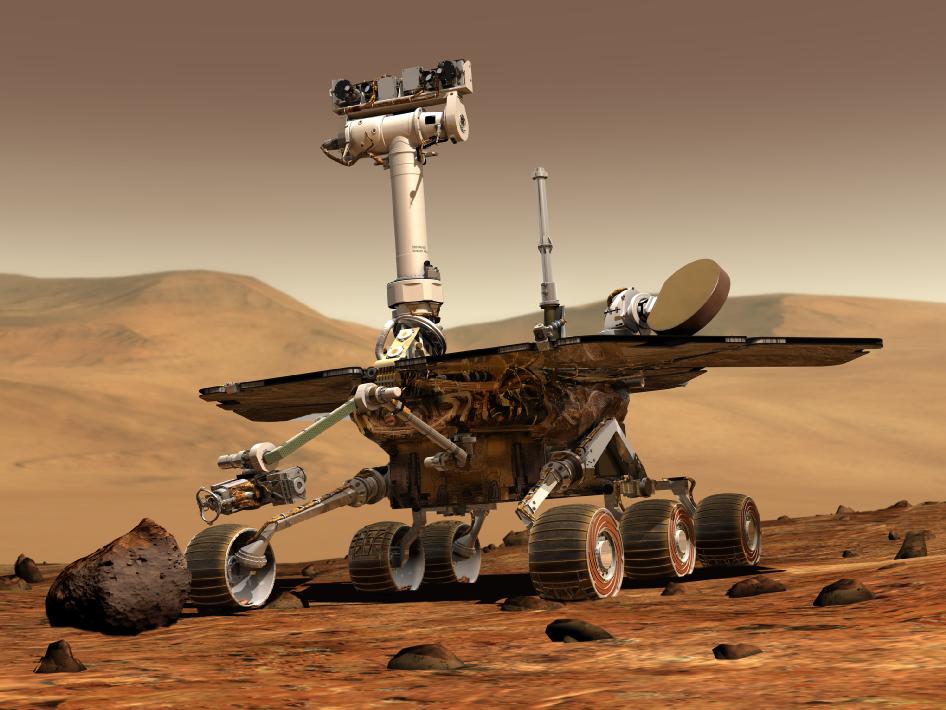
NASA has officially given up efforts to contact the presumably dead Mars rover Spirit. Things started going downhill for the rover back in the Spring of 2010 after attempts to free it from a mound of sand were unsuccessful. The rover was in a bad position for its solar panels to absorb power from the sun, and with the impending martian winter, engineers put Spirit into a sort of “hibernation” mode. They feared that the rover didn’t have enough power to run its heaters which protect the circuitry from the -125 °F temperatures that can occur during winter. Those fears appear to be correct, because now that we’re well into the Martian spring (for Spirit’s location), the solar panels should have collected plenty of power to run the communications equipment. But the rover has been silent for several months now, and the engineers believe the rover is truly dead.
The good news is that Spirit’s twin, Opportunity, is still going strong on the other side of the Mars, with no problems whatsoever. And furthermore, the death of Spirit comes after over 6 YEARS of operation. Loads and loads of valuable data have been gained from the rover, and it has lasted 25 TIMES its expected lifespan of a few months. I’ve said it before and I’ll say it again, these twin rovers are arguably NASA’s second greatest achievement, behind putting a man on the moon. For more, read Phil Plait’s post on this, or go straight to the source, NASA.

 steve cross loves music and science