NASA’s next Mars rover/why eyes are blue
April 6, 2011
This animation shows how NASA’s next Mars rover, called Curiosity, will get to its destination. The mission is schedule to launch late this year and if all goes as planned, 8.5 months later we’ll start learning more about Mars than ever before. This rover is the first we’ve sent to specifically look for evidence of life, both past and present. This video is the first I’ve seen that shows every aspect of how the rover will arrive on the surface. Getting a probe safely on the surface of Mars is much harder than you might think- it’s actually the hardest aspect of the whole mission. Mars has a very thin atmosphere, so not only does the initial entry NOT slow the probe down nearly as much as a thicker atmosphere like Earth’s would, but also the atmosphere renders parachutes almost pointless, because in order for a parachute to slow the probe to a safe touchdown speed they’d have to impractically massive in size. In both cases, the thin air makes the slowing mechanism much less effective. For Curiosity, NASA came up with this “sky-crane” landing process that is simply amazing. The engineering and technology required to pull this off simply can’t be overstated- it’s both magnificent and terrifying at the same time. I say terrifying because one tiny glitch or mechanical failure could cause the rover to crash into the surface, land sideways, or even miss Mars altogether. Every minute detail of the mission must be executed with absolute precision and perfection. In the current economic climate, failure of a mission this expensive would be a catastrophic blow to NASA’s unmanned mission programs, and we likely wouldn’t return to Mars’ surface again for many years. But with the huge successes of 2004’s twin rovers Spirit and Opportunity and 2008’s lander Phoenix, it’s safe to say NASA is getting pretty good at this. (Via Universe Today)
Another interesting tidbit I felt compelled to share: people with blue eyes (such as myself) don’t really have blue eyes. In fact, our eyes are actually pigment-less, and the same effect that makes the sky blue makes our eyes look blue. In a nutshell, irises have 3 layers and people with brown eyes have pigment in all 3. People with blue eyes have pigment only in the back layer, while the front layers have no color. However, those front layers also have tiny particles in suspension that scatter blue light (due to its shorter wavelength) more readily than other colors. This is the same thing that happens in the atmosphere and causes the sky to appear blue. As we age, those particles tend to get larger and scatter a larger portion of the light spectrum, thus our eyes look less blue and more grayish the older we get. (Via i09)
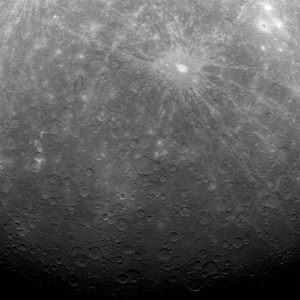
- Credit: NASA
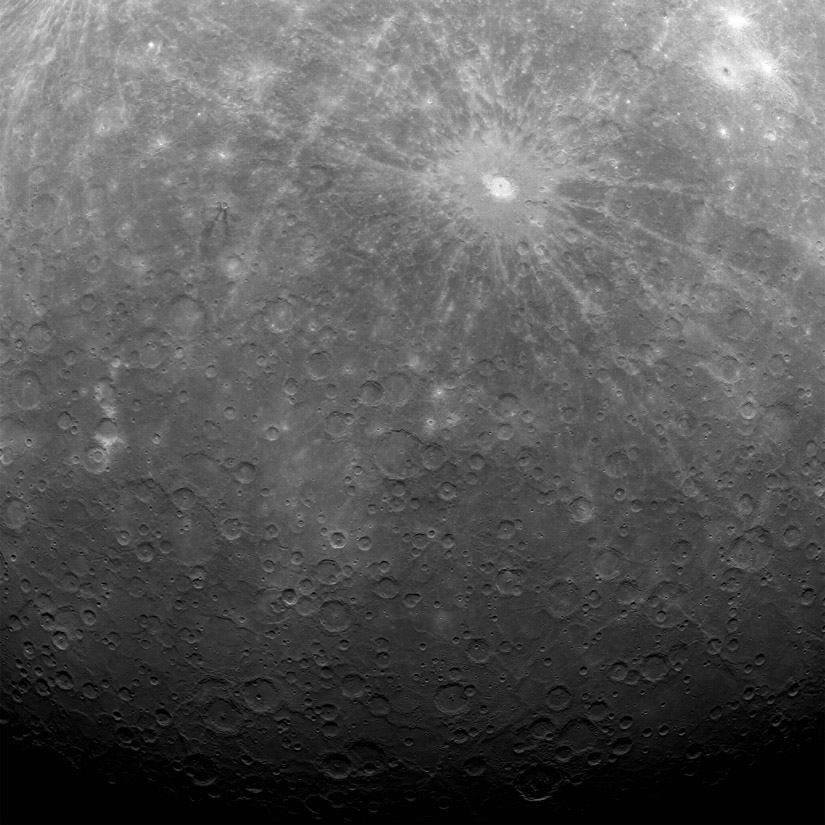
You’re looking at an important piece of history when you look at the above photograph. That’s the first ever image of Mercury taken from orbit. NASA’s Messenger spacecraft successfully entered stable orbit around the solar system’s smallest planet, and yesterday morning we got the first images taken from said orbit. The spacecraft has taken other images of Mercury as it approached, but Messenger just recently actually entered a permanent/stable orbit, and will remain there for at least a year, studying this hot, battered planet in unprecedented detail. This is also the first time any spacecraft has orbited Mercury to begin with. (Via Discovery News)
In some other space-related news, NASA decided to pull the plug on James Cameron’s idea to install a 3D camera on the next Mars rover mission, Curiosity. Honestly, I love this idea, as it would have allowed anyone with 3D glasses to watch cinema quality footage from the surface of Mars. When you really think about that, it’s absolutely mind-boggling: 3D video footage from another planet. However, NASA felt that since this rover is already way over-budget, the risk of failure was too great because the cameras haven’t been thoroughly tested. I’m certain that this technology will end up on another NASA mission to Mars in the future. So just wait. In another 5-10 year’s we’ll be looking at HD footage from Mars in 3D. NBD… (Via i09)
Some science news tidbits/NASA hasn’t found aliens!
December 1, 2010
It’s been a while since I posted much of anything science-related. Honestly I’ve been veeerrrry busy. Fucking slammed is a good way to put it. But here are some important bits of news/etc… to come out of the science world recently.
- First off, there’s been rampant speculation on some news blogs in the last day or so regarding an upcoming NASA press conference (scheduled for tomorrow afternoon) that will “affect the search for extraterrestrial life.” Of course many are taking that to mean that NASA has found aliens. That almost certainly NOT the case, and I must direct you to the ever-reliable ambassador of reality, Dr. Phil Plait of Bad Astronomy, for much more reasonable speculation on what NASA will be announcing tomorrow. Also, as always, Universe Today is on top it as well. The announcement will probably involve the discovery of a new way or process by which life could exist on Saturn’s moon Titan. So chill out, and don’t believe the sensationalist news sites that are claiming NASA has discovered aliens.
- The Large Hadron Collider has been busy slamming lead ions together for the past month or so. They had been in a “recess” of sorts since their last set of collisions involving single protons. Now they’re slamming much heavier lead nuclei together in an effort to recreate the conditions that physicists think existed just milliseconds after the Big Bang. (On an atom-size scale, of course.) They got what they were looking for, though it was a bit surprising. The leading theory was that a superheated blob called a quark-muon plasma existed, and that it acted much like a gas. However, this experiment showed that the quark-muon plasma actually behaved more like a perfect liquid with no viscosity. This collision was the most energetic heavy ion collision ever achieved on earth, 13 times more powerful than the previous record set by the Relativistic Heavy Ion Collider in Brookhaven, NY, but it’s only about half of the LHC’s full capacity. Who knows what we’ll find when the LHC ramps up to full capacity over the next few years. (Via NewScientist)
- We have now officially discovered over 500 exoplanets in our galaxy. Sort of. The news was announced, but there is really no way to put a “500” label on one particular planet. The problem is that the line between “confirmed” and “unconfirmed candidate” is a bit unclear, and many times in the past previously “confirmed” planets have been retracted as new, more accurate data has been gathered to prove they were in fact something else that’s not a planet. But the number is sufficiently past 500, so we can officially be happy that just 20 years after the discovery of the first exoplanet, we’re now past the 500-mark. With NASA’s Kepler spacecraft on the hunt, and already having produced over 700 exoplanet candidates, that number will soon start to rise very quickly. I’d say the next exoplanet milestone we’ll be celebrating is 1,000, along with the discovery of a true earth-twin. (Via Universe Today)
I’m back, here are some cool links
September 21, 2010

Eating lunch with the Darlins in the Bronx.
So I’m back! It was a blast and I’d do it all again in heartbeat. I don’t have time to give a full rundown, but quite possibly the most memorable moment was realizing that a tornado was hitting Brooklyn while Those Darlins were soundchecking in Bowery Ballroom. Here’s the official weather report from the NWS. Needless to say, tornadoes are pretty rare in NYC. Thankfully we were in Manhattan while all this was happening. Those Darlins have some great new songs on their new record, and their setlist for this tour is mostly those new songs, peppered with the favs from their debut, and the free single “Nightjogger” which you can download at the Nashville Cream. Basically they’ve taken on a bit more of a pure rock & roll character, and drummer “Sheriff” Linwood Regansburg has taken on a much more prominent role in the songwriting, and even sings on one of the new songs, though they’re not yet playing that song live. Stay tuned for more on them and more on the results of my photo documentary project.
Meanwhile, here are some awesome things I came across while catching up on all my RSS feeds:
Vaccines absolutely, beyond a shadow of a doubt, do NOT cause autism. A new study explored every possible way that thimerosal containing vaccines (TCVs) could be linked to autism and there was none. Absolutely no connection whatsoever; the same findings as the many other studies that have been done to investigate the claims of the anti-vax crowd. In fact, the result hinted that the administration of TCVs between birth and 7 months may actually reduce the risk of autism. It’s very simple, get your kids vaccinated! If you don’t, you are a threat to public health. Vaccines are one of mankind’s greatest scientific breakthroughs and have saved countless lives. There will always be a miniscule (and utterly negligible) risk of a bizarre allergic reaction or other complication, as there is with any medication or vaccine, but that risk is far, far, FAR outweighed by the benefits. And those risks have now been proven once and for all NOT to include autism.
A pair of astronomers have made an official prediction that the discovery of the first truly earth-like exoplanet will happen in less than a year– May of 2011. They used a well-known methodology called Scientometrics to make this prediction. I’d venture to say that to me, nothing in the field of astronomy, or even science in general, is more exciting than the very likely possibility of life on other planets. The discovery of the first true earth twin is a major step in that path. I really hope this prediction comes true.
Five awesome facts about NASA’s next robotic mission to Mars, the Mars Science Laboratory (a.k.a. Curiosity) which will launch in late 2011.
23 amazing photographs from the 1940s and 50s of nuclear bomb tests conducted by the US Military. This New York Times photos series is utterly fascinating, mainly because of images 5 through 7. Most of us have seen plenty of images of the mushroom clouds created by nuclear blasts, but those 3 images are unlike anything I’ve ever seen before. They were taken with a super high-speed camera and literally captured the blast at the very instant the explosion began. If I saw this image out of context I would probably think it was a microscope image of some sort of virus. The amazing irony here is that both a virus and an atomic bomb are incredibly destructive, yet in such completely different ways.
The actual scale of the observable universe, from the smallest possible thing the largest possible thing, is utterly impossible for the human mind to comprehend. Mathematicians came up with the concept of “orders of magnitude” to help with this, but I say it’s still impossible for any human to really grasp. But this fun little interactive Flash animation is pretty cool way of displaying the concept. (Via Dr. Neil deGrasse Tyson’s Twitter)
Energy and space science rant
September 2, 2010
 Rant time.
In case you haven’t been paying attention to the news, there was ANOTHER FUCKING OIL RIG EXPLOSION IN THE GULF. Which is why I’m going to now rant about how terrible fossil fuels are. There is nothing good about them as an energy source. They are filthy/pollute the environment, they’re inefficient, and most importantly they are FINITE. We will run out of them. Thankfully this particular explosion doesn’t seem as though it will cause more oil to gush into the Gulf of Mexico, but they aren’t sure yet. I firmly believe that every nation and every energy company in the world should be focusing 100% of their efforts on ways to eliminate the use of fossil fuels as an energy source as FAST AS POSSIBLE. As long as the world is still relying on them, we are speeding straight down a highway that ends with world wars the likes of which have never been seen, and possibly the end of the human race. Our use of fossil fuels will either lead to so much pollution that the entire ecosystem will collapse, or they will become so scarce that the entire world will go to war fighting over them. The very survival of our species could rely on finding a way to 100% renewable energy. Whether it be from the sun, the wind, the ocean, whatever… 100% renewable and clean energy as soon as possible MUST be the absolute goal, and we must stop at nothing to get there. There are lots of other uses for oil than energy, and dare I say those are probably a necessary evil, at least for a while- virtually all plastic is made from it, along with a host of other things, but those pale in comparison to how much is used for energy. I have no doubt technology will get to a point where we don’t need oil for manufacturing either, but energy should be our #1 priority.
Now for my space rant:
A group of spaceflight’s elite sent a letter to Congress yesterday urging the House Science & Technology Committee to revamp its NASA authorization bill. The group, composed of former astronauts, space industry veterans, and former NASA officials, are asking Congress to make their version of the bill look more like the Senate version, which is much closer to Obama’s initial budget recommendation which was announced in February. Unfortunately middle TN’s own Bart Gordon is the head of said committee. Yo Bart- I expect more from you than this. Look at the facts- Obama is right! I’ve said this many times on here before and I’ll say it again: NASA needs to focus its efforts on exploration beyond low-earth orbit and the moon. The private spaceflight industry is more than capable of taking over the job of getting our astronauts to and from the International Space Station, and can be capable much sooner than NASA could using its currently-under-development Constellation Program. But they need the help of NASA in the form of $$$. Less $$$, mind you, than we would spend on Constellation. We will never see the kind of innovation and progress again that we saw from NASA in the 1960’s unless their goals are ambitious and lofty. Putting a man on an asteroid and eventually on Mars should be the new main goal of NASA’s manned spaceflight program, and exploring the moons of Jupiter and Saturn should be the main goal of the unmanned (robotic probe) programs. Those are the kind of ambitious goals that will bring back the kind of innovation and tenacity of the 1960’s. Only this time it will be scientifically driven, not driven by a race to get to the moon before the Russians.
Rant: over.
Humidity myths/other science-y tidbits
June 29, 2010
 If you live in TN, or even the southeast at all, you know damn well that it’s been hot and humid as hell lately. The entire southeast has been a sauna for several weeks in a row. You always hear people say stuff like, “man, it’s 90 degrees and 90% humidity out there!” Anyone with half a brain knows that’s a VAST exaggeration, but honestly the concept of humidity is a rather confusing one, and even some meteorologists don’t explain it very well. I’m not going to attempt to fully explain it because it’s already been done quite well at this Cincinnati meteorologist’s website. Please click through that link if you want a very detailed, but still in layman’s terms, explanation. Read on if you want my extremely condensed version.
Basically, in terms of actually knowing how much water vapor is in the air, relative humidity sucks. In order to really know how humid it is, and how uncomfortable you will be, look at the dew point. The dew point is simply the temperature at which the water vapor in the air will begin to condense. The higher the dew point, the more H2O is in the air. According to most charts that I’ve found, dew points in the 40-50 degree range feel very dry, like you would feel in a desert… Dew points between 50-60 degrees generally feel comfortable, dew points between 60-70 degrees are generally uncomfortable, and dew points 70+ degrees are utterly oppressive. Yesterday afternoon our dew point in Nashville was hovering around 70-72 degrees. Relative humidity takes into account the air temperature as well as the dew point, and the relationship between temperature and RH is inverse. That means that as the air temp goes up, the RH goes down. Of course the relationship between dew point and RH is converse. Again, if you want a really good, albeit long explanation then visit this website. Fortunately, TN is in for a bit of a relief from the oppressive conditions we’ve been enduring. Cold fronts during the summertime aren’t exactly “cold” though they do normally bring slightly cooler temps, but the main thing they usually bring is a drier airmass. The typical summer weather pattern in the southeast US often involves hot and humid air from the Gulf of Mexico being blown northward across the southeastern states, creating the conditions we’ve been experiencing the past few weeks. Sometimes, however, an airmass that originates over the northern US and Canada will make its way southward. That’s exactly what’s happening today, and the dew point is already falling (this morning it was 68, and right now at lunchtime it’s all the way down to 61!). This airmass is drier because it originated over a large area of land, rather than water. All forecast I’ve seen are in agreement that the dry weather will persist for at least a week, if not more, though the temps will creep back up into the 90s by this weekend. But 90 degree temps with a dew point of 60 is hella better than 90/70!
I must mention a couple of science news tidbits that pinged my radar today and yesterday…
The Obama Administration has announced a new national policy for aerospace that supports and guides the plans for NASA that were announced back in February. This is more of an over-arching “this is where we’re headed” type of policy, and it needed to be implemented to be in line with Obama’s NASA plans. Again, I fully agree with his desire to cancel the Constellation program, rely on the private space industry for low-earth orbit, and focus NASA on exploring beyond the moon. With this new policy, NASA basically has no choice but to use the plan unveiled in February. Hopefully this will get some of the opponents of Obama’s plan in Congress to STFU. But that’s probably a pipe dream. (Via Space.com)
The Large Hadron Collider in Geneva continues to creep closer and closer to its final goal of having the most intense proton collisions ever. Right now, Fermilab still holds the record for highest beam intensity, but the LHC just set a new record for overall number of proton collisions. It will be several more years before they have the LHC running at full capacity, but I have no doubt it will pay off. (Via Discovery News)
Mars500 mission/ISS flyovers/Moon Zoo
May 12, 2010

Credit: NASA
Space Shuttle Atlantis is set to liftoff for its final scheduled flight this Friday at 2:20pm EDT. This will give some parts of the US an opportunity to see both the ISS and Atlantis streaking overhead at night. They will appear as simply a relatively fast-moving bright dot in the night sky. The ISS is so large now that its reflective surface allows it to be one of the brightest visible objects in the sky, even brighter than Venus. You can use Spaceweather.com’s simple satellite tracker web-tool to see when the ISS (and other satellites) will be doing a flyby of your area. Here’s the list for Nashville this week/end.
The European Space Agency is in the final phase of a large experiment designed to study the physiological and psychological effects of a small group of people being isolated for extended periods of time as they would be on a mission to Mars. This final phase is called Mars500, and is about to subject 6 crew members from all over the world to 520 days of a simulated Mars mission. They’ve gone to great detail to make the simulation as realistic as possible, with outside communication on a 40-minute delay, and with random interruptions. This all sounds a bit crazy, but it’s absolutely essential to understanding how humans will behave and interact in such isolated conditions. I have no doubt that this research will contribute to the success of mankind’s first manned mission to the red planet. The participants were all, of course, eager and willing to put themselves through this. (Via ESA website)
NASA is asking for help from the general public in identifying “scientifically interesting” features on the surface of the moon. The recent Lunar Reconnaissance Orbiter has taken extremely high-resolution images, and there’s so much real estate to cover that NASA scientists can’t possibly go through it all in any reasonable amount of time. So, they created a website through the Zooniverse project called Moon Zoo where people can take a virtual tour of the surface of the moon, seeing details potentially as small as astronaut footprints from the Apollo missions! The surface feature identification tasks they need everyday people to do are still too complex for even a supercomputer to manage. This idea follows a long line of crowd-sourcing computing projects that began with SETI@Home in the late 90’s. A brilliant idea if you ask me. (Via Space.com)
On a personal note: I just bottled a batch of Belgian Blonde Ale and it should be ready to drink in a week or so. This stuff is 7.3% ABV so it’s venturing into the realm of high-gravity beer. Contact me if you want to try some. Next batch: a British ESB/American Pale Ale hybrid that should be interesting.
 Today President Obama will speak at the Kennedy Space Center and unveil his updated vision for space exploration to the public and to NASA. The original plan he put forth in Feb. was met with harsh criticism because it canceled the entire Constellation program and left the job of getting astronauts to the International Space Station and low-earth orbit entirely in the hands of private industry after the scheduled termination of the Space Shuttle program in 2015. A few days ago intentionally-leaked information hit the blogosphere and rumors abound about what his updated plan will look like. The biggest rumors are that he’ll be injecting an additional $6 billion over the next few years specifically targeted at development of a heavy-lift launch vehicle. This rocket would primarily be for getting parts of a larger spacecraft into orbit, and no doubt that larger spacecraft will be intended to take humans to Mars and other solar system destinations. The other big rumor is that he wants to bring back one component of the gutted Constellation program- the Orion crew capsule. Instead of being the primary method of getting US astronauts to the ISS, however, it will simply serve as a US escape capsule attached to the ISS. This would alleviate the problem of US astronauts relying on the Russian Soyuz capsule as an escape pod. More on these rumors can be found at Universe Today and Space.com.
I will be watching the live coverage of Obama’s speech on NASA’s website. The streaming video starts at 12:30pm CDT, and Obama’s speech is scheduled for 1:40pm CDT. I’m looking forward to seeing just what he has in mind and how well he sells the idea to the skeptics and naysayers.
For the record, as I’ve said before, I’m totally behind his plan, and not just because I’m a liberal and I voted for him. NASA has gotten into a rut ever since the Apollo era, mostly due to political bullshit. They’ve done some awesome stuff, but the drive to explore new horizons has largely been lost. With the budding new private spaceflight industry there’s no reason why NASA can’t utilize them to do the simple, routine tasks of getting us to the ISS and low-earth orbit. NASA would be spinning its wheels and wasting money to focus on that task. To fulfill its original purpose, NASA need to focus its efforts getting us further into our solar system- Mars, asteroids, and robotic explorations to places like Saturn’s moons Titan and Enceladus, and Jupiter’s moon Europa, all of which have exciting potential as homes for microbial extraterrestrial life.
So tune in to Obama’s speech at 1:40 today, and in the meantime, check out astronomer Neil Degrasse Tyson’s comments on NASA’s future, from a recent Q & A session at the University of Buffalo.
(Via Bad Astronomy)
NASA updates/Chile earthquake shortens day length
March 2, 2010
It’s been a minute since I mentioned the NASA budget/direction controversy, so here’s a bit of an update:
Lots of NASA employees and contractors in the vicinity of Cape Canaveral have launched a campaign against Obama’s budget cuts/change of direction for NASA. They are doing this because when the shuttle program winds down later this year, and the Constellation program gets ousted altogether, there won’t be nearly as many jobs in the area. That’s a legitimate concern, but in the big picture, I say it’s a necessary evil. Besides, these people are engineers, scientists, etc… they are all very smart and quite capable of finding work in other areas, maybe even for the private companies like SpaceX that will take over the duties of getting cargo and astronauts to the International Space Station. I am all for Obama’s plan, because it pushes NASA to look ahead into exploring the rest of our solar system. That’s where the REAL science/discoveries happen. In reality the space shuttle is a dinosaur- it’s expensive to maintain, and it’s not safe. It has no bailout system whatsoever, so if something goes wrong (see: Challenger and Columbia), the astronauts inside are screwed. It is most definitely an impressive piece of engineering, but it’s time to move on. NASA can NOT continue spinning its wheels, never getting us past the ISS and/or low Earth orbit. NASA needs to focus its efforts/money on projects like the VASIMR plasma rocket engine, which could cut a spacecraft’s trip to Mars from 6 months to roughly 40 days. The new commercial spaceflight companies will be more than capable of handling NASA’s cargo and low Earth orbit needs much sooner than NASA could on its own via the Constellation program. End of rant.
In some happier science news, Google is developing a new thermal mirror energy system that could cut the cost of electricity to 5 cents per kWh. This would make solar thermal energy much cheaper than coal. These stations are made up of a huge array of mirrors arranged so that they create one gigantic parabolic mirror. The parabolic shape reflects all the sunlight into one point, at which a heat-collecting device is mounted (on top of a tower), which in turn heats water into steam that runs a turbine to generate power. Naturally this system is only good for areas which receive a lot of sunlight such as deserts, but if Google can make them cheap to build, they could play a big part in getting the world weened off of fossil fuels for energy production. As I’ve said before, we shouldn’t be fiddling with ways to cleanup our use of fossil fuels, we should be focusing eliminating our dependence on them altogether. (Via EcoGeek)
Finally, the earthquake that rocked Chile over the weekend may have actually shortened the length of a day. Granted the current estimate is that our day was shortened by only 1.26 milliseconds, but that’s still pretty amazing. Not only did the day shorten, but the figure axis was also offset by about 3 inches. Think of how big this planet is… that earthquake had to release an unfathomable amount of energy to actually alter its axis! (Via Space.com)

 steve cross loves music and science