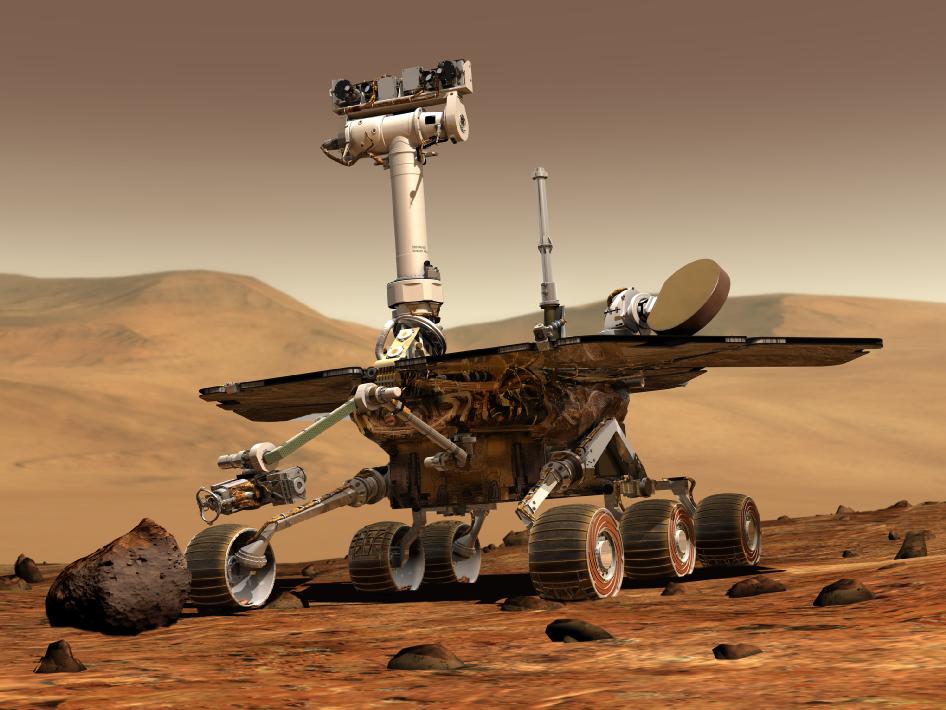
Credit: NASA
NASA has officially given up efforts to contact the presumably dead Mars rover Spirit. Things started going downhill for the rover back in the Spring of 2010 after attempts to free it from a mound of sand were unsuccessful. The rover was in a bad position for its solar panels to absorb power from the sun, and with the impending martian winter, engineers put Spirit into a sort of “hibernation” mode. They feared that the rover didn’t have enough power to run its heaters which protect the circuitry from the -125 °F temperatures that can occur during winter. Those fears appear to be correct, because now that we’re well into the Martian spring (for Spirit’s location), the solar panels should have collected plenty of power to run the communications equipment. But the rover has been silent for several months now, and the engineers believe the rover is truly dead.
The good news is that Spirit’s twin, Opportunity, is still going strong on the other side of the Mars, with no problems whatsoever. And furthermore, the death of Spirit comes after over 6 YEARS of operation. Loads and loads of valuable data have been gained from the rover, and it has lasted 25 TIMES its expected lifespan of a few months. I’ve said it before and I’ll say it again, these twin rovers are arguably NASA’s second greatest achievement, behind putting a man on the moon. For more, read Phil Plait’s post on this, or go straight to the source, NASA.
Today is Yuri’s Day/Night
April 12, 2011
 50 years ago today, the USSR beat the US in the first milestone of the space race: they put the first human, Yuri Gagarin, into space. Gagarin’s accomplishment is celebrated each year in a series of “Yuri’s Night” parties. Obviously this year is a big deal, since it’s the 50th Anniversary, and not only does Discovery News have a gallery of photos from various Yuri’s Night parties around the globe, but this story also clued me into something I didn’t yet know about- a feature length film by director Chris Riley that attempts to re-create what Yuri would have seen from his capsule. Audio from the flight has been released, as have video clips of Gagarin’s face during the flight, but no video of the earth below was taken during the flight. So, Riley teamed up with Italian astronaut Paolo Nespoli to capture video footage from the International Space Station’s Cupola as the passed over the same areas Gagarin’s capsule did during that first flight. Check it out on YouTube here.
30 years ago today, the US reached another milestone, coinciding with the 20th anniversary of Gagarin’s flight- they launched the first space shuttle flight. It was shuttle Colombia, with astronauts John Young and Robert Crippen on board. Thus it’s only fitting that today, during a ceremony celebrating 30 years of shuttle flights, NASA will announce the final resting places of the 3 remaining shuttles after they’re decommissioned. Many museums and towns with history tied to the space program have made their cases for getting one of the shuttles, but it’s expected that one will go to the Smithsonian and another to the Kennedy Space Center visitor complex. Beyond that, it’s anyone’s guess, but I have a feeling the 3rd will go to Houston, as it’s home to NASA’s mission control. (Update: the announcement was just made, and Discovery goes to the Smithsonian, Atlantis goes to Kennedy Space Center, and Endeavour goes to the California Science Center in L.A.) This celebration at KSC is just getting underway as I type this at 11:50am CDT, and the announcement regarding the shuttles’ destinations is scheduled for 3pm EDT (2pm here in Nashville). Watch it all at NASA TV if you’re interested. I’ll update this post after the announcement is made.
NASA’s next Mars rover/why eyes are blue
April 6, 2011
This animation shows how NASA’s next Mars rover, called Curiosity, will get to its destination. The mission is schedule to launch late this year and if all goes as planned, 8.5 months later we’ll start learning more about Mars than ever before. This rover is the first we’ve sent to specifically look for evidence of life, both past and present. This video is the first I’ve seen that shows every aspect of how the rover will arrive on the surface. Getting a probe safely on the surface of Mars is much harder than you might think- it’s actually the hardest aspect of the whole mission. Mars has a very thin atmosphere, so not only does the initial entry NOT slow the probe down nearly as much as a thicker atmosphere like Earth’s would, but also the atmosphere renders parachutes almost pointless, because in order for a parachute to slow the probe to a safe touchdown speed they’d have to impractically massive in size. In both cases, the thin air makes the slowing mechanism much less effective. For Curiosity, NASA came up with this “sky-crane” landing process that is simply amazing. The engineering and technology required to pull this off simply can’t be overstated- it’s both magnificent and terrifying at the same time. I say terrifying because one tiny glitch or mechanical failure could cause the rover to crash into the surface, land sideways, or even miss Mars altogether. Every minute detail of the mission must be executed with absolute precision and perfection. In the current economic climate, failure of a mission this expensive would be a catastrophic blow to NASA’s unmanned mission programs, and we likely wouldn’t return to Mars’ surface again for many years. But with the huge successes of 2004’s twin rovers Spirit and Opportunity and 2008’s lander Phoenix, it’s safe to say NASA is getting pretty good at this. (Via Universe Today)
Another interesting tidbit I felt compelled to share: people with blue eyes (such as myself) don’t really have blue eyes. In fact, our eyes are actually pigment-less, and the same effect that makes the sky blue makes our eyes look blue. In a nutshell, irises have 3 layers and people with brown eyes have pigment in all 3. People with blue eyes have pigment only in the back layer, while the front layers have no color. However, those front layers also have tiny particles in suspension that scatter blue light (due to its shorter wavelength) more readily than other colors. This is the same thing that happens in the atmosphere and causes the sky to appear blue. As we age, those particles tend to get larger and scatter a larger portion of the light spectrum, thus our eyes look less blue and more grayish the older we get. (Via i09)
- Credit: NASA
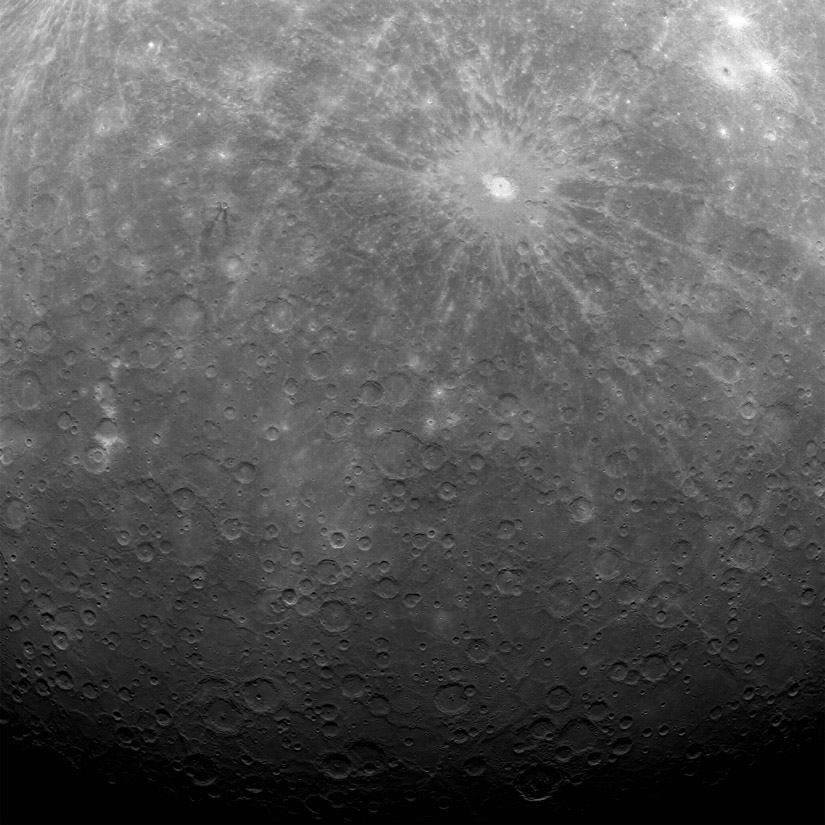
You’re looking at an important piece of history when you look at the above photograph. That’s the first ever image of Mercury taken from orbit. NASA’s Messenger spacecraft successfully entered stable orbit around the solar system’s smallest planet, and yesterday morning we got the first images taken from said orbit. The spacecraft has taken other images of Mercury as it approached, but Messenger just recently actually entered a permanent/stable orbit, and will remain there for at least a year, studying this hot, battered planet in unprecedented detail. This is also the first time any spacecraft has orbited Mercury to begin with. (Via Discovery News)
In some other space-related news, NASA decided to pull the plug on James Cameron’s idea to install a 3D camera on the next Mars rover mission, Curiosity. Honestly, I love this idea, as it would have allowed anyone with 3D glasses to watch cinema quality footage from the surface of Mars. When you really think about that, it’s absolutely mind-boggling: 3D video footage from another planet. However, NASA felt that since this rover is already way over-budget, the risk of failure was too great because the cameras haven’t been thoroughly tested. I’m certain that this technology will end up on another NASA mission to Mars in the future. So just wait. In another 5-10 year’s we’ll be looking at HD footage from Mars in 3D. NBD… (Via i09)

Credit: NASA
Space Shuttle Discovery touched down for the final time this morning just before noon at Kennedy Space Center. The shuttle has spent a total of 365 days in space and traveled a total of 148 million miles on 39 missions. It is the oldest shuttle in the fleet and has always been considered NASA’s workhorse. Universe Today has a post with a crop of great photos from this last mission, as does the NASA website of course. Some cool facts from my own knowledge as well as tweets from Astrophysicist Dr. Neil deGrasse Tyson: the shuttle is traveling roughly 17,500 mph while in orbit, but it’s de-orbit thrusters slow it by only 188 mph. That’s enough to allow it to slowly drop into the upper reaches of earth’s atmosphere, at which point the air begins to take over the slowing process. The drag from the earth’s atmosphere is the only thing that slows the shuttle down from then on, including on the runway because the shuttle has no brakes, just a parachute that deploys just after it touches down. Everything in the re-entry process is meticulously calculated because they only have one chance at it. The shuttle has no power- it’s only a glider once back in the atmosphere, so everything has to be absolutely perfectly executed. The pilot is assisted by lots of powerful onboard computers that take care of most of the difficult fine-tuned adjustments, but the pilot must be able to take over if something goes wrong- the skill level required is immense. On April 12th, NASA is expected to announce the final destinations of the three remaining orbiters after their retirement. Discovery is expected to go to the Smithsonian, but that is not certain until the announcement is made. More on that at Space.com.
I feel I must also mention the alien bacteria craziness that happened over the weekend and earlier this week. NASA scientist Richard Hoover had a paper published that claimed that he had found evidence of extraterrestrial bacteria in a meteorite. Well, basically everyone else in the science community is saying he’s wrong, and I’m inclined to agree. There are a host of reasons why his claim is probably bogus, not the least of which is the fact that contamination of a meteorite by earthly bacteria is all but inevitable. Also, the paper had not completed a peer-review process before it was published, not to mention that it was published in a less-than-reputable journal that has a history of publishing error-laden work. NASA even issued a statement saying that they had nothing to do with Hoover’s paper or his claim. Most of this info comes from Phil Plait’s analysis of the situation. Get the whole story from him.
On a lighter note, enjoy this animated GIF gem, also from Plait’s Bad Astronomy blog:

Amazing footage of Discovery launch from plane/Road to Bonnaroo tonight
February 28, 2011
Some amazing and unique footage of Space Shuttle Discovery’s launch last thursday from an airplane window. The people on this plane got very lucky, as this is something rarely seen by the public. It’s one of those “right place, right time” deals. Be sure to pump it up to HD resolution.
(Via Bad Astronomy)
If you’re in Nashville and are a fan of local music, be sure not to miss tonight’s Road to Bonnaroo 8 off 8th at Mercy Lounge. This is the third year of RTB, and tonight’s lineup looks great. This event really brings out the best in these bands, as most will have some sort of trick up their sleeve. We’ve seen just about every type of gimmick you can think of at these events in the past two years. If you didn’t know, the bands’ scores are made up of 50% audience vote and 50% judge vote. Tonight’s lineup:
Evan P. Donohue
Courtney Jaye
Chancellor Warhol
Majestico
Heartbeater
Kink Ador
The Kicks
Tyler Byant
For more info on the bands/artists and sample mp3s, visit the Mercy Lounge calendar.

Credit: NASA
Space Shuttle Discovery is ready for launch later today (4:50pm Eastern/3:50 Central) on its final trip to space. This mission has been delayed extensively- it was originally scheduled to launch in November of last year, but fuel leaks and then tiny cracks discovered on the external fuel tank caused major delays. The shuttle had to be returned to the massive vehicle assembly building (VAB) for repairs that took several months. But so far all is good for the launch today. The shuttle is carrying an additional storage module (essentially a storage closet in space) to the ISS, along with an external logistics platform and a humanoid robot called Robonaut 2. Robonaut 2, known as R2 (ha!) is basically an experiment to allow engineers to determine how the robot will work in space, and how to best control it from inside the ISS. The end goal is to have a humanoid robot that can venture outside the space station and assist spacewalking astronauts with repairs and upgrades. The robot will be controlled by an astronaut inside the space station via some sort of virtual reality-like interface.
As I said, this is the last flight of Discovery. The only confirmed remaining flight is that of Endeavour, scheduled for launch in April. This mission will carry a very important piece of scientific equipment called the Alpha Magnetic Spectrometer to the ISS. The AMS will help physicists answer some of the most daunting questions in cosmology. An additional flight of Atlantis is likely, though not 100% confirmed. It would launch in June and be the absolute final flight of the Space Shuttle program.
Thundersnow/new rocket for NASA
February 9, 2011
Thundersnow is possibly the coolest-sounding meteorological term I can think of. It happens very rarely, but when it does it’s awesome. Convection strong enough to cause lighting during a snowstorm is simply amazing, as are most things that rare. Through a ridiculous stroke of luck, scientists in Huntsville, AL got a rare opportunity to study this bizarre phenomenon in-depth. As you may know, Huntsville is home to NASA’s Marshall Space Flight Center. There are meteorologists and other scientists there with a barrage of better-than-average instruments that monitored the inner-workings of the snowstorm that hit the area Jan. 9th. They got the most thorough data ever recorded for thundersnow, and observed one bolt of lightning that traveled a whopping 50 miles horizontally before hitting the ground. The fact that such a rare and interesting phenomenon happened right on top of a facility so well-equipped to study it is quite remarkable, and those scientists were very excited to be able to study the thundersnow in such great detail. I look forward to seeing what is learned from this experience. (Via Discovery News)
NASA has been presented with yet another viable commercial option for replacing the Space Shuttle’s role of ferrying astronauts to and from the space station, as well as carrying cargo. A U.S. company called Alliant Techsystems teamed up with Europe’s Astrium to draft the proposal for a new rocket called Liberty. This new rocket would combine research of the now-dead Constellation program with the proven components of the European Space Agency’s Ariane 5 launch system. Since this collaborative effort combines mostly well-proven technology, it would be both cheap and relatively quick to build, shortening the problematic gap between the last Space Shuttle flight and the first availability of commercial access to space. If it truly will shorten said gap, I’m all for it. I hope it’s really as good as it sounds, but things like this always run into unforseen problems/delays. Right now, SpaceX still has the edge simply because it’s already had 2 very successful tests of its launch system, the Falcon 9 rocket and Dragon capsule. But Liberty could give SpaceX a run for their money. Check out the promo video below. (Via Universe Today)
Milestone in the search for earth-like exoplanets: Kepler-10b
January 11, 2011
A major milestone has been achieved by the Kepler Spacecraft- the smallest exoplanet found thus far. Kepler-10b is a small, dense, rocky world only 1.4 times the size of earth. It’s not earth-like, but it is earth-sized. This planet orbits its parent star very close- even closer than Mercury is to our sun, and it’s tidally-locked- meaning the same side always faces its star. It’s so hot that most of its surface is probably molten, and the star’s point-blank radiation would have long since “blown” away any atmosphere it might’ve had, so there’s no way it could support life. Still, this is a major milestone simply because it’s such a small planet. Detecting planets using the transit method is very difficult to begin with and the smaller they are, the harder they are to see. I’ve said this many times before, but it is literally only a matter of time, possibly only months, until Kepler uncovers a true earth-twin. That will create a fundamental shift in the mindset of the entire astronomy community from “are we alone?” toward the direction of “what are they like?”
(Via Universe Today, Bad Astronomy, and NASA)
Lunar eclipse + solstice tonight, not visible in Nashville due to clouds
December 20, 2010

Credit: Fred Espenak/NASA's Goddard Space Flight Center
You must’ve heard about this by now, but I’ll mention it to make sure you know: there’s a full lunar eclipse happening tonight, and it just so happens that it’s also the winter solstice, a.k.a. the shortest day/longest night of the year. Just a coincidence, but a relatively rare one. Lunar eclipses aren’t super-rare- we get one about once every 2-3 years, but they can be pretty spectacular if the earth’s atmospheric conditions cast an eerie orange-red hue on the moon. There’s no way to know if that will happen for sure, but from my experience it happens more often than not. Unfortunately there’s a very good chance it will cloudy and/or raining tonight in middle TN, but if you’re elsewhere, good luck! It starts at about 1:30am EST, that’s 12:30am central, 11:30pm mountain, and 10:30pm pacific. For more details and a good rundown of what to expect, visit Bad Astronomy, and for a good explanation of the red/orange hue, visit this NASA article.
And I can’t help but post this comic from xkcd: I agree 100%


 steve cross loves music and science