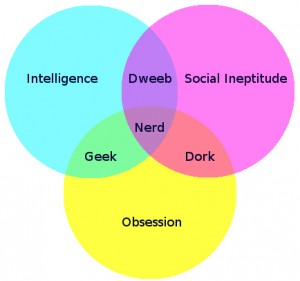
Rocky exoplanet confirmed/nerd Venn diagram
September 17, 2009

Image Via Space.com
A European satellite observatory recently discovered a very small exoplanet that is said to be the first with a proven density similar to Earth’s. Follow-up observations were done at a telescope in Chile to determine the planet’s mass, which was then combined with its radius to calculate its density. The planet has about 5 times Earth’s mass. But don’t get too excited just yet- the planet is far from habitable. It orbits VERY close to its parent star (23 times closer than Mercury is to our Sun), which not only means it’s really effin’ hot, but it also is probably tidally locked, which means the same side of the planet is always facing the star. So one side is literally boiling with molten rock, and the other side is extremely cold. There’s no way it could have any atmosphere, either. BUT this is still an important step toward finding an Earth-twin. No we know that we can find planets similar in size and density to our own. It’s just a matter of time until Kepler or CoRoT finds one orbiting in its star’s habitable zone. (Via Space.com)
Ever wondered about the difference between a nerd, a geek, a dweeb, and dork? Look no further. This pretty much nails it down perfectly. (Via Clusterflock)
NASA can’t get out of LEO with current budget/Levitating Mice
September 10, 2009
Bad news for NASA from the Augustine Commission. Under the current budget through 2015, we can’t even get out of Low-Earth Orbit. What that means is we can only go to the ISS. We can’t even get back to the moon, let alone send people to Mars or beyond. The commission’s recommendations are best summarized in a cool graphic that I found on Universe Today yesterday. See below.

Image via Universe Today
Obviously Obama has to allocate more money to NASA if we are to even think about achieving the current set of goals. (Those being: retiring the space shuttle, developing the new Ares rockets, Orion Crew Module, and Antares Moon Lander, and getting back to the Moon around 2020.) In these times that will be tough, and sadly NASA could get put on the backburner for a few years until we have more economic stability. Let’s hope for the best, though.
In some much better NASA news, the newly refurbished Hubble Space Telescope is working like a charm and is taking better pictures than ever before. Check out some of the gorgeous new images at NASA’s website. You can even download super hi-res versions. Eye. Gasm.
Who knew that we’d be able to build an actual, real-life antigravity device so soon? Scientists have found a way to levitate small creatures as big as mice. We’ve all seen the classroom science experiment where they use a superconductor in liquid nitrogen to levitate a tiny disc. But you can actually do that with almost anything. They key is getting the magnetic field to the right strength. AND there’s a practical goal of this research other than “Holy Shit! We made a mouse float in mid-air! Cool!” The practical goal is to study long-term effects of microgravity on the mice’s bodies, the results of which can be applied to astronauts in space and help NASA plan for missions to Mars and beyond. (Via LiveScience)
Here’s one of those awesome Hubble images:

Image via NASA
Google UFO explained/Shuttle photos/EEstor
September 8, 2009

Image via Universe Today
Whew. That was quite an eye-gasm wasn’t it? That was taken on the current space shuttle mission (STS-128) to the International Space Station. The mission is about to come to an end, with a scheduled landing on Thursday. (Via Universe Today)
I also found on UT the final explanation of the Google UFO logo that caused quite a stir yesterday all over the interwebz. The Google tech-nerds were simply showing some love for the Japanese video game Zero Wing, the one with the famous quote “All your base are belong to us” at the beginning. Google also tweeted a mysterious set of numbers. It turns out if you insert the corresponding letters of the alphabet, you get “All your O are belong to us.” No, Google doesn’t know something we don’t. No, it wasn’t a hint that we’ll soon be visited by aliens, or that the government will finally come clean on a huge conspiracy theory. Sorry, Fox Mulder.
Until this morning I’d never heard of EEStor, but this new technology could revolutionize…. everything. But apparently it’s been met with quite a bit of skepticism. Basically it’s a new way of storing electricity, much more efficient than a lithium ion battery, and it would make storage of power generated by wind turbines and solar cell arrays much easier. The problem with power from the wind and sun is that it isn’t constant, therefore you need a way to store that power so that it can be used at all times, even when it’s dark or there’s no wind. That storage has been a big hurdle for the progress of these types of energy. Basically what they’ve done is invent a capacitor capable of storing much more energy than any capacitor before. It was once thought that basic problems with the very laws of physics prevented the development of capacitors with this much storage potential. But apparently this company has managed to convince the Zenn motor company, along with several investors with deep pockets, that they have found a way around those problems. If they’re really on to something it could make 100% green, sustainable power much closer to reality. If you’re a total electronics nerd and want to read the nitty-gritty on this, check out this article. (Via EcoGeek)
NASA’s options/Zooey Deschanel dances/vacation
August 6, 2009
This will be my last post for about a week or more. Tomorrow right after work Megan and I are heading westward to spend some time at Yellowstone and the surrounding areas, and possibly Portland as well. Having to make the 34 hour drive back from Portland is looking less and less appealing, however. That being said, posting will be virtually non-existent for a while.

Photo via USA Today
As I mentioned a few days ago, we saw 500 Days of Summer last weekend. Most people would agree that there’s no such thing as too much Zooey Deschanel, and thus I highly recommend watching this cute music video put together as a promotional piece for the movie. It’s for She & Him’s “Why Do You Let Me Stay Here” and features ZD dancing with Joseph Gordon-Levitt. I have no idea how to embed USA Today videos on WordPress, so just go watch it here. (Via Stereogum)
I know I flooded you with science nerdiness yesterday, but I have to post this. I read an article this morning on Space.com containing details on the options for the future direction of NASA that Obama’s Augustine Commission are reviewing. Basically they’ve narrowed it down to 7 generalized options. They’ve been holding public hearings to get input from citizens (which is awesome) and plan to convene to make their final decisions and present them to President Obama at the end of this month. I’ve mentioned this many times on here before, but this is the first time I’ve seen the actual options that are under review. Personally, I’m torn between the “Directly Shuttle-Derived System” and relying on commercial spaceflight. It’s obvious that the current Ares I is having issues. It’s also obvious that many companies, the leader of them being Virgin Galactic, are really close to making commercial spaceflight a simple and easy solution. NASA could just buy flights from a private company to get astronauts to and from the ISS. I definitely think the US has invested way too much time and money into the ISS to end our involvement in 2015, just 4 years after it will be completed. It will still be useful and there’s no sense in abandoning it. Then NASA could possibly use the shuttle-derived plan, along with Ares V (which hasn’t had as many setbacks as Ares I because it’s not intended to carry humans; only cargo) to get to the moon and eventually Mars. Just my two cents.
See y’all in a week!
Ares I-X/Man-made Auroras
August 5, 2009

Image Via Universe Today
NASA is assembling the Ares I-X rocket currently in the the Vehicle Assembly Building at the Kenndey Space Center. This rocket is a test version for the Ares I which, under the current plan, will eventually take astronauts to the ISS and moon. They plan to do the test flight on Oct. 31st of this year. However, Obama’s Augustine Commission is currently reviewing the direction of NASA and could come out with a report that recommends scrapping the Ares rockets in favor of retro-fitting the space shuttle’s external fuel tank/SRB assembly to work with the new Orion Crew Vehicle. (I’ve posted about this before.) I’d say the test will happen regardless of the Augustine Commission’s recommendations, and furthermore I’d speculate that their findings will be somewhat dependent on the results of this test flight. Either way, it’ll be cool to see what happens. (Via Universe Today)
It’s unfortunate that most really big advances and breakthroughs in science are the result of military initiatives. (See: THE INTERNET) A scientist can ask the government for money to research a technology that could greatly improve the lives of everyone, but as soon as he/she mentions that the technology could have military applications, their chance of getting said money goes up exponentially. Such is the case with one of the most mysterious facilities ever to be built. No, I’m not talking about Area 51, I’m talking about HAARP (High Frequency Active Auroral Research Program) in Alaska. This thing is literally capable of creating its own miniature aurora in the sky. It’s a 3.6 megawatt antenna array aimed directly into the sky, and its purpose is to turn the ionosphere (a layer at the top of the atmosphere full of charged particles) into a giant low frequency antenna. I think the intent of the scientists behind this project is good, but the facility has fueled tons of conspiracy theories. Some even say it is responsible for Hurricane Katrina. I’m not knowledgeable enough to know exactly how ultra low frequency radio waves can affect the weather, but I do know that something powerful enough to blast the ionosphere and create a mini-aurora is pretty awesome, and the scientific knowledge that can be gained from such experiments is well-worth the evils of military application. The main military application in this case is the penetrating power of those ultra-low frequency radio waves generated by the ionosphere. Those waves could be used to detect underground bunkers and communicate with submarines deep in the ocean. Other radio waves are quickly absorbed by just a few feet of water or land, but these high-powered, low frequency waves have much more penetrating ability. I suggest reading this well written article on Wired about HAARP for more info if you’re interested. Here’s what the antenna array looks like:

NASA’s new administrator/Solar Eclipse
July 22, 2009
 An historic solar eclipse occurred today over parts of Asia, including India, Nepal, and China. CNN.com has a great slideshow of images from the event. I’ve been patiently awaiting the next solar eclipse that will be seen in the U.S., and there’s a lot more waiting to be done. It won’t happen till 2017. But, when it finally does hit the U.S., Nashville is in for a real treat. Check out this map (be patient, it seems that website is a bit slow) of the Aug. 21st, 2017 total eclipse. You can easily see that the main shadow, or umbra, goes right smack over Nashville. I have no idea if I’ll still be in Nashville in 2017, but you can bet I’ll be traveling back for it if I’m not still living here. A total solar eclipse is a once-in-a-lifetime experience. The May 20th, 2012 annular eclipse barely extends into northern California, but the 2017 one will be much better. For more info and a complete list of solar eclipses for the next several hundred years, check out the NASA eclipse website.
Charles Bolden was confirmed as NASA’s new administrator, along with Lori Garver as his Deputy Administrator. The two laid out some fresh policies at a videoconference with all the NASA centers. Of particular interest is their view toward feelings in the NASA workplace. Garver said “Feelings are not something that were popular in the last few years at NASA, but they’re back. Feelings are back!” I like it. If bringing feelings back to NASA equates to more passion for broadening mankind’s reach into space, then I’m all for it. Hopefully Garver can be successful in keeping Congress interested in what NASA’s up to, and keep them a top priority when it comes to funding. (Via Universe Today)
Speaking of NASA’s budget and direction, a new article on Space.com sheds some more light on details of what our first manned Mars mission would look like. The Ares V rocket under current development would do all the heavy lifting and get the cargo/equipment there, but they’d probably have to develop something a bit roomier than the Orion capsule to get the crew there, as Orion is only big enough to fit 3 people and at least 6 will be needed for a mission to Mars. Check it out here.
WalMart begins redeeming itself/Endeavour docks with ISS
July 17, 2009
Just about everyone hates WalMart for various reasons. At least everyone with half a brain. BUT they’re beginning to redeem theirselves in my eyes with this new initiative to instate a universal carbon footprint rating for all retail stores to use. Different environmental groups have attempted to do this for years but failed repeatedly because it’s such a an enormous undertaking. But hopefully not too enormous for WalMart. If anyone has the power to get this kind of research done, it’s WalMart. Let’s hope this is a case of the giant with superpowers using them for good, not evil. This could have a huge effect if successful, because it will put real pressure on manufacturers to “green” their processes and products. More at the New York Times. (Via EcoGeek)

Credit: NASA TV
Space Shuttle Endeavour did a fly-around of the ISS today and then successfully docked. They took many detailed photographs of the heat shields and will inspect them in the days to come. The shuttle engineers are intrigued by the 12-ish pieces of foam seen falling off the external fuel tank late in the launch footage. This is mainly because of how late it occurred. It happened at a time/height when atmospheric pressure is very low and thus there’s much less stress on the foam to cause it to fall off, so they aren’t really sure why it happened. Nonetheless, initial opinion is that the heat shield did not suffer any major damage that would threaten safety of the crew on re-entry, but that opinion can always change. (Via Space.com)
As I mentioned in the music post above, I’m splitting up the categories somewhat, so comment and let me know what you think!

Image via nasa.gov
Today is the 40th anniversary of the launch of Apollo 11, on its way to what is arguably mankind’s greatest achievement thus far- putting a man on the moon. As part of the celebration, NASA has posted mp3’s of recorded conversations inside the module. They’re certainly not the highlights of the mission, but it is interesting to hear the casual conversations between Armstrong, Aldrin, and Collins. They have also posted newly restored footage from the mission here. Also of interest- notice the main logo in the upper-left corner of the website. They replaced the blue sphere with an image of the moon. (Via Universe Today)
Unsurprisingly, the Boston Globe’s Big Picture blog put together a collection of 40 hi-res images from the Apollo 11 mission. Check out the eyegasm here.
Endeavour FINALLY lifted off yesterday after 6 delays. Watch the video here. This is a minor milestone in space exploration, as there are now a total of 13 humans in space at the same time, the most in history. There are 6 on the ISS and 7 on Endeavour. Some debris was clearly seen falling off the external fuel tank during yesterday’s launch, and the shuttle will perform a flip maneuver to allow the ISS astronauts to take hi-res photos of the heat tiles to look for damage. We’ll know in a couple of days if the damage was significant.
The New York Times did a nice article on the future of NASA, focusing on missions to the moon, Mars and the budget constraints that may force changes in those plans.
 Attention bands everywhere: the Next Big Nashville deadline for entry was extended until this coming Friday. It was originally today, but last Friday they announced the extension. So get over to American Songspace and apply if you haven’t. It’s only ten bucks!
Those Darlins just keep making bigger and bigger news stories. This time they got a mention on CNN and the New York Times! Check out CNN.com and watch the video clip. They talk about Hannah Montana first, then mention the Darlins at about 2:50 into the clip. Then check out the NYT review here. They also got written up on Brooklyn Vegan for the 368th time….
Tonight is Nashville Cream’s 70’s cover night at Mercy Lounge. It’s like an 8 off 8th in that there’s 8 bands and they play about 3 songs each, but all bands are doing covers of songs from the 70’s. It’s totally free and 21+. It’ll be a blast so come on down.
Oddee posted a blog about 10 very strange bars. My favorite is the bar made of ice. Pretty awesome.
From the science world…
The launch of Space Shuttle Endeavour was scrubbed AGAIN yesterday due to storms in the vicinity of the launch area. They’re going to retry the launch at 6:51pm EDT tonight, but the forecast is still pretty iffy. Basically any afternoon/early evening launch time during the summer months is a shot in the dark because storms pop every afternoon in Florida due to the interaction between the hot/humid air over the land and the cooler seabreeze coming in off the ocean. Basically they’ll just have to get lucky.
In other NASA news, a really cool interactive flash application is up on their website. It’s a panoramic view made of images taken during the Apollo 11 moon landing (except for the image of the Eagle lander, which is obviously CG). You can scroll around from several different viewpoints. In case you didn’t know, this year is the 40th Anniversary of the moon landing.
Cream’s 60’s cover night/new Spoon/snow on Mars
July 6, 2009
 The Nashville Scene/Cream is sponsoring all the 8 off 8th Mondays during July, and each week the 8 bands will all perform covers from a specific decade- the 60’s through the 90’s. Tonight is 60’s night and the bands are:
Matt Friction and the Cheap Shots
Roman Candle
Eureka Gold
The Clutters
Kindergarten Circus
Ole Mossy Face
Jacob Jones
Millionaire Magicians
Tigers Con Queso will be on the lineup for 90’s night on July 27th. More info at Nashville Cream. I’ll be there tonight taking pics, so come on out. It’ll be fun.
Hipster Runoff posted the new single Got Nuffin from Spoon today. It’s a good song, so go grab it.
I’ve got a lot of science to dump on you today, so here we go…
Astronomers have been a little puzzled by our Sun recently because it’s been unusually quiet. We reached solar minimum, the lowest part of the 11-year cycle of sunspot activity, in 2008. Normally we’d be seeing some sunspots appearing, marking the beginning of the next cycle, but for some reason the Sun has been strangely quiet this year, and no one really understands why. This weekend marked the first real appearance of sunspots for the new cycle, breaking the stretch of puzzling silence. Space.com has more.
I’ve always loved the large-scale, long-term predictions and statements that Dr. Stephen Hawking is known for. One of his latest predictions/statements is truly fascinating. He proposes that we take a much broader view of the term “evolution” and include not only genetic information (internal), but also external information. Because we now have the ability to communicate external information we are now in a different stage of evolution. Just like so many of his broad ideas, this one really makes you think almost on a totally different level. Read more at the Daily Galaxy article.
Even though communication with NASA’s Phoenix Mars Lander ceased last fall, scientists are still evaluating the data collected while it was in operation. The scientists used a specialized instrument on the lander to detect water ice clouds and even snow falling to the martian ground. Yes, I said snow. On Mars. How effin’ cool is that? Learn more about this phenomenon by reading the Universe Today article.
Also from Universe Today- a more substantiated version of the blurb I posted a couple weeks ago regarding the possible back-up to NASA’s new Constellation program. A video clip from the presentation made to an external review committee by shuttle program manager John Shannon has been posted on YouTube. Apparently NASA is taking this proposal pretty seriously and everyone there is waiting on the final word by an executive session as to whether they’ll keep charging ahead with the current plans for the Ares rockets or try this new plan to retrofit the existing external fuel tank/solid rocket booster system to work with the new Orion Crew Vehicle. Watch the video below. As Universe Today points out, this system would be MUCH cheaper and faster to implement. Honestly, I think there’s a decent possibility that they’ll end up going for this and scrapping the Ares rockets. Only time will tell. Full article here.

 steve cross loves music and science