The Sun is alive: auroral displays are on the rise
January 24, 2012
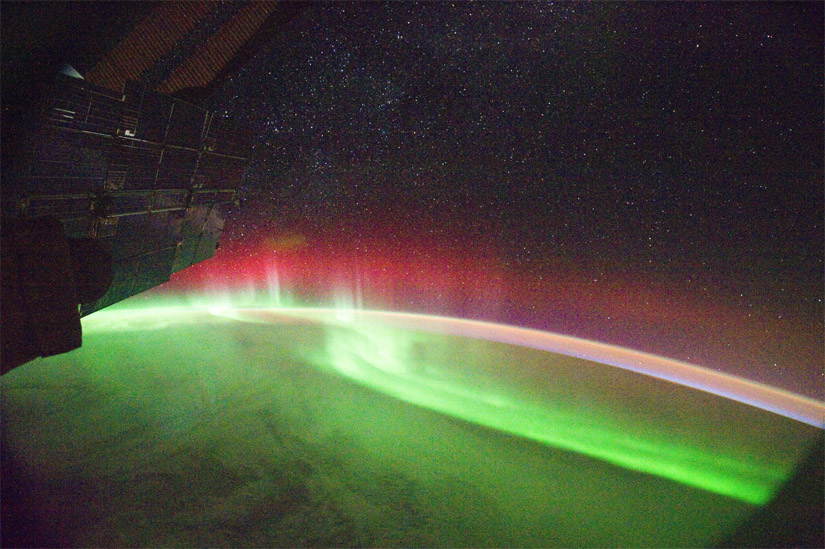
Credit: NASA
As I’ve mentioned before, our Sun is steadily heading toward the peak of its next 11-year sunspot cycle. The peak is expected in 2013. That means we can expect a steady increase in aurorae as well, because sunspots lead to solar flares and coronal mass ejections (CMEs) and when those happen to be aimed at earth, we get dazzling displays near the north and south poles. Sometimes those displays can even be seen as far south as Tennessee. Over the weekend there was a massive solar flare and CME, one that released the same amount of energy as millions of nuclear bombs, and it headed straight for earth. The blast of particles reached earth last night/this morning and created an astonishing auroral display, which was captured by many photographers at various locations. Here are a few blog posts and other links I’ve come across today showing some of those photos as well as explaining the physics of what actually causes the upper atmosphere to glow when bombarded by these particles.
Spectacular Aurorae Erupt Over Norway (Discovery News) Absolutely breathtaking photos by Bjørn Jørgensen.
Huge Solar Flare Seen By Solar Dynamics Observatory (Space.com)
The Sun Aims a Storm Right at Earth! (Bad Astronomy) Good explanation of the science behind the aurorae.
Can Solar Flares Hurt Astronauts? (Universe Today) Good explanation of why the flare/CME poses little risk to astronauts onboard the ISS.
The Higgs boson: progress made but nothing conclusive yet
December 13, 2011
 You’ve no doubt already seen or heard mention of this breaking news elsewhere, but I simply must weigh-in: This morning physicists at CERN’s Large Hadron Collider announced that they are making significant progress toward discovering the Higgs boson, or what many tend to call “the God Particle.” They really are on the verge of making a discovery that will change the face of physics forever, and vastly improve our understanding of the building blocks of EVERYTHING in the universe, and how the universe came into existence. The announcement does not mean that they have found the Higgs, just that they’ve seen a series of spikes in activity (the few nanoseconds right after a particle collision) within the predicted mass range for the Higgs. They’ve narrowed its mass down to a pretty small range with a fairly high degree of certainty because they’ve amassed quite a bit of data, and the chances that this is just a statistical fluke are getting lower and lower. Still though, the certainty is not high enough for physicists to claim an actual discovery. This elusive Higgs boson is the last missing “link” in the most widely accepted theory of particle physics- The Standard Model. If the Higgs is finally confirmed to exist within the range of mass predicted by the Standard Model, then this theory will essentially become rock-solid.
*Steps onto soapbox.*
But the beauty of science and the scientific method is that it will be just as exciting, if not MORE exciting, if the Higgs is proven to either exist outside the predicted range of mass or not exist at all! Science relies strictly on data, and if the data shows something not predicted then you go back to the drawing board and keep trying until you have a theory that fits the reality of the data. That method is infallible, and that is why I love science.
*Steps down from soapbox.*
For more-
the Guardian has been posting live updates to their story.
But BBC News has the best coverage I’ve seen.
Neutrinos faster than light? Let’s be realistic.
September 26, 2011

Of course the big news about the “faster than light” neutrinos would have to break right in the middle of Soundland, when I was insanely busy running around taking literally thousands of photos for 4 days straight… but the above image pretty much sums up how I feel about it. There’s an old saying in science- extraordinary claims require extraordinary evidence. However, in this case we’re not dealing with crackpot fringe scientists, we’re dealing with CERN scientists. In other words these people are very disciplined and have ruled out just about every other statistical anomaly, measurement inaccuracy, or other explanation for their results. So the fact that they measured neutrinos that appear to have traveled faster than light is not in question. The key word there is appear. And this is such a massively important discovery that the scientists involved are asking for comparison from the rest of the worldwide scientific community. They want others to repeat their experiments and see if they get the same result. When you’re questioning one of the most iron-clad, thoroughly proven theories of science such as General Relativity, you’d better have rock-solid, repeatable evidence to support your claim. No matter what the outcome of this, it will fascinating to sit back and watch as it unfolds. Here are a few links to interesting articles I’ve found relating to this news:
Science Friday: Coriolis Effect does NOT affect water drains/indirectly affects tornadoes
April 29, 2011
So I’m thinking that some Fridays I’m gonna steal NPR’s “Science Friday” idea and write a post debunking some popular myths. Not gonna happen every Friday, but I’m gonna make a pointed effort to do it somewhat often.
Today we’ll tackle the myth about water spinning in opposite directions down the drain in the northern and southern hemispheres. This is simply not true at all. While large-scale weather systems do indeed follow this pattern due to a phenomenon called the Coriolis Effect, water going down a drain does not. Minute things such as imperfections in the angle at which a basin was installed, inconsistencies in the surface or shape of the basin, and any residual motion in the water itself are what determine the direction the water rotates when drained. Once the water begins to drain, the conservation of angular momentum takes over and any hint of rotational motion in the water, whether clockwise or counter-clockwise, gets amplified as it moves toward the drain, creating a vortex. This is the same law of physics that causes tornadoes and dust devils to behave the way they do. The classic explanation for this concept is the spinning ice skater. As he/she moves her limbs closer to their body the conservation of angular momentum forces their rotational speed to increase. They can then move their limbs further away and they will slow down again. So no, no matter what you’ve heard, water does NOT always drain counter-clockwise in the northern hemisphere and clockwise in the southern. That being said, experiments have been done that show the Coriolis Effect can be seen in draining water IF AND ONLY IF all other forces are completely removed. A large and absolutely perfect cylinder-shaped container with one very small hole exactly in the center was filled with water and allowed to sit untouched for 24 hours to allow any residual motion in the water to die out. The container was perfectly balanced with extreme precision. The plug in the hole was then carefully removed and the water did eventually start rotating counter-clockwise, and continued to do so when the experiment was repeated. BUT clearly this only happens in extremely controlled conditions. In your sink or toilet, a myriad of other forces are orders of magnitude stronger and completely overwhelm the minute effect of the Earth’s rotation. Snopes has a decent debunking of this myth as well.
Tornadoes are different. I was asked about this yesterday, in the wake of the massive tornado outbreak on Wednesday. The Coriolis Effect does influence the direction tornadoes spin, but in a more indirect way. There have, in fact, been clockwise (anticyclonic) tornadoes documented in many cases in the U.S. There have even been a few storms that dropped multiple tornadoes, both cyclonic and anticyclonic, at the SAME TIME. As I said earlier, the Coriolis Effect is what causes large-scale weather systems such as hurricanes, low pressure systems, and high pressure systems to rotate the way they do. Low pressure systems and hurricanes always rotate counter-clockwise in the northern hemisphere and clockwise in the southern. The opposite is true for high pressure (clear weather) systems. The storms which produces tornadoes are always associated with a large-scale low pressure system. The Coriolis Effect determines the rotation of that large-scale system, which in turn has an indirect influence on the structure of the supercell thunderstorms which spawn tornadoes. Tornadoes are far, far more common in the U.S. than anywhere else in the world, and because the warm moist air which “feeds” these storms at the surface is moving in from the southeast, and the cooler, drier air aloft is moving in from the northwest, that setup naturally lends itself to counter-clockwise rotation, hence most but not all tornadoes in the U.S. spin counter-clockwise. This illustration from NOAA’s National Severe Storms Laboratory shows the inner workings of a tornadic storm quite well:
 The U.S. Department of Energy’s Office of Science Education has a website called NEWTON, with a forum of sorts called “ask a scientist.” This very question regarding the rotation of tornadoes was asked, and I found this particular response quite helpful:
At least the great majority of tornadoes rotate counterclockwise (as do all low-pressure systems) in the northern hemisphere, and clockwise in the southern hemisphere, for the reason (coriolis force) given by Eric Peterson in response #1. But occasionally, it would seem, northern hemisphere tornadoes do rotate clockwise: S. Flora’s book “Tornadoes of the United States” cites an 1890 article in the American Meteorological Journal. Its author, a J.P. Finley, states that, of 550 American tornadoes he studied, 29 were deemed to have rotated clockwise. I have not been able to find any “modern” study of this question. But I believe it could be true. The region of swirling air that contracts to become the tornado is not itself large enough in extent to have its rotation dictated by the coriolis force; rather, it “inherits” this tendency from the great masses of air whose movement sets the stage for the storms and any associated tornadoes. If the study cited is correct and representative, on occasion the direction of rotation is set by some other factor, perhaps the topography in the area where the tornado forms, for example.
So there you have it. I won’t have as much time every week to write up a post this in-depth, so don’t expect this every Friday, but I’ll do my best.
NASA’s next Mars rover/why eyes are blue
April 6, 2011
This animation shows how NASA’s next Mars rover, called Curiosity, will get to its destination. The mission is schedule to launch late this year and if all goes as planned, 8.5 months later we’ll start learning more about Mars than ever before. This rover is the first we’ve sent to specifically look for evidence of life, both past and present. This video is the first I’ve seen that shows every aspect of how the rover will arrive on the surface. Getting a probe safely on the surface of Mars is much harder than you might think- it’s actually the hardest aspect of the whole mission. Mars has a very thin atmosphere, so not only does the initial entry NOT slow the probe down nearly as much as a thicker atmosphere like Earth’s would, but also the atmosphere renders parachutes almost pointless, because in order for a parachute to slow the probe to a safe touchdown speed they’d have to impractically massive in size. In both cases, the thin air makes the slowing mechanism much less effective. For Curiosity, NASA came up with this “sky-crane” landing process that is simply amazing. The engineering and technology required to pull this off simply can’t be overstated- it’s both magnificent and terrifying at the same time. I say terrifying because one tiny glitch or mechanical failure could cause the rover to crash into the surface, land sideways, or even miss Mars altogether. Every minute detail of the mission must be executed with absolute precision and perfection. In the current economic climate, failure of a mission this expensive would be a catastrophic blow to NASA’s unmanned mission programs, and we likely wouldn’t return to Mars’ surface again for many years. But with the huge successes of 2004’s twin rovers Spirit and Opportunity and 2008’s lander Phoenix, it’s safe to say NASA is getting pretty good at this. (Via Universe Today)
Another interesting tidbit I felt compelled to share: people with blue eyes (such as myself) don’t really have blue eyes. In fact, our eyes are actually pigment-less, and the same effect that makes the sky blue makes our eyes look blue. In a nutshell, irises have 3 layers and people with brown eyes have pigment in all 3. People with blue eyes have pigment only in the back layer, while the front layers have no color. However, those front layers also have tiny particles in suspension that scatter blue light (due to its shorter wavelength) more readily than other colors. This is the same thing that happens in the atmosphere and causes the sky to appear blue. As we age, those particles tend to get larger and scatter a larger portion of the light spectrum, thus our eyes look less blue and more grayish the older we get. (Via i09)
Mayan calendar end disputed/Big Pics of NIF
October 19, 2010
It’s been a while since I got on my soapbox of how the 2012 Mayan calendar doomsday myth is, well… a myth. Let me begin by saying that there is no reason to believe that anything exceptional will happen when the Mayan long count calendar ends. Anyone that tells you otherwise is either totally full of shit, or is very gullible to fluff and hype (generated by the former). The descendants of the Mayans themselves have even said that the doomsday myth is bullshit. So, this thing is already completely blown out of the water by real science and reason, but just in case you needed another reason not to believe the doomsday hype, now the actual date of the end of the long count calendar is in question. The methods used to convert the Mayan calendar into our own Gregorian years has been shown to be unreliable, and this could throw off the date conversion by as much as 50 to 100 years. So in reality, the Mayan calendar might have already ended (and thus simply started over again)! I’ll keep an eye out for any updates and clarifications to this story, but let’s face it- the Mayan calendar doomsday hype is nothing more than fear-mongering and utter ignorance. (Via LiveScience)

Image via Wikipedia
I know I link to this blog all the time, but the Boston Globe’s Big Picture blog continually showcases some of the most amazing imagery you’ll find anywhere, and what’s best about it is the content. This particular series involves the National Ignition Facility in California. This massive experiment could literally solve all the world’s energy problems. What they’re attempting to do here is essentially create a miniature star right here on earth. Just recently they completed a successful test in which they fired 192 lasers simultaneously into one tiny frozen target capsule containing deuterium and tritium (isotopes of hydrogen). The ultimate goal is to create a nuclear fusion reaction- the same process taking place in the center of our Sun. As you can easily deduce, this would release enormous amounts of energy that is completely clean- the only by-product is helium, which is the element formed when hydrogen atoms fuse. The only hurdle is that it already requires a massive amount of energy to power the lasers that start the reaction in the first place, so the reactor must produce significantly more energy than it consumes in order to truly be a viable solution to the energy crisis. Another issue could be safety. With a reaction as powerful as nuclear fusion, things can get dangerous very quickly. Thankfully though, if an explosion were to occur, it wouldn’t involve the radioactive fallout danger associated with current nuclear reactors which use a different process- nuclear fission. (AKA the reaction used in the atomic bomb.) Click here to learn more about the NIF.
Humidity myths/other science-y tidbits
June 29, 2010
 If you live in TN, or even the southeast at all, you know damn well that it’s been hot and humid as hell lately. The entire southeast has been a sauna for several weeks in a row. You always hear people say stuff like, “man, it’s 90 degrees and 90% humidity out there!” Anyone with half a brain knows that’s a VAST exaggeration, but honestly the concept of humidity is a rather confusing one, and even some meteorologists don’t explain it very well. I’m not going to attempt to fully explain it because it’s already been done quite well at this Cincinnati meteorologist’s website. Please click through that link if you want a very detailed, but still in layman’s terms, explanation. Read on if you want my extremely condensed version.
Basically, in terms of actually knowing how much water vapor is in the air, relative humidity sucks. In order to really know how humid it is, and how uncomfortable you will be, look at the dew point. The dew point is simply the temperature at which the water vapor in the air will begin to condense. The higher the dew point, the more H2O is in the air. According to most charts that I’ve found, dew points in the 40-50 degree range feel very dry, like you would feel in a desert… Dew points between 50-60 degrees generally feel comfortable, dew points between 60-70 degrees are generally uncomfortable, and dew points 70+ degrees are utterly oppressive. Yesterday afternoon our dew point in Nashville was hovering around 70-72 degrees. Relative humidity takes into account the air temperature as well as the dew point, and the relationship between temperature and RH is inverse. That means that as the air temp goes up, the RH goes down. Of course the relationship between dew point and RH is converse. Again, if you want a really good, albeit long explanation then visit this website. Fortunately, TN is in for a bit of a relief from the oppressive conditions we’ve been enduring. Cold fronts during the summertime aren’t exactly “cold” though they do normally bring slightly cooler temps, but the main thing they usually bring is a drier airmass. The typical summer weather pattern in the southeast US often involves hot and humid air from the Gulf of Mexico being blown northward across the southeastern states, creating the conditions we’ve been experiencing the past few weeks. Sometimes, however, an airmass that originates over the northern US and Canada will make its way southward. That’s exactly what’s happening today, and the dew point is already falling (this morning it was 68, and right now at lunchtime it’s all the way down to 61!). This airmass is drier because it originated over a large area of land, rather than water. All forecast I’ve seen are in agreement that the dry weather will persist for at least a week, if not more, though the temps will creep back up into the 90s by this weekend. But 90 degree temps with a dew point of 60 is hella better than 90/70!
I must mention a couple of science news tidbits that pinged my radar today and yesterday…
The Obama Administration has announced a new national policy for aerospace that supports and guides the plans for NASA that were announced back in February. This is more of an over-arching “this is where we’re headed” type of policy, and it needed to be implemented to be in line with Obama’s NASA plans. Again, I fully agree with his desire to cancel the Constellation program, rely on the private space industry for low-earth orbit, and focus NASA on exploring beyond the moon. With this new policy, NASA basically has no choice but to use the plan unveiled in February. Hopefully this will get some of the opponents of Obama’s plan in Congress to STFU. But that’s probably a pipe dream. (Via Space.com)
The Large Hadron Collider in Geneva continues to creep closer and closer to its final goal of having the most intense proton collisions ever. Right now, Fermilab still holds the record for highest beam intensity, but the LHC just set a new record for overall number of proton collisions. It will be several more years before they have the LHC running at full capacity, but I have no doubt it will pay off. (Via Discovery News)
Blended iPad/Iceland Volcano
April 8, 2010
I’d forgotten that the Blendtec blender existed. Of course they had to do a demo with an iPad. Sure enough, it blends….
Be sure to check all the other blendable things on their channel.
In case you’ve been under a rock, the Eyjafjajokull (don’t even begin to try to pronounce that…) volcano has been erupting in Iceland for well over a week now. Coincidentally, the sun decided to send a rather strong geomagnetic storm our way last weekend. We all know what happens during geomagnetic storms- aurora borealis. Since Iceland is at such a high latitude, it almost always gets to see these aurorae, and when you combine that with a rather docile volcanic eruption, you get photographers hanging out there and taking eye-gasm photographs like this: (Via Live Science)

Photo by Albert Jakobsson
I haven’t posted any real mind-benders on here in quite a while, so here goes:
An Indiana University theoretical physicists is proposing that our universe might actually exist inside a wormhole, inside a black hole that exists in a much bigger universe. If that isn’t a total mind-fuck, I don’t know what is. But it’s really cool to think about if you can wrap your brain around it. The only way I can do that is to reduce our space-time to 2 dimensions and visualize like they do in all those discovery channel shows that talk about black holes and wormholes. You know- the old bowling ball on a sheet analogy. If you dare, read the full article at Universe Today. And see the 2D visualization.
LHC smashes both particles and records
March 30, 2010
 Earlier this morning the Large Hadron Collider successfully smashed two proton beams together at 3 times the previous record speed. Unfortunately, it will probably be at least a few months before we know any of the results of the collisions. That’s because there’s so much data produced from just one collision that it takes even the world’s fastest supercomputers a considerable amount of time to do all the number-crunching. In the meantime, they’ll probably be doing even more collisions at even higher velocities. Amazingly, even though they’re shattering all the records for collision velocity, this thing is still only in the testing phase. It could be at least another year before they’re smashing particles at the machine’s full potential. I especially enjoy the analogy made by Steve Myers of CERN that aligning the beams is akin to “firing needles across the Atlantic and getting them to collide half way.” Good analogies really put things into perspective. This device is easily the most significant piece of technology mankind has ever built. More can be found at Discovery News. I was also elated to see that this story made headlines on CNN.com this morning.
In somewhat related news, particle collisions (though much less powerful) might be the cause of Toyota’s recent accelerator problems. The current thinking is that cosmic rays may be responsible for glitches in the processing chips used by Toyota in their cars’ computers, and that those glitches are causing the faulty accelerator problem. It sounds rather ridiculous, but it’s actually happened before in other sensitive electronics. The earth’s upper atmosphere is constantly bombarded with radiation from not only our own sun, but also high-energy gamma rays from distant supernovae. The ozone layer absorbs almost all of this deadly radiation, but the impacts result in a cascade of lower-energy particles that do make it to the surface. These are mostly harmless, but when they impact sensitive microprocessors, they can wreak havoc. Since Toyota has been a pioneer into the realm of increasingly computerized vehicles, that puts them at higher risk for these types of problems. (Via Live Science)

 steve cross loves music and science