I’m back, here are some cool links
September 21, 2010
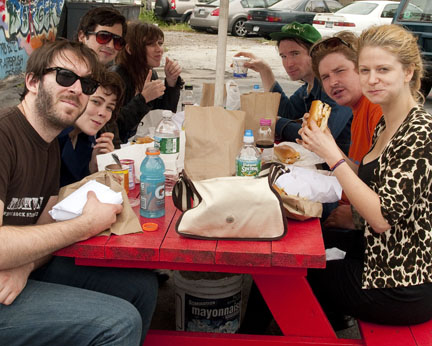
Eating lunch with the Darlins in the Bronx.
So I’m back! It was a blast and I’d do it all again in heartbeat. I don’t have time to give a full rundown, but quite possibly the most memorable moment was realizing that a tornado was hitting Brooklyn while Those Darlins were soundchecking in Bowery Ballroom. Here’s the official weather report from the NWS. Needless to say, tornadoes are pretty rare in NYC. Thankfully we were in Manhattan while all this was happening. Those Darlins have some great new songs on their new record, and their setlist for this tour is mostly those new songs, peppered with the favs from their debut, and the free single “Nightjogger” which you can download at the Nashville Cream. Basically they’ve taken on a bit more of a pure rock & roll character, and drummer “Sheriff” Linwood Regansburg has taken on a much more prominent role in the songwriting, and even sings on one of the new songs, though they’re not yet playing that song live. Stay tuned for more on them and more on the results of my photo documentary project.
Meanwhile, here are some awesome things I came across while catching up on all my RSS feeds:
Vaccines absolutely, beyond a shadow of a doubt, do NOT cause autism. A new study explored every possible way that thimerosal containing vaccines (TCVs) could be linked to autism and there was none. Absolutely no connection whatsoever; the same findings as the many other studies that have been done to investigate the claims of the anti-vax crowd. In fact, the result hinted that the administration of TCVs between birth and 7 months may actually reduce the risk of autism. It’s very simple, get your kids vaccinated! If you don’t, you are a threat to public health. Vaccines are one of mankind’s greatest scientific breakthroughs and have saved countless lives. There will always be a miniscule (and utterly negligible) risk of a bizarre allergic reaction or other complication, as there is with any medication or vaccine, but that risk is far, far, FAR outweighed by the benefits. And those risks have now been proven once and for all NOT to include autism.
A pair of astronomers have made an official prediction that the discovery of the first truly earth-like exoplanet will happen in less than a year– May of 2011. They used a well-known methodology called Scientometrics to make this prediction. I’d venture to say that to me, nothing in the field of astronomy, or even science in general, is more exciting than the very likely possibility of life on other planets. The discovery of the first true earth twin is a major step in that path. I really hope this prediction comes true.
Five awesome facts about NASA’s next robotic mission to Mars, the Mars Science Laboratory (a.k.a. Curiosity) which will launch in late 2011.
23 amazing photographs from the 1940s and 50s of nuclear bomb tests conducted by the US Military. This New York Times photos series is utterly fascinating, mainly because of images 5 through 7. Most of us have seen plenty of images of the mushroom clouds created by nuclear blasts, but those 3 images are unlike anything I’ve ever seen before. They were taken with a super high-speed camera and literally captured the blast at the very instant the explosion began. If I saw this image out of context I would probably think it was a microscope image of some sort of virus. The amazing irony here is that both a virus and an atomic bomb are incredibly destructive, yet in such completely different ways.
The actual scale of the observable universe, from the smallest possible thing the largest possible thing, is utterly impossible for the human mind to comprehend. Mathematicians came up with the concept of “orders of magnitude” to help with this, but I say it’s still impossible for any human to really grasp. But this fun little interactive Flash animation is pretty cool way of displaying the concept. (Via Dr. Neil deGrasse Tyson’s Twitter)
 A massive grin sprawled across my face as I read this Nashvillest post about the upcoming “Way Late Play Date” nights at the Adventure Science Center. “Best idea ever” is an understatement. It’s been at least 15 years since I’ve been to that place- then it was called Cumberland Science Museum I believe- and I’ve wanted to go back ever since moving to middle TN in 2000. I’m quite sure I’m not the only one who’s wanted to go but felt like I’d get in the way of all the kids if I went without having my own kids. Some genius in their event planning dept. must’ve realized this and come up with the idea for this event. It’s a 21+ event, which will include 2 alcoholic drinks in the $15 ticket price. Booze+science is a winning combination in my mind. I just really hope some dumbass doesn’t get wasted and then hurl while in the moonwalk simulator. Oh, and you can also get a discount by buying 2 tickets together for only $25. The dates are June 24th and July 27th. Embrace your inner nerd and get tickets here before they sell out! (Megan & I will be there June 24th.)
I’ve written many blog posts about NASA’s Kepler Mission here early last year around the time it launched, but it’s been a while since I mentioned it. The spacecraft has been silently staring into the heavens looking for minuscule dips in stars’ brightness which may indicate a transiting planet orbiting said star. Now that it’s been over a year since its first observations, NASA is obligated by law to release the data to the public for further scrutinization. Astoundingly, Kepler has produced a list of 750 candidates for exoplanets. This is a massive list, considering the current list of known exoplanets is at about 450. I say “candidates” because these are not confirmed exoplanets yet, they are data sets that could indicate exoplanets, but those stars need further review and observation by other telescopes to confirm that the dips in their brightness was definitely caused by a transiting planet. This could take years, because in some of the cases, another transit will have to be observed to confirm that it’s indeed a planet. Nevertheless, this is very exciting news, and I have absolutely no doubt that at least one of these candidates will turn out to be the holy grail of planet-hunting: an earth twin. Read more about this at Universe Today, and even more at the NY Times.
Now behold the most badass kid ever. He had his tooth pulled by a rocket. (You may think this is a bit cruel, but I’m positive that the tooth was a baby tooth that was on the verge of falling out anyway.) (Also via Universe Today)
Shuttle Mission update/new Apple tablet/Life on Venus?
July 28, 2009

I agree with Yewknee- Day. Made.
Ok, now that you’ve been properly entertained by that photograph thanks to Yewknee’d, let’s get on with the good stuff.
Rumors have been spreading like wildfire for months that Apple will be releasing a new tablet device that could revolutionize mobile entertainment. According to this article on Financial Times, (via Kottke) it’s looking like the device will be released this fall, just in time for the Holiday shopping season. If this thing is as good as it sounds, Apple’s REALLY gonna cash in, and if it flops, their public image will be severely tarnished. But I have no doubt they will succeed with this in the same way they succeeded with the iPhone, save for that minor pricing debacle when it first came out. It seems to me that this thing will be an iPod Touch on steroids. Having just bought a new Macbook Pro, I sure as hell won’t be able to cough up the cash for one of these, but I can’t wait to go play with them at the Apple Store!
Space Shuttle Endeavour undocked from the ISS today after successfully installing the newest Japanese component. The shuttle is scheduled to land at the Kennedy Space Center this Friday at 10:47am EDT, weather permitting. (Via Space.com)
There’s been a lot of speculation about the possibility of life on Mars and more recently, life on Saturn’s moons Titan and Enceladus, and Jupiter’s moon Europa. But not since the 50’s have we ever thought that life could exist on Venus. People used to think Venus might have a climate somewhat like a tropical paradise, but that notion came to a screeching halt when scientists discovered that its surface is basically a good approximation of hell. Its surface temperature is over 860 degrees Fahrenheit, the atmospheric pressure is 92 times greater than Earth’s and made of mostly CO2 and laden with sulfuric acid clouds. But recent research has shown that it’s possible that microbial life could thrive in conditions found in the upper atmosphere of Venus. We continually discover life in places on Earth once thought to be utterly inhospitable, so it’s no longer such a stretch to imagine life surviving in such extreme environments as are found in Venus’ upper atmosphere. Scientists think that Venus was once much more Earth-like, and even had oceans. But what’s commonly referred to as a “runaway greenhouse effect” took over and caused the planet to heat up enough to boil away all water on the surface and create the hellish environment we see today. It’s possible that primitive life may have emerged during the planet’s more hospitable past and had time to evolve, adapt, and escape to the planet’s outer atmosphere where it could survive. (Via Daily Galaxy)
Kepler’s first images/Green rooftops/hipster grifter
April 17, 2009

Image via Space.com
The Kepler spacecraft took its first few images earlier this week, and NASA has released them. The one shown here is zoomed in on a small cluster of stars about 13,000 light years from Earth. Kepler has a 95 megapixel camera to take these images. 95 megapixels. Fuck.
An awesome new concept is emerging in some of the world’s largest cities- green rooftops. It’s a concept that I sincerely hope catches on quickly. Typical building rooftops are dark and dry; they absorb and then release much more heat than a natural plant-covered surface would, and the result is what’s called the “heat-island effect.” This phenomenon is what causes some large cities to be a few degrees hotter than the surrounding areas, and it’s a growing problem. But if we cover most of the city rooftops with gardens and grass, this problem would be virtually eliminated. Please check out this National Geographic article on the subject… not only for the story but for the awesome photography.
Will humans ever be able to travel beyond our solar system? Or will we just resort to armchair astronomy and send an army of intelligent robots to other worlds to explore them for us? The question is tackled in this great article by Luke McKinney from the Daily Galaxy. It’s a short and entertaining read, as all of McKinney’s witty posts tend to be.
The new Harry Potter movie comes out July 15th, and the trailer has just hit the interwebs. I first saw it on this io9 post.
Carles of Hipster Runoff had an encounter with the now somewhat-famous hipster grifter, who brought her cancer/pregnant/sex fraud scheme from Salt Lake City to Brooklyn scammed quite a few hipsters out of a lot of money.
As I said yesterday, I’ll be photographing Rites of Spring this weekend, but there’s also a TON of other great stuff going down, most notably National Record Store Day on Saturday, for which Grimey’s is hosting their Big Ass Outdoor Sale. Be sure to stop by between 10am-8pm and check out the great record deals and live music out in the parking lot. A list of some other stuff happening can be found at Nashvillest. Have a great weekend!
Kepler mission launch a success!
March 7, 2009
Just a quick weekend update: NASA’s Kepler Mission launched successfully last night aboard a Boeing Delta II rocket! It’s now headed toward its final orbit where it will trail earth’s path around the sun hunting for other worlds like our own. Read full details at Universe Today. Happy Hunting!

 steve cross loves music and science