Today is Yuri’s Day/Night
April 12, 2011
 50 years ago today, the USSR beat the US in the first milestone of the space race: they put the first human, Yuri Gagarin, into space. Gagarin’s accomplishment is celebrated each year in a series of “Yuri’s Night” parties. Obviously this year is a big deal, since it’s the 50th Anniversary, and not only does Discovery News have a gallery of photos from various Yuri’s Night parties around the globe, but this story also clued me into something I didn’t yet know about- a feature length film by director Chris Riley that attempts to re-create what Yuri would have seen from his capsule. Audio from the flight has been released, as have video clips of Gagarin’s face during the flight, but no video of the earth below was taken during the flight. So, Riley teamed up with Italian astronaut Paolo Nespoli to capture video footage from the International Space Station’s Cupola as the passed over the same areas Gagarin’s capsule did during that first flight. Check it out on YouTube here.
30 years ago today, the US reached another milestone, coinciding with the 20th anniversary of Gagarin’s flight- they launched the first space shuttle flight. It was shuttle Colombia, with astronauts John Young and Robert Crippen on board. Thus it’s only fitting that today, during a ceremony celebrating 30 years of shuttle flights, NASA will announce the final resting places of the 3 remaining shuttles after they’re decommissioned. Many museums and towns with history tied to the space program have made their cases for getting one of the shuttles, but it’s expected that one will go to the Smithsonian and another to the Kennedy Space Center visitor complex. Beyond that, it’s anyone’s guess, but I have a feeling the 3rd will go to Houston, as it’s home to NASA’s mission control. (Update: the announcement was just made, and Discovery goes to the Smithsonian, Atlantis goes to Kennedy Space Center, and Endeavour goes to the California Science Center in L.A.) This celebration at KSC is just getting underway as I type this at 11:50am CDT, and the announcement regarding the shuttles’ destinations is scheduled for 3pm EDT (2pm here in Nashville). Watch it all at NASA TV if you’re interested. I’ll update this post after the announcement is made.
Thundersnow/new rocket for NASA
February 9, 2011
Thundersnow is possibly the coolest-sounding meteorological term I can think of. It happens very rarely, but when it does it’s awesome. Convection strong enough to cause lighting during a snowstorm is simply amazing, as are most things that rare. Through a ridiculous stroke of luck, scientists in Huntsville, AL got a rare opportunity to study this bizarre phenomenon in-depth. As you may know, Huntsville is home to NASA’s Marshall Space Flight Center. There are meteorologists and other scientists there with a barrage of better-than-average instruments that monitored the inner-workings of the snowstorm that hit the area Jan. 9th. They got the most thorough data ever recorded for thundersnow, and observed one bolt of lightning that traveled a whopping 50 miles horizontally before hitting the ground. The fact that such a rare and interesting phenomenon happened right on top of a facility so well-equipped to study it is quite remarkable, and those scientists were very excited to be able to study the thundersnow in such great detail. I look forward to seeing what is learned from this experience. (Via Discovery News)
NASA has been presented with yet another viable commercial option for replacing the Space Shuttle’s role of ferrying astronauts to and from the space station, as well as carrying cargo. A U.S. company called Alliant Techsystems teamed up with Europe’s Astrium to draft the proposal for a new rocket called Liberty. This new rocket would combine research of the now-dead Constellation program with the proven components of the European Space Agency’s Ariane 5 launch system. Since this collaborative effort combines mostly well-proven technology, it would be both cheap and relatively quick to build, shortening the problematic gap between the last Space Shuttle flight and the first availability of commercial access to space. If it truly will shorten said gap, I’m all for it. I hope it’s really as good as it sounds, but things like this always run into unforseen problems/delays. Right now, SpaceX still has the edge simply because it’s already had 2 very successful tests of its launch system, the Falcon 9 rocket and Dragon capsule. But Liberty could give SpaceX a run for their money. Check out the promo video below. (Via Universe Today)
Space X successfully launches & recovers Dragon Capsule
December 8, 2010
 This morning Space X launched the first full version of their Dragon capsule atop a Falcon 9 rocket. The company’s rocket underwent a successful test launch back in July, and this launch successfully put their Dragon capsule into orbit. The capsule orbited earth for about 3 1/2 hours, then re-entered the atmosphere and splashed down in the Pacific Ocean, where it will be recovered later this afternoon. This was the first successful commercial spaceflight involving re-entry and recovery. The Dragon capsule is under contract to NASA to carry cargo to the International Space Station. Space X is in a battle to also win a contract from NASA to ferry astronauts to and from the ISS once the Space Shuttle is retired next year. A slightly different version of the Dragon capsule would be used for this, atop the same Falcon 9 rocket. This test’s success puts Elon Musk’s Space X much closer to that goal.
I am quite confident that Space X, or whatever other commercial spaceflight company that wins the NASA contract, will be able to cheaply and safely get our astronauts to and from the ISS. There is absolutely no reason NASA should devote more than basic oversight and money to this task. What NASA needs to focus its efforts on now is going beyond the ISS- to asteroids, to Mars, and even farther than that.
In other news, Mozilla has adopted two Red Pandas (aka firefoxes) and is streaming their activities live at http://firefoxlive.mozilla.org. What’s most awesome about this is that they’re being kept at the Knoxville Zoo, right here in Tennessee. I DARE you to watch the videos of them and not smile. (Via Candice Burnside)
Energy and space science rant
September 2, 2010
 Rant time.
In case you haven’t been paying attention to the news, there was ANOTHER FUCKING OIL RIG EXPLOSION IN THE GULF. Which is why I’m going to now rant about how terrible fossil fuels are. There is nothing good about them as an energy source. They are filthy/pollute the environment, they’re inefficient, and most importantly they are FINITE. We will run out of them. Thankfully this particular explosion doesn’t seem as though it will cause more oil to gush into the Gulf of Mexico, but they aren’t sure yet. I firmly believe that every nation and every energy company in the world should be focusing 100% of their efforts on ways to eliminate the use of fossil fuels as an energy source as FAST AS POSSIBLE. As long as the world is still relying on them, we are speeding straight down a highway that ends with world wars the likes of which have never been seen, and possibly the end of the human race. Our use of fossil fuels will either lead to so much pollution that the entire ecosystem will collapse, or they will become so scarce that the entire world will go to war fighting over them. The very survival of our species could rely on finding a way to 100% renewable energy. Whether it be from the sun, the wind, the ocean, whatever… 100% renewable and clean energy as soon as possible MUST be the absolute goal, and we must stop at nothing to get there. There are lots of other uses for oil than energy, and dare I say those are probably a necessary evil, at least for a while- virtually all plastic is made from it, along with a host of other things, but those pale in comparison to how much is used for energy. I have no doubt technology will get to a point where we don’t need oil for manufacturing either, but energy should be our #1 priority.
Now for my space rant:
A group of spaceflight’s elite sent a letter to Congress yesterday urging the House Science & Technology Committee to revamp its NASA authorization bill. The group, composed of former astronauts, space industry veterans, and former NASA officials, are asking Congress to make their version of the bill look more like the Senate version, which is much closer to Obama’s initial budget recommendation which was announced in February. Unfortunately middle TN’s own Bart Gordon is the head of said committee. Yo Bart- I expect more from you than this. Look at the facts- Obama is right! I’ve said this many times on here before and I’ll say it again: NASA needs to focus its efforts on exploration beyond low-earth orbit and the moon. The private spaceflight industry is more than capable of taking over the job of getting our astronauts to and from the International Space Station, and can be capable much sooner than NASA could using its currently-under-development Constellation Program. But they need the help of NASA in the form of $$$. Less $$$, mind you, than we would spend on Constellation. We will never see the kind of innovation and progress again that we saw from NASA in the 1960’s unless their goals are ambitious and lofty. Putting a man on an asteroid and eventually on Mars should be the new main goal of NASA’s manned spaceflight program, and exploring the moons of Jupiter and Saturn should be the main goal of the unmanned (robotic probe) programs. Those are the kind of ambitious goals that will bring back the kind of innovation and tenacity of the 1960’s. Only this time it will be scientifically driven, not driven by a race to get to the moon before the Russians.
Rant: over.
Senate and House pass bills for future of NASA
July 22, 2010
 The Senate and the House of Representatives have both passed their own versions of Obama’s proposed budget for NASA. As I’ve mentioned here before, Obama’s plan to abandon the Constellation program and leave American access to low earth orbit in the hands of the private sector was met with a good bit of criticism, both from Republicans and Democrats alike. Though I supported (and still support) his initial plan, I figured we would end up with some sort of compromise in the end. Not surprisingly, that’s where we’re headed now that the Senate and House versions have come out. I don’t have the time nor the willpower to type out the gritty details of the differences, but in a nutshell, the Senate wants to extend the space shuttle by another mission or two, slash funding for commercial space companies in half, accelerate the development of a heavy-lift rocket based on current shuttle booster technology, and slash funding of research into advanced technologies. For a more detailed comparison between Obama’s plan and the Senate plan, check out this article on Universe Today.
The House plan, which was issue by the House Science and Technology Committee (chaired by TN’s own Bart Gordon) is even worse. They want to slash funding for development of commercial access to low earth orbit by MUCH more than the Senate version, and like the Senate they want to speed up development of a heavy-lift rocket. The biggest problem is that the House version essentially brings back Constellation. For more detailed info on the House version, check out this article on Space.com.
I’m by no means a politician or an economics expert, but I’m firm in my belief that if NASA keeps focusing money and effort on access to LEO/the ISS, then we are spinning our wheels and making no progress. NASA cannot keep funding and worrying about getting our astronauts to and from the ISS AND worry about/fund our exploration into the rest of the solar system at the same time.
 A massive grin sprawled across my face as I read this Nashvillest post about the upcoming “Way Late Play Date” nights at the Adventure Science Center. “Best idea ever” is an understatement. It’s been at least 15 years since I’ve been to that place- then it was called Cumberland Science Museum I believe- and I’ve wanted to go back ever since moving to middle TN in 2000. I’m quite sure I’m not the only one who’s wanted to go but felt like I’d get in the way of all the kids if I went without having my own kids. Some genius in their event planning dept. must’ve realized this and come up with the idea for this event. It’s a 21+ event, which will include 2 alcoholic drinks in the $15 ticket price. Booze+science is a winning combination in my mind. I just really hope some dumbass doesn’t get wasted and then hurl while in the moonwalk simulator. Oh, and you can also get a discount by buying 2 tickets together for only $25. The dates are June 24th and July 27th. Embrace your inner nerd and get tickets here before they sell out! (Megan & I will be there June 24th.)
I’ve written many blog posts about NASA’s Kepler Mission here early last year around the time it launched, but it’s been a while since I mentioned it. The spacecraft has been silently staring into the heavens looking for minuscule dips in stars’ brightness which may indicate a transiting planet orbiting said star. Now that it’s been over a year since its first observations, NASA is obligated by law to release the data to the public for further scrutinization. Astoundingly, Kepler has produced a list of 750 candidates for exoplanets. This is a massive list, considering the current list of known exoplanets is at about 450. I say “candidates” because these are not confirmed exoplanets yet, they are data sets that could indicate exoplanets, but those stars need further review and observation by other telescopes to confirm that the dips in their brightness was definitely caused by a transiting planet. This could take years, because in some of the cases, another transit will have to be observed to confirm that it’s indeed a planet. Nevertheless, this is very exciting news, and I have absolutely no doubt that at least one of these candidates will turn out to be the holy grail of planet-hunting: an earth twin. Read more about this at Universe Today, and even more at the NY Times.
Now behold the most badass kid ever. He had his tooth pulled by a rocket. (You may think this is a bit cruel, but I’m positive that the tooth was a baby tooth that was on the verge of falling out anyway.) (Also via Universe Today)
 Today President Obama will speak at the Kennedy Space Center and unveil his updated vision for space exploration to the public and to NASA. The original plan he put forth in Feb. was met with harsh criticism because it canceled the entire Constellation program and left the job of getting astronauts to the International Space Station and low-earth orbit entirely in the hands of private industry after the scheduled termination of the Space Shuttle program in 2015. A few days ago intentionally-leaked information hit the blogosphere and rumors abound about what his updated plan will look like. The biggest rumors are that he’ll be injecting an additional $6 billion over the next few years specifically targeted at development of a heavy-lift launch vehicle. This rocket would primarily be for getting parts of a larger spacecraft into orbit, and no doubt that larger spacecraft will be intended to take humans to Mars and other solar system destinations. The other big rumor is that he wants to bring back one component of the gutted Constellation program- the Orion crew capsule. Instead of being the primary method of getting US astronauts to the ISS, however, it will simply serve as a US escape capsule attached to the ISS. This would alleviate the problem of US astronauts relying on the Russian Soyuz capsule as an escape pod. More on these rumors can be found at Universe Today and Space.com.
I will be watching the live coverage of Obama’s speech on NASA’s website. The streaming video starts at 12:30pm CDT, and Obama’s speech is scheduled for 1:40pm CDT. I’m looking forward to seeing just what he has in mind and how well he sells the idea to the skeptics and naysayers.
For the record, as I’ve said before, I’m totally behind his plan, and not just because I’m a liberal and I voted for him. NASA has gotten into a rut ever since the Apollo era, mostly due to political bullshit. They’ve done some awesome stuff, but the drive to explore new horizons has largely been lost. With the budding new private spaceflight industry there’s no reason why NASA can’t utilize them to do the simple, routine tasks of getting us to the ISS and low-earth orbit. NASA would be spinning its wheels and wasting money to focus on that task. To fulfill its original purpose, NASA need to focus its efforts getting us further into our solar system- Mars, asteroids, and robotic explorations to places like Saturn’s moons Titan and Enceladus, and Jupiter’s moon Europa, all of which have exciting potential as homes for microbial extraterrestrial life.
So tune in to Obama’s speech at 1:40 today, and in the meantime, check out astronomer Neil Degrasse Tyson’s comments on NASA’s future, from a recent Q & A session at the University of Buffalo.
(Via Bad Astronomy)
Credit: NASA
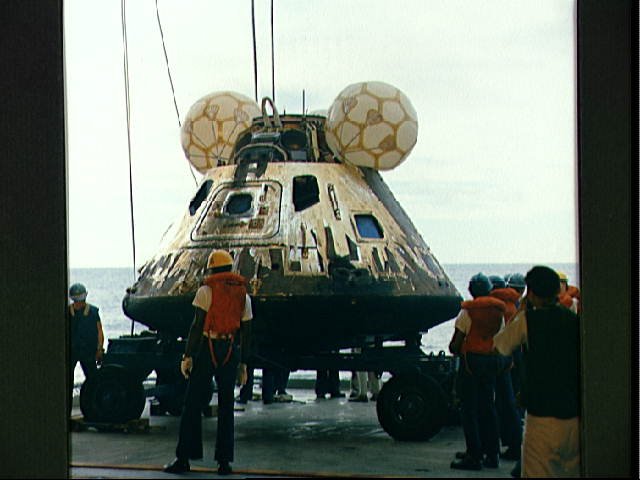
Universe Today is currently running a pretty cool blog series called “13 Things That Saved Apollo 13.” They talked to NASA engineer Jerry Woodfill who came up with 13 key things that led to their survival. Yesterday’s post was part 2 of the series, focusing on the hatch between the Command Module and lander that wouldn’t shut initially. This malfunction actually turned out to be a blessing, because if they’d been able to shut it, it would’ve slowed down the later efforts that were vital to their survival. I look forward to the rest of this series.
One day over the weekend my girlfriend pointed me to an article about an east TN father who asked the Knox County schoolboard to remove a biology textbook that uses the phrase “the biblical myth that the universe was created by the Judeo-Christian God in 7 days” (regarding creationism) from its curriculum. That sounded like just the type of thing Dr. Phil Plait of Bad Astronomy would pick up, and sure enough he did. Thankfully the board and review committee is standing behind the book and it will remain in the curriculum. Let me re-iterate how important it is that creationism stay out of public school curricula- IT IS UNCONSTITUTIONAL. These are public schools! The separation of church and state is crucial to our democracy and teaching anything from the Bible as a viable scientific theory in public schools is a clear violation of that. This book states that the story of creation in the Bible is a myth, and by strict definition that is completely true. I would even say that the statement doesn’t go far enough. It should go on to say that creationism is simply not true. Decades of research and cold, hard scientific evidence have proven beyond any and doubt that our planet and solar system is roughly 4 billion years old. The stories in the Bible are parables that have absolutely no scientific basis. Let’s keep them out of scientific discourse in the classroom, because they are NOT SCIENCE.
New views from space station/cold weather and global warming rant
February 18, 2010
Warning: I’m about to rant.
If I hear one more person say “look at this winter and all this snow… global warming… yeah right” I’m going to punch them in the fucking face. If you believe for one second that this winter’s excessive snow and cold weather in the southeastern US proves global warming is a myth, then you are simply solidifying your incredible ignorance and utter stupidity. There is a big difference between the terms “weather” and “climate.” Weather refers to the day-to-day changes in precipitation, temperature, barometric pressure, wind, etc… Climate refers to long-term, general trends in weather. We’re talking decades and centuries. That’s why global warming is referred to as “climate change,” not “weather change.” We will still have variations in seasons, even as global warming continues. Some winters will be colder and snowier than others, and some summer will hotter and drier than others. Some springs will be stormier, and some falls will have more hurricanes. These small-scale variations can be affected by long-term climate change, but there are many MANY other factors that come into play with small-scale weather events. One thing you may not realize about this winter (if you’re from anywhere east of the Mississippi) is that while we’ve had a cold, snowy winter in the east, most areas in the American west have had a very warm, dry winter. This is why there have been so many problems with Olympics. The mountains around Vancouver have not had as much natural snow as usual, and it’s also been warmer than usual. The direct reason for this winter’s weather is best described as a perfect combination of El Nino and the Arctic Oscillation. The AO is in a more negative phase this year than it has been in decades, which means the cold air at the northern latitudes is dropping farther southward into the US. This, combined with the very active and moist southern jet stream (which resides mostly over Mexico, Texas, and into the Gulf states), has resulted in a snowy winter for the southeastern US. This does NOT mean global warming is false! The average GLOBAL temperature is still warmer than normal. All this is explained in a much-less rant-y fashion at the Weather Underground blog. More details about the negative AO can be found in this AccuWeather article. Hey, Sen. James Inhofe, you just proved your massive ignorance and incompetence with your little igloo stunt next to the Capitol.
Rant over. Now for some much more pleasant science goodies…
The latest shuttle mission to the ISS, still in progress, delivered the new Tranquility node with a huge 7-panel window called Cupola, which was officially opened on Wed. Check this article on Universe Today for more details and to see pics of it. Look for many spectacular photos from this window to be released soon.
What would normally be a fairly unimpressive, routine rocket launch turned into a spectacular event last Thursday. NASA’s Solar Dynamics Observatory satellite launched on top of an Atlas V rocket. What makes this so special is the amazing coincidence of the rocket’s sonic boom (created as it surpasses the speed of sound) with its passage through the cirrus cloud layer. The weird looking ripples you see at about 1:50 into the video below are REAL. It looks like some kind of computer effect, but it’s NOT. There are still shots of them as well. What’s even more amazing is that another atmospheric phenomenon called a sun dog was happening at the time as well, and it appears that the sonic boom disrupted the ice crystals in the cloud, destroying the sun dog. All this via Bad Astronomy.

 steve cross loves music and science