Energy and space science rant
September 2, 2010
 Rant time.
In case you haven’t been paying attention to the news, there was ANOTHER FUCKING OIL RIG EXPLOSION IN THE GULF. Which is why I’m going to now rant about how terrible fossil fuels are. There is nothing good about them as an energy source. They are filthy/pollute the environment, they’re inefficient, and most importantly they are FINITE. We will run out of them. Thankfully this particular explosion doesn’t seem as though it will cause more oil to gush into the Gulf of Mexico, but they aren’t sure yet. I firmly believe that every nation and every energy company in the world should be focusing 100% of their efforts on ways to eliminate the use of fossil fuels as an energy source as FAST AS POSSIBLE. As long as the world is still relying on them, we are speeding straight down a highway that ends with world wars the likes of which have never been seen, and possibly the end of the human race. Our use of fossil fuels will either lead to so much pollution that the entire ecosystem will collapse, or they will become so scarce that the entire world will go to war fighting over them. The very survival of our species could rely on finding a way to 100% renewable energy. Whether it be from the sun, the wind, the ocean, whatever… 100% renewable and clean energy as soon as possible MUST be the absolute goal, and we must stop at nothing to get there. There are lots of other uses for oil than energy, and dare I say those are probably a necessary evil, at least for a while- virtually all plastic is made from it, along with a host of other things, but those pale in comparison to how much is used for energy. I have no doubt technology will get to a point where we don’t need oil for manufacturing either, but energy should be our #1 priority.
Now for my space rant:
A group of spaceflight’s elite sent a letter to Congress yesterday urging the House Science & Technology Committee to revamp its NASA authorization bill. The group, composed of former astronauts, space industry veterans, and former NASA officials, are asking Congress to make their version of the bill look more like the Senate version, which is much closer to Obama’s initial budget recommendation which was announced in February. Unfortunately middle TN’s own Bart Gordon is the head of said committee. Yo Bart- I expect more from you than this. Look at the facts- Obama is right! I’ve said this many times on here before and I’ll say it again: NASA needs to focus its efforts on exploration beyond low-earth orbit and the moon. The private spaceflight industry is more than capable of taking over the job of getting our astronauts to and from the International Space Station, and can be capable much sooner than NASA could using its currently-under-development Constellation Program. But they need the help of NASA in the form of $$$. Less $$$, mind you, than we would spend on Constellation. We will never see the kind of innovation and progress again that we saw from NASA in the 1960’s unless their goals are ambitious and lofty. Putting a man on an asteroid and eventually on Mars should be the new main goal of NASA’s manned spaceflight program, and exploring the moons of Jupiter and Saturn should be the main goal of the unmanned (robotic probe) programs. Those are the kind of ambitious goals that will bring back the kind of innovation and tenacity of the 1960’s. Only this time it will be scientifically driven, not driven by a race to get to the moon before the Russians.
Rant: over.
NASA’s Kepler Mission discovers multi-planet system in Milky Way
August 26, 2010

Credit: NASA/Ames/JPL-Caltech
NASA’s Kepler Mission released its first official findings today at press event. These are the first fully confirmed exoplanet discoveries by the mission, and there will be many more confirmations coming down the pipe no doubt. This system isn’t quite as exciting as I’d hoped… on Tuesday I read that NASA was planning a press conference to announce Kepler’s findings so naturally I was hoping they’d found a planet similar to earth, but I seriously doubted the news would be that exciting. I’d say it’ll be at least another year before any earth twins are confirmed, because obviously an earth twin would have an orbital period close to 1 earth year, and multiple transits would be needed to confirm it as a planet.
The system discovered is the first multi-planet system confirmed using the transit method (measuring the dip in light seen from a star as a planet crosses between us and the star). It has two Saturn-sized planets and possibly one “super earth,” a planet roughly 1.5 times the size of earth. This smaller planet has not been confirmed, however, so it’s still just an “exoplanet candidate.” Furthermore, they say the smaller planet is VERY close to the star, completing an orbit in only a matter of days. This means the planet would be scorchingly hot and quite unsuitable for any kind of life. While not the “holy grail” of planet-hunting, these findings confirm that the techniques and devices being used to hunt for exoplanets are indeed working, and that we’re well on our way toward finding that illusive earth-twin. (Via NASA)
Sun sends blast of particles due to arrive tonight
August 3, 2010
 The above image was taken just as our Sun belched a Coronal Mass Ejection (CME) in our direction on sunday night. This blob of charged particles are already beginning to interact with the earth’s magentosphere, and will likely result in some spectacular aurorae for the northern latitudes as the brunt of it arrives tonight and tomorrow morning. This is the first large scale activity the Sun has seen in several years, as it has been at the low-point of its 11-year cycle of sunspot activity. Events like this will slowly become more common over the next 3 or 4 years as the sun reaches its next peak in activity around 2012-2013. This is NOT any kind of major disaster, though it may cause a few glitches with satellites, as any CME event is prone to do. Unfortunately TN is way too far south to see any of the auroral activity, but if you’re in the northern US you might be able to see it. It is possible for aurorae to be seen this far south, but it’s very rare and requires a very powerful solar storm, such as the one from April 2001 (the last solar maximum) which made aurorae visible as far south as Texas. Such an event is possible as we head toward this next solar maximum, but I wouldn’t count on it. This upcoming maximum is expected to be about half as intense as the last one. (Via Space.com and Universe Today.
Here’s a video of the current CME when it first erupted sunday night.
Facts and myths about the Kepler exoplanet cadidates
July 29, 2010
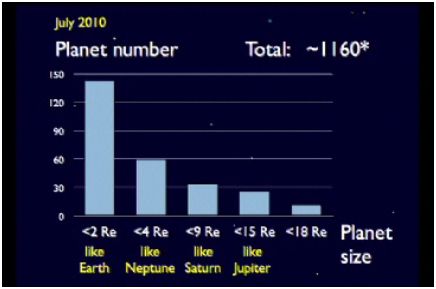
Screenshot from Sasselov's talk
So there’s been a bit of a media buzz lately about the possibility that the Kepler space observatory may have discovered 100’s of earth-like planets orbiting other stars in our galaxy. Recently at a TED talk, one of the chief investigating scientists on the Kepler team, Dr. Dimitar Sasselov, mentioned that the team had found “candidates” for “earth-like” worlds, “that is, having a radius smaller than twice Earth’s radius.” Many mainstream media outlets have twisted this into reports saying that we’ve found 100’s of earth-twins (having an atmosphere, liquid water, etc…) orbiting other stars.
First of all, we HAVE NOT confirmed ANY of these as exoplanets yet. It will take considerable follow-up observations by other telescopes to confirm these as exoplanets, and not glitches or other phenomena that look like a transiting exoplanet. Also, the phrase “earth-like” as he used it simply means that it’s similar in size to earth. Just because an exoplanet is similar in size and composition to earth does not mean it is habitable. In fact, most of the exoplanet candidates have fast orbits and are very close to their parent star (which is why they were detected so quickly). This would make them much more akin to Mercury or Venus- both of which are far too hot to sustain life. The true earth-like exoplanets (that are in the habitable zone, have a similar radius, and could potentially harbor life) will take at least another year to discover, simply because they have longer orbital periods- closer to 1 year. Most of this information was culled from Dr. Sasselov’s NASA blog post in which he clarifies what he was saying in his talk. For even more info, check out Universe Today.
Don’t get me wrong, I’m incredibly excited about this mission, but I’m not going to pop the champagne cork until those scientists issue an official press release saying something like, “YES, we have definitely PROVEN that planet earth is not unique, and our galaxy is filled with small, rocky planets orbiting within the habitable zone of their parent stars.” That is a day I’ve dreamed of ever since I was a little boy fascinated by astronomy programs on the Discovery channel and the X-Files. There has been tons of speculation on this matter, but until now there was no solid, observational evidence to PROVE it.
Some random weather tidbits
July 26, 2010
I find it interesting that while this July is shaping up to be one of the hottest on record (duh, just walk outside), just 1 year ago we were experiencing one of the coolest Julys on record. More on that at the National Weather Service.
That cool summer was followed by a cool winter as well, and though it’s hard to even think about snow right now, it was also one of the snowiest winters on record for most of the eastern US. I mentioned this once before, but a new study confirms the findings that last winter’s brutality was due to the convergence of 2 things- El Nino and a negative North Atlantic Oscillation. The former usually brings more precipitation to the southeastern US, and the latter usually brings colder air to the southeastern US. (Via EurekAlert)
I haven’t mentioned beer on this blog in a while… so here’s whats up with my homebrewing endeavors: I currently have a batch of northern English brown ale in the bottles carbonating. Haven’t tasted it yet but they should be ready to drink this coming friday. I’m about to start another batch of the ESB/Pale Ale hybrid that I made in May. That was by far the best batch of beer I’ve made, and it will be the first one I’ve repeated. I’m still not to the point of all-grain brewing yet, as I haven’t built a mash tun. It’ll happen soon though.
Dr. Phil Plait gets own TV show on Discovery
July 23, 2010
 Pardon me while I totally nerd-out for a minute… but I must share some news that made me very happy this morning. I first saw this in a tweet from Dr. Neil de Grasse-Tyson. Dr. Phil Plait- astronomer, author, blogger, and relentless promoter of real science and reality in general- is getting his very own show on the Discovery Channel. I’ve been a big fan of his ever since discovering his blog Bad Astronomy. He’s been mentioning a so-called “sooper seekrit project” in his posts for about a year now, and this must be what he was referring to. I get the feeling that there was some sort of miscommunication between him and the powers-that-be at Discovery, because all the tweets and mentions about this new show lead back to this YouTube video, which is basically a promo commercial/sneak-peek at the new series. However, he hasn’t yet mentioned it on his blog or even tweeted about it *update: he finally mentioned it on his blog here. Turns out it will only be a 3-part series… :(* . This doesn’t surprise me given the fact that he’s currently at Comic-Con. It looks like the show is going to take on a Mythbusters-esque vibe but mostly focusing on all the myths and junk science surrounding various doomsday/disaster scenarios such as asteroid impacts, comet impacts, gamma-ray bursts, and hopefully the ridiculous 2012 Mayan calendar myth. I honestly wouldn’t be the slightest bit surprised if Jamie and Adam of Mythbusters are producers of this show… or somehow otherwise involved with it.
No idea when this show will air, *the show will probably air this fall* but I’m definitely looking forward to it. Congrats, Phil!
Senate and House pass bills for future of NASA
July 22, 2010
 The Senate and the House of Representatives have both passed their own versions of Obama’s proposed budget for NASA. As I’ve mentioned here before, Obama’s plan to abandon the Constellation program and leave American access to low earth orbit in the hands of the private sector was met with a good bit of criticism, both from Republicans and Democrats alike. Though I supported (and still support) his initial plan, I figured we would end up with some sort of compromise in the end. Not surprisingly, that’s where we’re headed now that the Senate and House versions have come out. I don’t have the time nor the willpower to type out the gritty details of the differences, but in a nutshell, the Senate wants to extend the space shuttle by another mission or two, slash funding for commercial space companies in half, accelerate the development of a heavy-lift rocket based on current shuttle booster technology, and slash funding of research into advanced technologies. For a more detailed comparison between Obama’s plan and the Senate plan, check out this article on Universe Today.
The House plan, which was issue by the House Science and Technology Committee (chaired by TN’s own Bart Gordon) is even worse. They want to slash funding for development of commercial access to low earth orbit by MUCH more than the Senate version, and like the Senate they want to speed up development of a heavy-lift rocket. The biggest problem is that the House version essentially brings back Constellation. For more detailed info on the House version, check out this article on Space.com.
I’m by no means a politician or an economics expert, but I’m firm in my belief that if NASA keeps focusing money and effort on access to LEO/the ISS, then we are spinning our wheels and making no progress. NASA cannot keep funding and worrying about getting our astronauts to and from the ISS AND worry about/fund our exploration into the rest of the solar system at the same time.
Higgs Boson rumor/awesomeness
July 13, 2010
There’s been a lot of buzz lately about possible evidence of the elusive Higgs Boson, the so-called “God particle” being discovered at Fermilab’s Tevatron collider. Apparently some of the physicists have entertained the idea that an unexpected result from a recent particle collision experiment might possibly be evidence of the Higgs Boson, while others dismiss the idea. So, don’t go thinking that we’ve finally found the Higgs Boson (and not even at the LHC nonetheless) just yet. An official statement on the matter has not been released yet, and we have no clue what they found until that happens. So everyone just chill out for a minute until some official findings are released. All we know for sure now is there was an “unexpected result.” (Via Discovery News)
Now I must simply share a few things I’ve run across the past couple of days that are simply awesome:
–What the Fuck Should I Make for Dinner? Perfect for those “I don’t know what I want, what do you want?” times.
-Yazoo Brewing Co. may be switching to cans, but they want your input first. Weigh all the options before making your choice.
-Sam Kean of Slate is blogging the entire periodic table of elements. Nerd-out!
-And if this doesn’t make your day (and even week) infinitely better, then you are beyond help:

Humidity myths/other science-y tidbits
June 29, 2010
 If you live in TN, or even the southeast at all, you know damn well that it’s been hot and humid as hell lately. The entire southeast has been a sauna for several weeks in a row. You always hear people say stuff like, “man, it’s 90 degrees and 90% humidity out there!” Anyone with half a brain knows that’s a VAST exaggeration, but honestly the concept of humidity is a rather confusing one, and even some meteorologists don’t explain it very well. I’m not going to attempt to fully explain it because it’s already been done quite well at this Cincinnati meteorologist’s website. Please click through that link if you want a very detailed, but still in layman’s terms, explanation. Read on if you want my extremely condensed version.
Basically, in terms of actually knowing how much water vapor is in the air, relative humidity sucks. In order to really know how humid it is, and how uncomfortable you will be, look at the dew point. The dew point is simply the temperature at which the water vapor in the air will begin to condense. The higher the dew point, the more H2O is in the air. According to most charts that I’ve found, dew points in the 40-50 degree range feel very dry, like you would feel in a desert… Dew points between 50-60 degrees generally feel comfortable, dew points between 60-70 degrees are generally uncomfortable, and dew points 70+ degrees are utterly oppressive. Yesterday afternoon our dew point in Nashville was hovering around 70-72 degrees. Relative humidity takes into account the air temperature as well as the dew point, and the relationship between temperature and RH is inverse. That means that as the air temp goes up, the RH goes down. Of course the relationship between dew point and RH is converse. Again, if you want a really good, albeit long explanation then visit this website. Fortunately, TN is in for a bit of a relief from the oppressive conditions we’ve been enduring. Cold fronts during the summertime aren’t exactly “cold” though they do normally bring slightly cooler temps, but the main thing they usually bring is a drier airmass. The typical summer weather pattern in the southeast US often involves hot and humid air from the Gulf of Mexico being blown northward across the southeastern states, creating the conditions we’ve been experiencing the past few weeks. Sometimes, however, an airmass that originates over the northern US and Canada will make its way southward. That’s exactly what’s happening today, and the dew point is already falling (this morning it was 68, and right now at lunchtime it’s all the way down to 61!). This airmass is drier because it originated over a large area of land, rather than water. All forecast I’ve seen are in agreement that the dry weather will persist for at least a week, if not more, though the temps will creep back up into the 90s by this weekend. But 90 degree temps with a dew point of 60 is hella better than 90/70!
I must mention a couple of science news tidbits that pinged my radar today and yesterday…
The Obama Administration has announced a new national policy for aerospace that supports and guides the plans for NASA that were announced back in February. This is more of an over-arching “this is where we’re headed” type of policy, and it needed to be implemented to be in line with Obama’s NASA plans. Again, I fully agree with his desire to cancel the Constellation program, rely on the private space industry for low-earth orbit, and focus NASA on exploring beyond the moon. With this new policy, NASA basically has no choice but to use the plan unveiled in February. Hopefully this will get some of the opponents of Obama’s plan in Congress to STFU. But that’s probably a pipe dream. (Via Space.com)
The Large Hadron Collider in Geneva continues to creep closer and closer to its final goal of having the most intense proton collisions ever. Right now, Fermilab still holds the record for highest beam intensity, but the LHC just set a new record for overall number of proton collisions. It will be several more years before they have the LHC running at full capacity, but I have no doubt it will pay off. (Via Discovery News)

 steve cross loves music and science