NASA updates/Chile earthquake shortens day length
March 2, 2010
 It’s been a minute since I mentioned the NASA budget/direction controversy, so here’s a bit of an update:
Lots of NASA employees and contractors in the vicinity of Cape Canaveral have launched a campaign against Obama’s budget cuts/change of direction for NASA. They are doing this because when the shuttle program winds down later this year, and the Constellation program gets ousted altogether, there won’t be nearly as many jobs in the area. That’s a legitimate concern, but in the big picture, I say it’s a necessary evil. Besides, these people are engineers, scientists, etc… they are all very smart and quite capable of finding work in other areas, maybe even for the private companies like SpaceX that will take over the duties of getting cargo and astronauts to the International Space Station. I am all for Obama’s plan, because it pushes NASA to look ahead into exploring the rest of our solar system. That’s where the REAL science/discoveries happen. In reality the space shuttle is a dinosaur- it’s expensive to maintain, and it’s not safe. It has no bailout system whatsoever, so if something goes wrong (see: Challenger and Columbia), the astronauts inside are screwed. It is most definitely an impressive piece of engineering, but it’s time to move on. NASA can NOT continue spinning its wheels, never getting us past the ISS and/or low Earth orbit. NASA needs to focus its efforts/money on projects like the VASIMR plasma rocket engine, which could cut a spacecraft’s trip to Mars from 6 months to roughly 40 days. The new commercial spaceflight companies will be more than capable of handling NASA’s cargo and low Earth orbit needs much sooner than NASA could on its own via the Constellation program. End of rant.
In some happier science news, Google is developing a new thermal mirror energy system that could cut the cost of electricity to 5 cents per kWh. This would make solar thermal energy much cheaper than coal. These stations are made up of a huge array of mirrors arranged so that they create one gigantic parabolic mirror. The parabolic shape reflects all the sunlight into one point, at which a heat-collecting device is mounted (on top of a tower), which in turn heats water into steam that runs a turbine to generate power. Naturally this system is only good for areas which receive a lot of sunlight such as deserts, but if Google can make them cheap to build, they could play a big part in getting the world weened off of fossil fuels for energy production. As I’ve said before, we shouldn’t be fiddling with ways to cleanup our use of fossil fuels, we should be focusing eliminating our dependence on them altogether. (Via EcoGeek)
Finally, the earthquake that rocked Chile over the weekend may have actually shortened the length of a day. Granted the current estimate is that our day was shortened by only 1.26 milliseconds, but that’s still pretty amazing. Not only did the day shorten, but the figure axis was also offset by about 3 inches. Think of how big this planet is… that earthquake had to release an unfathomable amount of energy to actually alter its axis! (Via Space.com)
New views from space station/cold weather and global warming rant
February 18, 2010
Warning: I’m about to rant.
If I hear one more person say “look at this winter and all this snow… global warming… yeah right” I’m going to punch them in the fucking face. If you believe for one second that this winter’s excessive snow and cold weather in the southeastern US proves global warming is a myth, then you are simply solidifying your incredible ignorance and utter stupidity. There is a big difference between the terms “weather” and “climate.” Weather refers to the day-to-day changes in precipitation, temperature, barometric pressure, wind, etc… Climate refers to long-term, general trends in weather. We’re talking decades and centuries. That’s why global warming is referred to as “climate change,” not “weather change.” We will still have variations in seasons, even as global warming continues. Some winters will be colder and snowier than others, and some summer will hotter and drier than others. Some springs will be stormier, and some falls will have more hurricanes. These small-scale variations can be affected by long-term climate change, but there are many MANY other factors that come into play with small-scale weather events. One thing you may not realize about this winter (if you’re from anywhere east of the Mississippi) is that while we’ve had a cold, snowy winter in the east, most areas in the American west have had a very warm, dry winter. This is why there have been so many problems with Olympics. The mountains around Vancouver have not had as much natural snow as usual, and it’s also been warmer than usual. The direct reason for this winter’s weather is best described as a perfect combination of El Nino and the Arctic Oscillation. The AO is in a more negative phase this year than it has been in decades, which means the cold air at the northern latitudes is dropping farther southward into the US. This, combined with the very active and moist southern jet stream (which resides mostly over Mexico, Texas, and into the Gulf states), has resulted in a snowy winter for the southeastern US. This does NOT mean global warming is false! The average GLOBAL temperature is still warmer than normal. All this is explained in a much-less rant-y fashion at the Weather Underground blog. More details about the negative AO can be found in this AccuWeather article. Hey, Sen. James Inhofe, you just proved your massive ignorance and incompetence with your little igloo stunt next to the Capitol.
Rant over. Now for some much more pleasant science goodies…
The latest shuttle mission to the ISS, still in progress, delivered the new Tranquility node with a huge 7-panel window called Cupola, which was officially opened on Wed. Check this article on Universe Today for more details and to see pics of it. Look for many spectacular photos from this window to be released soon.
What would normally be a fairly unimpressive, routine rocket launch turned into a spectacular event last Thursday. NASA’s Solar Dynamics Observatory satellite launched on top of an Atlas V rocket. What makes this so special is the amazing coincidence of the rocket’s sonic boom (created as it surpasses the speed of sound) with its passage through the cirrus cloud layer. The weird looking ripples you see at about 1:50 into the video below are REAL. It looks like some kind of computer effect, but it’s NOT. There are still shots of them as well. What’s even more amazing is that another atmospheric phenomenon called a sun dog was happening at the time as well, and it appears that the sonic boom disrupted the ice crystals in the cloud, destroying the sun dog. All this via Bad Astronomy.
NASA/Obama look to cancel Constellation program
February 1, 2010
As expected, today Obama submitted his budget proposal for NASA, which includes cutting the Constellation/Ares rocket program. Under the new plan, he wants to pursue commercial options for getting people to low-earth orbit, and focus NASA’s main efforts on exploring the rest of the solar system. This will no doubt meet some resistance in Congress and the Senate, but overall I think it will go through. I’m starting to agree with it more and more. The biggest reason is that companies like SpaceX will probably be capable of safely transporting our astronauts to the ISS much sooner than NASA’s Ares rockets could have (without a massive and utterly impossible funding boost). Read more details at Space.com and at Discovery news.
Now enjoy these two nice nuggets via yewknee’d:
Sky:
Snowpocalypse: Part Duex/NASA rumors
January 28, 2010
Here we go again. I recommend investing in Kroger stock this year, because they’re gonna get a big boost in sales in TN from all these “snowstorms” wherein a meteorologist utters the word “snow” and 75% of the population immediately clears the milk, bread, and egg isles. (Apparently people only eat french toast during snowstorms?) As usual, I’ve been monitoring the progress of the forecast and find it interesting that the NWS hasn’t issued the winter storm warning yet, only a watch. I’m sure the warning will come, but it’s kinda funny that they’re hesitating, no doubt because of the giant snow fail from a few weeks ago. (To be fair, some areas around the midstate did get something close to the forecasted amounts, though no one really got the full 2-3 inches that was initially forecast…) This system is a little different than the last one, however. This one will most definitely have enough moisture to generate the 3-5 inches, unlike the last system which had moisture “issues.” The big limiting factor with this system will instead be temperatures. Nashville will literally be right on the dividing line between having an ice/rain mix and having an all snow event. If this system decides to track just 50 to 100 miles further north than the models think it will, that will cause more warm air to advect farther north, and we’ll end up having mostly rain friday changing to a little snow on the backside fri. night into sat. morning. If it decides to track slightly further south, we’ll have all snow, but much less of it, and areas to the south of us could actually see more snow than Nashville does. This system has a little better chance of “success” in giving us a good ol’ fashioned snowfall than the last one, but I wouldn’t place any bets yet.

Big rumors abound in the blogosphere about Obama’s budget proposal due to land in Congress on Monday. The biggest rumor is that it will completely cutout NASA’s Constellation program, which is the rocket system currently under development to not only replace the Space Shuttle, but also put men back on the Moon. I reported many times on the progress of the Augustine Commission and its recommendations for how NASA should proceed given that its current “trajectory” was financially unsustainable. One of the options they proposed was to eliminate the Constellation program and let commercial spaceflight companies like SpaceX takeover the duties of getting astronauts to the International Space Station and other low-earth orbit missions. I have a feeling that if the budget really does cut the Constellation funds, that’s where we’ll be headed next. Honestly I think it may not be a bad idea, because it would allow NASA to focus more on getting man further out into the solar system, and eventually to Mars. I tend to agree with Dr. Phil Plait’s (the Bad Astronomer) sentiments on the issue (as usual) but I’m not in total agreement with him that we should still go back to the moon. But then again, he’s the astronomer with a Ph.D and I’m not. For even more info, check out Universe Today. Check those blogs again on Monday afternoon, as I’d say they’ll be able to update waaaay sooner than I will once the actual budget info is released.
Skydiving from space/NASA Spirit rover stuck for good
January 27, 2010
Back in 1960, a man named Joe Kittinger did probably the ballsiest thing ever done by any human being. EVER. He jumped out of a balloon that had lifted him literally to the edge of space- 102,800 feet above sea level. That’s roughly 20 miles. Not only was it by far the highest skydive (space-dive?) ever, but he also set a record for the fastest that a human being has ever traveled outside of a machine. Because he was free-falling through such thin air during the first few minutes of his jump, there wasn’t nearly as much friction to slow his fall, which allowed him to free-fall at supersonic speeds. Yes, he was traveling faster than the speed of sound, with nothing but a pressure suit around him to keep him alive. I can’t think of anything more utterly badass than that. Now a couple of people are trying to break Joe’s record by jumping from an even higher altitude. Frenchman Michel Fournier and Austrian Feliz Baumgartner are both attempting to make these jumps this year, according to an article on Discovery.com. Some would say these guys are totally crazy, but I say they are total badasses, and envy them. Watch Joe Kittinger describe his experience in this video:
NASA’s Mars rover Spirit will now become a stationary asset. The twin rovers Spirit and Opportunity were launched in 2003, and successfully landed on Mars in 2004. They were only intended to operate for 90 days, yet amazingly they have lasted 6 years. The news that NASA has abandoned efforts to free the Spirit rover from the pit of sand in which it’s been stuck for the last 6 months is somewhat saddening, but in context, it really doesn’t matter at all. These rovers are quite possibly NASA’s 2nd greatest accomplishment, next to putting a man on the moon. We should only be thrilled that this amazing little robot lasted as long as it did. Its mission is far from over, however, as it can still do plenty of science sitting right where it is. Of course, Opportunity is still mobile and NASA continues to drive it around, exploring new territory. Who knows how long these things will last? I have a strong feeling the abrasive dust that now coats almost every inch of both rovers will eventually take its toll, but how long that takes is beyond me. For more check out this article on Space.com. Here’s a cool animated GIF showing the last few maneuvering attempts to free it from the sand dune:

In the past 10 years or so, I’ve become more and more of a skeptic. Especially in the last 5 or so years, the American public has become increasingly susceptible to scaremongering and inflated fears about health issues, doomsday nonsense, and other junk science that has no basis in reality. The myth about cell phone radiation causing brain cancer is one example of this. The flat truth is that there had been no proven link between cell phone use and brain cancer. In fact, according to Christopher Wanjek’s column on LiveScience there has been no significant increase in brain cancer that correlates in any way with the increase of cell phone usage. We all know how much cell phone usage has risen in the last 2 decades… if they cause brain cancer, why the hell hasn’t there been a corresponding increase in the disease? Because there’s no connection. That being said, this article on NewScientist is one of many covering research into the effects of cell phone radiation on the brain, and in fact it does affect brain tissue, and there have been some hints that extremely prolonged exposure could cause some degree of tissue damage, but tissue damage is not the same thing as brain cancer. Furthermore, another recent study actually showed that cell phone radiation reversed the effects of Alzheimer’s disease in mice! (And if you look at the bottom of that article, you’ll see that the study wasn’t funded by any cell phone companies…) We might even soon be seeing cell phone radiation used as a treatment for the disease. So, the jury may still be out on whether it causes tissue damage or has therapeutic effects on memory, but with as many studies as have been done on the link between the radiation and brain cancer, it’s pretty obvious that cell phones don’t cause brain cancer. Unfortunately some companies have tried to capitalize on the scaremongering by marketing products that are supposed to “protect” you brain from the radiation. These don’t work, and several have been shut down by the FTC.
Now that I’m off my skeptic soapbox, something actually interesting:
Biologists have discovered a species of sea slug that is the first know organism to be able to produce chlorophyll. This creature actually has aspects of both plants and animals, and thus sounds like something straight out of a sci-fi movie. But it’s real. Scientists have determined that it somehow “borrowed” the plant genes that allow chlorophyll production from the algae that it consumes. Exactly how it did that in it’s evolutionary path is still a mystery. It still can’t produce the actual chloroplasts (the cells that are responsible for the conversion of sunlight into energy) without consuming algae, but it apparently can produce chlorophyll entirely on its own.
And just for kicks: How the main LOST characters would each make a peanut butter & jelly sandwich. (Via Yewknee’d)
SNOW FAIL
January 7, 2010
This has happened so many times before, you’d think forecasters would get a clue. As a weather nerd I’ve followed the same models the forecasters use, they are easily found on the NOAA/NWS website. For some reason, the models often fail to take into account just how ridiculously DRY the air is with these Canadian arctic highs, and how stubborn it can be. We’ve had a very cold and VERY DRY last few days because we’ve been under the influence of a high pressure center that slid down the midwest into the southeast from Canada. The low pressure system and associated front that is currently passing through middle TN is ahead of yet ANOTHER Canadian DRY airmass. Even though there is some moisture associated with this front, there isn’t enough to overcome the insanely dry air at the surface. There’s plenty of snow flying around waaaay up there, but it’s evaporating as it falls through the lower layers of the atmosphere via a process called sublimation. As of about 10am, we are finally starting to see a few tiny grains of snow making it to ground in downtown Nashville. Other areas to the north and west have already seen about 1/2 inch, but I doubt Nashville will even get that much. It won’t be over till the front pushes on through later this afternoon, though. The only thing we can be 100% sure of with this system is that it will be FYAO cold this weekend.
UPDATE 3pm: Snowflakes finally started fleshing out around noon in downtown Nashville as moisture finally reached the lower levels, but it still has only amounted to a dusting.
This has happened before, and I just don’t see why conventional wisdom never makes its way into these forecasts sometimes. They rely too strictly on the computer models. To the meteorologists defense, however, winter weather has always been, and always will be VERY fickle and hard to forecast in the southeastern US. Also, the science of meteorology is always a work in progress, and any forecast past 1 day or so is at best an educated guess. No matter how sophisticated our computer models get, they will never be near as complex as the forces at work in our atmosphere, and until we devise some method of actually controlling the weather, a 100% accurate forecast past 12-24 hours is simply impossible. For more info on why snow is pretty hard to come by in TN, see my post on the subject from last year.
That being said, here’s my conspiracy theory: Kroger is in cahoots with the NWS and all other forecasters in the southeast. They promise them a cut of the massive profits from all the bread, milk, and eggs sales in exchange for inflating the snow amounts.
KIDDING!!!
Static electricity/astronomy updates
January 6, 2010
January is often a time for lots of updates from the world of astronomy, because it’s when the American Astronomical Society has their yearly conference/meeting. This year’s is a big one, with lots of news regarding exoplanets. Unofortunately, no Earth-twins have been found yet but there are some other interesting stories from Kepler and many other sources. Some highlights so far:
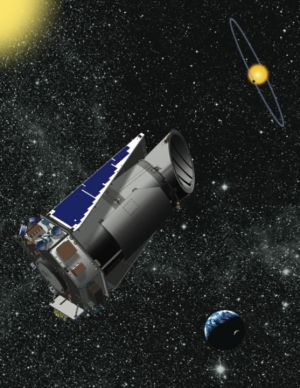 The Kepler mission has found its first batch of exoplanets, all of which are gas giants similar to Jupiter (though one is reportedly more like Neptune) orbiting very close to/quickly around their parent stars. It’ll be a few years before it finds anything else, because anything else takes a lot longer to orbit. Since Kepler is specifically looking for transiting planets (the planet passing directly between its parent star and us) it has to have 3-4 transits to be absolutely sure of its findings. Since planets like ours take a year or more to orbit… well, you do the math. It even found one gas giant that has the same approximate density as sytrofoam. (Via NASA and NewScientist)
Another interesting tidbit to come out this year is a much clearer picture of just how common solar systems like our own are in the universe/galaxy. According to astronomers from Ohio State University, who were heading up a larger collaborative effort called MicroFUN (micro-lensing follow-up network), about 10–15 percent of all stars have planet systems like ours (meaning a few gas giants orbiting far out, with probably a few small, rocky planets in closer). 10-15 percent may seem like a small number, but when you consider the overall vast number of stars just in our own galaxy alone, you’ll realize that even 10 percent equals hundreds of millions of solar systems. It should be quite obvious now that there are other worlds out there very similar to our own, we just haven’t found solid evidence of them yet, so we can’t be 100% sure. But I am confident the Kepler, the CoRoT mission, or maybe even a ground-based telescope, will find one within the next decade. (Via EurekAlert! and Space.com)
Here’s a little bit of everyday science for you:
We’ve all been annoyed when we get out of our cars or walk across a carpeted room in the winter time and shock the #&*$@! out of ourselves on the door/other metallic object. So why the hell does it always happen so much more in the winter? It has to do with the humidity. Especially in the eastern US, the winter months are much MUCH drier than the summer ones. (Remember that Relative Humidity is NOT a direct measurement of how much moisture is actually in the atmosphere, go by the dewpoint- the lower the dewpoint, the less moisture is in the air.) Colder air has less moisture capacity than does warmer air, thus the winter months are very dry. Well all know that static electricity is the buildup of an electric charge in our bodies and/or clothes due to simple friction. During the summer months when the air is more humid, the moisture in the air allows those charges to constantly dissipate because we all know water is a good conductor of electricity. The static electric charge never has a chance to build up because it’s constantly “seeping” away into the moist air. In the winter, the dry air does not conduct and “seep” away the static electric charge, allowing it to build up until we reach for something metallic such as a doorknob and POW! the electricity instantly discharges in one big spark and we get shocked.
Back with some science
December 30, 2009
The holidays obviously consumed my life to the point that I haven’t posted in over a week. Sorry ’bout that. I also haven’t shared any good sciencey tidbits in a while, so here you go:
I recently saw James Cameron’s latest epic Avatar. I won’t get too involved with reviewing the film as I’m no film critic by any means, but I will say this- it’s beautiful. The animation is astounding and most notably, the landscape is gorgeous. The dialogue and storyline is utterly pathetic. It’s basically the same story as Last of the Mohicans, Fern Gully, or Dances With Wolves, only this time it’s injected into a sci-fi mold. That being said, I always can enjoy that story to some degree no matter how many times it gets retold and rehashed. What is pretty cool about the movie is the science behind it. There will always be a big gap between “movie physics” and reality, but the over-arching idea of a habitable moon similar to Earth orbiting a gas giant similar to our own Jupiter in different star system is entirely plausible. The fact that the moon’s atmosphere is toxic to humans makes it slightly more realistic, along with the reduced gravity resulting in the native animal life being mostly large compared to that of Earth. Space.com has more on the science of Avatar’s Pandora.

Image via Universe Today
I’ve mentioned on here before that NASA and the European Space Agency have teamed up for the next decade or so of Mars exploration. The exact timeline and details of that effort are now beginning to come into focus, thanks to the recent discovery of a constantly replenished quantity of methane in Mars’ atmosphere The first step will be a new orbiting observatory launched in 2016 that is specifically equipped to further explore the possible sources of this methane, and map out exactly where it’s the strongest. Also on this first mission will be small lander designed to test the parachute/thruster landing system that will be used on the future missions involving the “real” landers/rovers. Those rover/lander missions will be launched in 2018, and will be specifically designed to search for signs of life. Recent developments in the theories about the possible source of the methane have started to lean more towards microbial life, probably living under the surface. That’s very exciting. More on this at Universe Today.
What kind of blogger would I be if I didn’t have some sort of “year-in-review” post? Unfortunately I haven’t had the time to come up with anything myself, but here are a couple of 2009 recap posts from other science blogs that you might find interesting:
Live Science: 9 stories we love, and hated, in 2009.
Space.com: The 9 top spaceflight stories of 2009.
Some of probably already know this, but I’m currently in the process of moving. Megan and I are renting a small house near Germantown, and though the house will be awesome once we get settled in, the timing really sucked. I can’t think of a worse possible time to be moving than during the holidays. So posting here will probably be limited until next week.

 steve cross loves music and science