Warp Drives and Fire Tornadoes: your daily dose of awesome
September 20, 2012
What could possibly be more awesome than a TORNADO MADE OF FIRE?!? Not much. This is a spectacular natural phenomenon that occurs in wildfires. It’s the same atmospheric process that causes dust devils- the difference here is that the strong updraft is from the heat of the fire, so it’s much more intense than a normal dust devil. The hot air rises rapidly and the surrounding winds happen to be flowing into the updraft at just the right angles so that the rising column of air gets a twist. From there the law of conservation of angular momentum takes over and the vortex becomes self-sustaining. This one was captured recently in Australia.
Also from the department of TOTALLY AWESOME: Warp Drives (like the ones they used in Star Trek) may actually be much closer to reality than ever thought. NASA physicist Dr. Harold White has recently done some tweaking of the theoretical design of the famous Alcubierre Warp Drive, originally proposed in 1994 by physicist Miguel Alcubierre. The original design, while theoretically possible, was completely impractical because it required more energy than a human mind can comprehend. But with Dr. White’s tweaks, the amount of energy required to run this thing suddenly became more plausible. Essentially the ship would be able to travel much faster than light, without actually traveling faster than light. It does this by literally compressing a region of space-time ahead of it and expanding a region behind it. The ship itself is in a bubble in which it never breaks the speed of light relative to the space-time it’s in. Think of it like surfing a wave of space-time. Granted, the amount of energy require to run the Warp Drive is still roughly equivalent to 1.5 million Hiroshima bombs, but with a little antimatter (about 500 kilograms) that number is not out of reach. The problem is that the idea hasn’t been tested in real life. So Dr. White and his team are currently attempting to actually warp space-time on a microscopic scale in their lab. Take a moment to digest that. Right now, we are attempting to warp space-time in a lab. It doesn’t get much more awesome than that. For more info on how the drive actually works check out this article on Extreme Tech or this article on Discovery News.
Science roundup: Higgs boson passes peer review/Antimatter propulsion looks feasible
September 12, 2012

Click to enlarge. Trust me- you want to do this!
Before the newsy stuff I had to give you that eye-gasm of a photo of our nearest star a.k.a. the Sun, blowing off millions of tons of hot gas into space a couple weeks ago. This image combines two spectrums of light that we can’t see with our eyes, both of which are in the ultraviolet range and show the magnetic activity better. Both were taken with NASA’s Solar Dynamic Observatory (SDO). We should be glad this enormous eruption wasn’t aimed directly at Earth, else we could have had serious satellite and power disruptions.
Now for the headlines:
- The teams of physicists at the Large Hadron Collider have officially published their findings on the Higgs boson in a legit, peer-reviewed journal- Physics Letters B. This is the same journal in which Peter Higgs first published his revolutionary paper that began the hunt for the boson to begin with. Once a discovery passes this level of scrutiny, it’s DONE. That means we did it! Scientists have been a little hesitant to actually call this discovered particle the Higgs boson, however, since all the properties and attributes of the particle are yet to be nailed down. Over the next few years we’ll start to get a better picture of just what this particle looks and feels like, so to speak, and I’m sure there will be many more questions raised than answered. (Via NewScientist)
- Star Trek is starting to look a bit more like reality than science fiction thanks to new research being done into anitmatter and fusion propulsion. That’s right- antimatter, as in the stuff they used to run the Enterprise‘s Warp Drive. NASA teamed up with consulting firm the Tauri Group for a presentation that included a prediction that human technology will have advanced to the point that antimatter and fusion propulsion will be possible for spaceships by around 2060. The technology will not, however be capable of faster-than-light travel. According to the 2010 report the presentation was based upon, it would take about 4 months to get a ship to Jupiter with this technology. That’s significantly faster than current technology, but still a very VERY far cry from Warp speed. (Via Space.com)
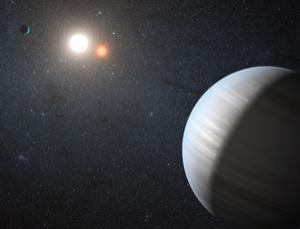
Artist interpretation of Kepler 47c. Credit: NASA/JPL-Caltech/T. Pyle
It’s been a while since we had any juicy exoplanet news. That changed yesterday as a new breakthrough was announced in exoplanet science. For the first time astronomers have confirmed multiple planets orbiting a binary star. The star is about 5,000 light years away and what really makes this discovery interesting is that one of the two planets orbits in the habitable zone, where liquid water could exist on its surface. The catch is- the planet is a gas giant, similar to Jupiter and Saturn, but more the size of Uranus. However, planets like that almost always have many moons, some of which could have an atmosphere and even support life, just like the Forest Moon of Endor, home of the Ewoks in Star Wars. Pretty exciting stuff! Read more about it at NewScientist.
 In other news, if you’re anywhere in the southeast and looking for some nerdy fun this Labor Day, look no further than Rocket Fest at the U.S. Space & Rocket Center in Huntsville, AL. This event just popped onto my radar today via Bad Astronomy, and low & behold Dr. Plait himself will be one of the guest speakers! It should be no secret that I’m a big fan of him and and his blog. This is a fundraiser open to anyone, any age, and the proceeds go to the scholarship fund for Space Camp, and the U.S. Space & Rocket Center Foundation. Honestly what excites me the most about it (besides seeing Phil Plait speak) is the fact that you can get a signed print of that AWESOME poster for a mere $20 donation. I’m not sure yet if I’ll be there, but I had to mention it because it’s all sorts of awesome!
Scientists create the iSquid/more eye candy from Mars
August 29, 2012
From the department of Holy Fucking Shit Nature Is Awesome: Scientists have hooked up squid skin to an iPod and made its pigment cells dance in time to Cypress Hill. They took the electronic waveform of the music and turned it into tiny electric impulses that caused the pigment cells, called chromatophores, to react in time with the music. The result is utterly fascinating:
(Via Kottke.org)
The MSL team at NASA has been as busy as ever testing, calibrating, and tweaking Curiosity’s cameras and instruments. A lot of great things have been accomplished over the last week or so, but two things are most interesting to me. The first recorded song ever to be beamed back from another planet was a song specially composed and recorded by will.i.am of the Black Eyed Peas. The song was called “Reach for the Stars.” While I’m not really a Black Eyed Peas fan, I’m really happy that such a big-name pop culture figure is trying to get kids more involved and interested in Science, Technology, Engineering, and Math (STEM). The other bit of news from Curiosity that really impressed me is this new image from the rover’s 100mm MASTCAM:

Click to enlarge. Seriously, you want to see this full size! Credit: NASA/JPL
This photo, to me, is much more interesting to look at than the other, wider images taken thus far. The reason is that it’s using a 100mm telephoto lens, which makes the scale and depth of the scene more prominent. Also, the photo was taken near sunrise or sunset when the angle of sunlight was low, which makes the jagged rock formations on Mt. Sharp more prominent and dramatic. Notice how there are many flat layers of rock exposed on the side of the mountain? They look just like the layers of bedrock along the sides of canyons and mountains here on Earth! The layers you see on Earth were formed by water, when sediments collected on the floor of oceans and lakes and eventually hardened into rock over millions of years. Therefore, scientists are pretty sure the rock layers seen in this photo on Mars were formed the same way, at the bottom of bodies of water on the surface millions of years ago. The big question we still have to answer is, what caused the water to disappear? Also, was there any life in or around that water millions of years ago? I can’t think of anything more exciting than answering those questions about Mars’ past.
We’re going to Mars again in 2016/More Curiosity updates
August 23, 2012
NASA announced that it has selected the InSight Mars lander for its next Discovery mission. (Discovery missions are NASA’s lowest cost tier of science missions, such as Kepler, Dawn, Messenger, Mars Pathfinder, and more.) You may be thinking, “ANOTHER mission to Mars? What for?” Well, despite all the awesome science that Curiosity will do, it can’t tell us much about the deep interior of Mars, or what Mars’ seismic activity is like. The InSight lander will be a stationary robot much like the Phoenix lander. In addition to measuring seismic activity, it will deploy a probe that will drill deep below the surface to measure the flow of heat inside Mars. These measurements will help scientists understand how Mars formed and what happened in the past that changed the surface from one of flowing water (and possibly life) to the barren dry wasteland it is today. (Via Universe Today)

Click to enlarge. Credit: NASA/JPL
Curiosity completed its first set of driving maneuvers on Mars. This image was the first that showed the wheel tracks, confirming that the rover drove successfully. This was only a test of Curiosity’s driving systems, the first of several. Tests of every science instrument and every other system on the rover will continue for at least a month or so before they’ve established a solid baseline for how everything behaves now that it’s actually on Mars. Only then can the scientists begin run the real experiments the rover was designed to carry out. Science is sometimes very tedious and slow, but the results and knowledge gained is very much worth it.
Mars Curiosity updates and images
August 15, 2012

The base of Mt. Sharp, Curiosity’s main destination. Credit: NASA/JPL
NASA’s Curiosity rover has been one resounding success after another, and every step of preparation and equipment testing has gone perfectly. The latest success was an upgrade to the rover’s software programming, changing its computer from landing mode to roving mode. The process took 4 days, but went swimmingly. For more details on that visit this Discovery News article.
There have been enough high resolution images made available from the rover that photographer Andrew Bodrov was able to create this absolutely STUNNING 360 rotating panorama of the rover’s surroundings. Seriously, this is one of the coolest things I’ve seen in a while. Brodov used images from NASA’s other rovers Spirit and Opportunity for reference to add-in the sun and sky components. (Via Universe Today)
Keep your browser on NASA’s JPL website for the latest images from this amazing mission.
NASA’s Curiosity Rover lands on Mars Sunday night
August 2, 2012
You’d have to have been under a rock to no know that NASA’s latest and greatest Mars rover is about to land on the Red Planet. It’s been all over the news lately… but here are a few more deets that you may not know, including when and how to watch the coverage.
As usual, Universe Today is on top of the coverage, and this infographic was particularly interesting. They will also be teaming up with Google, CosmoQuest, and the SETI Institute to do a live webcast via Google+ to cover the event. Among the cast of hosts is one of my favorite fellow science enthusiasts/skeptics Dr. Phil Plait of Bad Astronomy. That begins at 10pm central time. The actual landing is scheduled for 12:31am central time. For more on the webcast check out the post on Universe Today.
Some random cool facts:
- This is the most complex landing procedure ever carried out by a NASA interplanetary mission.
- The supersonic parachute that slows the lander during the descent phase is a whopping 51 feet in diameter.
- The rover itself is about the size of a Mini Cooper.
- The rover weighs 1,982 pounds (on earth… on Mars it weighs about 747 pounds)
- The rover is powered by a small nuclear reactor.
- Curiosity will land inside Gale Crater, near the base of Mount Sharp, which has layers of exposed minerals that the rover will sample and study.
- The total cost of the mission is $2.5 billion.
Scientific eye candy
July 24, 2012
Two pieces of eye candy for your viewing pleasure today:
Over the past 40 years the US Geological Survey and NASA have teamed up on the LANDSAT mission, a series of imaging satellites that have taken some breathtaking photos of our planet. They recently posted a series of images and got the public to vote on the top 5. Those 5 can be seen in the video below, and the full gallery can be seen on the USGS website.
Secondly, I came across this set of amazing weather photos by photographer Camille Seaman last week. Feast your eyes on these simultaneously gorgeous and terrifying views of storm clouds over the great plains.

(Credit: Camille Seaman) Click through to view the full gallery.
These are both Mars-related stories that popped up across the blogosphere over the past week:
The first bit of news is that NASA’s Mars Science Laboratory (MSL) mission is getting ever closer to its destination, and the dreaded “Seven Minutes of Terror” entry and landing sequence. They recently produced a video that does a pretty good job of conveying just how hard it is to land anything on Mars, and especially how insane this particular landing sequence is. It’s CRAZY HARD to do what they’re attempting to do. I’ve seen many other animations of this many times over, and it STILL blows my mind just how tedious and difficult this is from a scientific and engineering perspective. Seeing the video is essential, so here it is. Just watch:
The second bit of Mars-related news is a little crazier and far-fetched. A group of private investors are pooling their resources and claim that we can have humans on Mars by 2023. This project is called Mars One, and I have to be honest… the whole thing sounds utterly insane. They want to create such a huge media spectacle that the public interest and avenues for profit are such that they can raise the massive amount of cash it’ll take to make this happen. The craziest part of the whole thing is that it will be a one-way mission for the people who actually go to Mars. I think the ethics of such a thing are mostly subjective- I have no problem with a one-way mission if the people going are truly, honestly 100% dedicated to it. I think it’s honorable, and who am I to judge them for making such a profound decision. Neil Armstrong, Buzz Aldrin, and the rest of the Apollo astronauts all knew the extremely high risks involved with what they were doing. They accepted it and went on to accomplish arguably the greatest feat in the history of mankind thus far- walk on the moon. I hope they pull it off, I really do, and without all the oversight and red tape of a government agency like NASA, the likelihood of this happening so soon is greater. But still. 2023 is REALLY REALLY soon to put humans on Mars. Here’s their promo video:
Crazy? Or just crazy enough to make it happen?
Exoplanets: xkcd scores a home run
June 21, 2012
I’ve written a lot about exoplanets, planet-hunting missions such as Kepler, and various other topics related to the search for other worlds in the universe. Never have I seen any one image that could really sum up my feelings about it. But that time has come, and the brilliant Randall Munroe who does the well-known nerdy web comic xkcd is the man who did it. I can’t really say any more- just look and read for yourself. Be sure to click through to enlarge it enough to read the small text.


 steve cross loves music and science