 Remember back in the 90s and early aughts when SETI (Search for Extraterrestrial Intelligence) had those screensavers you could install that would process chunks of radio telescope data, looking for interesting signals? It would quietly download the data packets, process them, and send them back to SETI. That project has long since been canceled, but its successor is even cooler- SETI Live. The latest version of it just launched yesterday, and it literally allows you to visually analyze real data from the Allen Telescope Array. As I understand it, there are parts of the radio spectrum that are crowded by our own human-made signals. Even the most sophisticated computer software has a hard time distinguishing between something that’s manmade and something that’s extraterrestrial in origin, so they need human eyes to make the distinction. The project is part of Zooniverse, which has many other projects that allow the general public to take part in real scientific research and experiments. So sign yourself up and get to analyzing- you never know what you’ll find, especially now that they’re aiming the radio telescopes at stars known to have planets orbiting them!
Now sit back and enjoy this eye candy: yet another gorgeous timelapse video created from photos of earth at night taken from the International Space Station. I could literally watch stuff like this all day. There have been several of these created thus far, but this one just might be the best yet. It’s like crack for your eyes…
(Via Universe Today)
Playing guitar in space
February 23, 2012
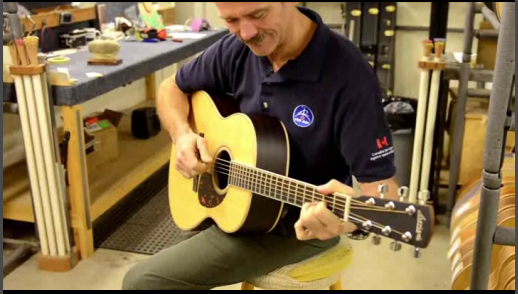 I’m always happy when the worlds of music and science collide in cool ways, as should be quite evident by the name of this blog. In reality science IS music, just like science is everything, but this is one instance where it’s especially cool. Astronaut Chris Hadfield is scheduled to be commander of the International Space Station, and he also happens to be a musician. It turns out music is actually an integral part of maintaining the psychological health of the astronauts, and so NASA decided to put an acoustic guitar on the station. This video from Space.com shows Hadfield explaining the guitar design itself, as well as the challenges and adaptations one has to make when playing in zero gravity. Very cool.
On a side note, I’m well aware of collective facepalm the science community is doing right now since the story broke yesterday that the apparent faster-than-light neutrinos discovered last fall may actually be due to a simple bad GPS cable connection. This is still, as far as I can tell, unconfirmed, so I’m holding off on posting anything in-depth. But I will say that I almost expected it to be something so trivial… We’ll see how it pans out.
Try NASA’s new Facebook game
February 1, 2012
 NASA is making strides in their publicity and education efforts with a set of new games- Space Race Blastoff and Sector 33. Space Race Blastoff is a Facebook app that lets you compete with other players in quick, 10-question science trivia rounds. The topics range from general science to NASA missions and astronauts. Of course, I signed up immediately and became addicted for about 10 games, then I started getting repeat questions. BUT, this game is still a beta version, so I’m sure the database of questions will be ever-expanding. Also, I’d like to see a feature where you can directly compete with a friend. All in good time, I’m sure.
I haven’t tried Sector 33 yet because it’s only for iPhone, iPad, and iPod Touch. (I’m an Android user.) But you can read all about it in this post at Universe Today. Basically, it lets you try your hand at being an air traffic controller- widely considered to be one of the most stressful jobs. If you start playing Space Race Blastoff, however, lookout- my name on there is Disco Science, and I dare say I’m a force to be reckoned with.
#nergasm
The Sun is alive: auroral displays are on the rise
January 24, 2012
Credit: NASA
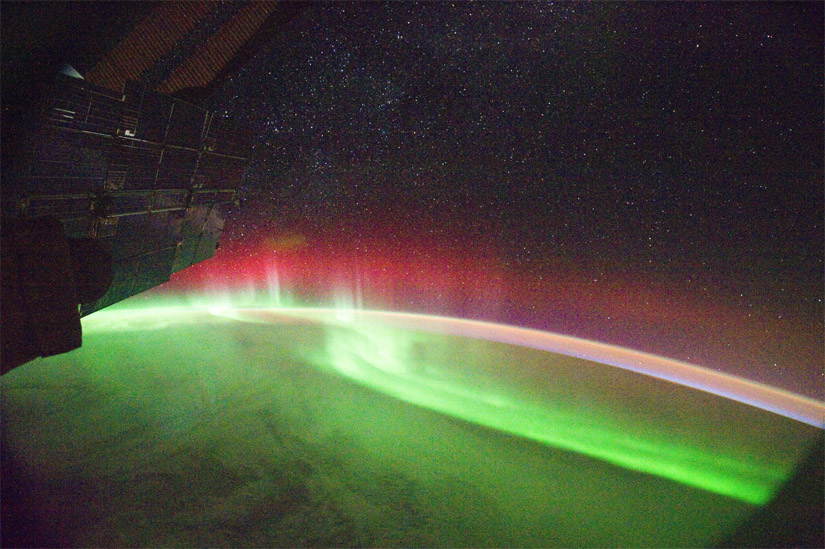
As I’ve mentioned before, our Sun is steadily heading toward the peak of its next 11-year sunspot cycle. The peak is expected in 2013. That means we can expect a steady increase in aurorae as well, because sunspots lead to solar flares and coronal mass ejections (CMEs) and when those happen to be aimed at earth, we get dazzling displays near the north and south poles. Sometimes those displays can even be seen as far south as Tennessee. Over the weekend there was a massive solar flare and CME, one that released the same amount of energy as millions of nuclear bombs, and it headed straight for earth. The blast of particles reached earth last night/this morning and created an astonishing auroral display, which was captured by many photographers at various locations. Here are a few blog posts and other links I’ve come across today showing some of those photos as well as explaining the physics of what actually causes the upper atmosphere to glow when bombarded by these particles.
Spectacular Aurorae Erupt Over Norway (Discovery News) Absolutely breathtaking photos by Bjørn Jørgensen.
Huge Solar Flare Seen By Solar Dynamics Observatory (Space.com)
The Sun Aims a Storm Right at Earth! (Bad Astronomy) Good explanation of the science behind the aurorae.
Can Solar Flares Hurt Astronauts? (Universe Today) Good explanation of why the flare/CME poses little risk to astronauts onboard the ISS.
 So there has been some excitement and confusion lately over a signal discovered by SETI researchers after they aimed one of their radio telescopes toward “objects of interest” discovered by the Kepler mission. These are possible exoplanet discoveries, but they’ve yet to be confirmed by other telescopes. (These are called Kepler Objects of Interest, or KOIs.) Until now, SETI researchers have been blindly aiming their telescopes all over they sky listening for possible alien radio signals. Now that the Kepler team has a few KOIs that might be habitable, it makes sense for SETI to narrow their search and start listening specifically in the direction of those KOIs. Well, they did just that, and they found an interesting signal! One that is clearly not just natural background noise. But, that signal is almost definitely interference from one of our own satellites, because the signal still shows up even when they aim the radio telescopes away from the exoplanets. So, don’t let anyone fool you- SETI has NOT discovered an alien radio signal.
As he always does, Dr. Phil Plait of Bad Astronomy lays out the truth on this. Universe Today has an excellent post on it as well.
Kepler finds earth-sized alien planets/Some amazing volcano photos
December 21, 2011

Credit: NASA
The Kepler team at NASA announced yet another exciting discovery yesterday: the first confirmed earth-size alien planets, Kepler 20f and 20e. The mission has found other exoplanets that pretty close to earth-size, but these two are by far the closest yet. What really befuddled me about this announcement was that that in addition to those two smaller, rocky worlds, there are three bigger gas-giant or super-earths in this system as well. No only that, but all five of these exoplanets’ orbits would fit inside our own Mercury’s orbit around our sun! That’s a lot of planets crammed into a tiny area! Of course that also means that these planets are scorching hot- far too hot to be habitable. But, it’s very reassuring to confirm that Kepler can positively identify alien planets that are earth-size and even tad bit smaller (Kepler 20e is about 87% the size of earth). As usual, Dr. Phil Plait at Bad Astronomy has a very good explanation of the whole thing. And I’ll also point you toward this article on space.com about the likelihood of us finding a true earth-twin within the coming year.
And now I will simply tell you to go take a look at this amazing set of volcano photographs and have a a few eyegasms. You’re welcome.
Kepler finds potentially habitable exoplanet 2.4x size of earth
December 5, 2011
Should’ve gotten to posting this earlier today but I was waaay too busy.
Very exciting news in the science world today- NASA’s Kepler mission has been very busy lately, finding exoplanets left and right. Problem is, those observations have to be followed-up and duplicated by other telescopes, usually ground-based. Thus, it takes a while to fully confirm the existence of an exoplanet discovered by Kepler. Finally though, they’ve found one that is close to earth’s size, and orbits a star similar to our sun within its habitable zone. It’s not quite the “holy grail” of planet hunting because the planet is 2.4 times the size of earth, but it’s getting us ever-closer to the discovery of a true earth-twin. This is awesome. It’s only a matter of time…

Credit: NASA/Ames/JPL-Caltech
For more, check out this article on Space.com, or this article on Discovery News.
Mars Science Laboratory launches/other badassery
November 30, 2011
That is video of the final separation of NASA’s new Mars Science Laboratory rover (named Curiosity), sending it on its way to Mars. The probe launched successfully this past Saturday atop an Atlas V rocket, and will reach Mars in August of 2012. If you follow this blog you’ll know that I’ve mentioned this probe excitedly before- that’s because this is the biggest, boldest of all the robotic rovers we’ve sent to Mars. It’s about the size of a small SUV and it will be looking for evidence of conditions that may have been conducive to the development of microbial life, past and present. Important distinction: the probe is NOT searching for life itself, just for evidence that the planet may have been habitable in the past or maybe even the present. August 2012 will be a tense month for NASA and all following this probe’s progess, because the final landing stages are immensely tedious and complex. (See the landing animation below.) For now though, we just sit and wait as the probe zips through space and the engineers make the final adjustments to its trajectory. For some more expert commentary on this mission, check out Bad Astronomy or Universe Today.
Since I probably won’t be posting again until this Friday’s “A Few Good Shows” post, here are a couple more videos full utter badassery:
“Jetman” Yves Rossy flies alongside fighter jets on his jetpack. It doesn’t get much cooler than that…
Nothing like some shirtless 9-year-olds totally nailing “Crazy Train”
Monday videos: cats and space
November 14, 2011
Few words today, simply two videos to entertain you for different reasons.
HD timelapse footage of earth from the International Space Station. This has been making the rounds on the interwebs already, so you’ve probably seen it, but it’s just too good not to post. The city lights combined with the aurorae make this simply jaw-dropping/drool-inducing. Be sure to set HD to “on” and make it fullscreen!
And now let us take a quick look into the exciting new world of “catvertising”…
(Via yewknee’d)
Timelapse videos of auroras from the space station
October 20, 2011
This post needs very few words. Just sit back and enjoy these gorgeous timelapse videos shot from the International Space Station. They’re of the Aurora Borealis and/or Aurora Australis. Be sure to click on the resolution and choose the HD version, and make that shit fullscreen! (All via Universe Today)

 steve cross loves music and science