Mayan calendar end disputed/Big Pics of NIF
October 19, 2010
It’s been a while since I got on my soapbox of how the 2012 Mayan calendar doomsday myth is, well… a myth. Let me begin by saying that there is no reason to believe that anything exceptional will happen when the Mayan long count calendar ends. Anyone that tells you otherwise is either totally full of shit, or is very gullible to fluff and hype (generated by the former). The descendants of the Mayans themselves have even said that the doomsday myth is bullshit. So, this thing is already completely blown out of the water by real science and reason, but just in case you needed another reason not to believe the doomsday hype, now the actual date of the end of the long count calendar is in question. The methods used to convert the Mayan calendar into our own Gregorian years has been shown to be unreliable, and this could throw off the date conversion by as much as 50 to 100 years. So in reality, the Mayan calendar might have already ended (and thus simply started over again)! I’ll keep an eye out for any updates and clarifications to this story, but let’s face it- the Mayan calendar doomsday hype is nothing more than fear-mongering and utter ignorance. (Via LiveScience)

Image via Wikipedia
I know I link to this blog all the time, but the Boston Globe’s Big Picture blog continually showcases some of the most amazing imagery you’ll find anywhere, and what’s best about it is the content. This particular series involves the National Ignition Facility in California. This massive experiment could literally solve all the world’s energy problems. What they’re attempting to do here is essentially create a miniature star right here on earth. Just recently they completed a successful test in which they fired 192 lasers simultaneously into one tiny frozen target capsule containing deuterium and tritium (isotopes of hydrogen). The ultimate goal is to create a nuclear fusion reaction- the same process taking place in the center of our Sun. As you can easily deduce, this would release enormous amounts of energy that is completely clean- the only by-product is helium, which is the element formed when hydrogen atoms fuse. The only hurdle is that it already requires a massive amount of energy to power the lasers that start the reaction in the first place, so the reactor must produce significantly more energy than it consumes in order to truly be a viable solution to the energy crisis. Another issue could be safety. With a reaction as powerful as nuclear fusion, things can get dangerous very quickly. Thankfully though, if an explosion were to occur, it wouldn’t involve the radioactive fallout danger associated with current nuclear reactors which use a different process- nuclear fission. (AKA the reaction used in the atomic bomb.) Click here to learn more about the NIF.
Doubt cast on Gliese 581g planet
October 13, 2010

Credit: Lynette Cook/NSF
Planet hunting is a delicate and tedious science. A very strong emphasis is placed on multiple teams of astronomers being able to replicate the results of the first team to announce any kind of discovery. If another team is unable to replicate the findings of the first, it casts a serious shadow of doubt on the validity of the initial findings. That’s exactly what is happening with the Gliese 581g exoplanet that was announced just last week. Sadly, a team that works directly with the HARPS detector on the 3.6m telescope at the La Silla Observatory in Chile has been unable to confirm the existence of Gliese 581f or g. They have access to more data than the team who initially announced the discovery, and they can’t find a clear enough signal in the background “noise” of the observations to confirm this planet. As more teams run computer models and look at observations from other telescopes with radial velocity planet-finding instruments, maybe we’ll get a clearer picture of whether these two planets actually exist. (Via Universe Today via Dynamics of Cats blog)
Don’t worry though, the Kepler mission will undoubtedly start popping out earth-twin discoveries in another year or so, mark my word.
Breaking news: new earth-sized planet found in Gliese 581 system
September 29, 2010

Image via Wikipedia
Our old friend Gliese 581 just keeps getting more and more interesting. Astronomers have discovered yet another VERY interesting planet orbiting this star. The star itself is a red dwarf- much smaller and cooler than our own sun, which mean it’s habitable zone is much closer than that of our sun. This new planet is only about 3 times the mass of earth, and it is within the star’s habitable zone!
Clearly this is exciting, but it’s still not a true “earth-twin” because we have no way to determine if the planet even has an atmosphere. It was discovered the same way all 5 other planets in this system have been discovered- the radial velocity, or “wobble” method in which astronomers measure the planet’s tug on the star as it orbits. I’m assuming the planet does not line on the plane of our line of sight to the star, otherwise we’d have transit observations to go along with these RV observations. Also, because it is so close (it orbits in only about 37 days) it’s probably tidally locked. This means the planet rotates at the same rate it orbits the star, resulting the same face of the planet always facing the star, exactly how or own moon always faces us with same side. Thus, one side of the planet would be much hotter than the other, and this is big mitigating factor in the likelihood of the planet harboring life.
The big deal here is simply that there is a somewhat earth-like planet orbiting a star right at our galactic doorstep. The Gliese 581 system is only about 20 light years away. Statistically, if earth-like planets were rare in our galaxy, the chances of one being so close to us would be VERY VERY low. So having one at our doorstep means that earth-like planets must be pretty common in our galaxy, VERY common, in fact. I have a strong feeling that as more data from the Kepler mission comes in, they’re going to start popping up everywhere, and that’s exciting.
I could go on and on, but what I’ve presented thus far is a condensed version of the Bad Astronomy post that just went up, so head over there to get the full details. As always Phil does a great job presenting the facts in laymen’s terms.
I’m back, here are some cool links
September 21, 2010

Eating lunch with the Darlins in the Bronx.
So I’m back! It was a blast and I’d do it all again in heartbeat. I don’t have time to give a full rundown, but quite possibly the most memorable moment was realizing that a tornado was hitting Brooklyn while Those Darlins were soundchecking in Bowery Ballroom. Here’s the official weather report from the NWS. Needless to say, tornadoes are pretty rare in NYC. Thankfully we were in Manhattan while all this was happening. Those Darlins have some great new songs on their new record, and their setlist for this tour is mostly those new songs, peppered with the favs from their debut, and the free single “Nightjogger” which you can download at the Nashville Cream. Basically they’ve taken on a bit more of a pure rock & roll character, and drummer “Sheriff” Linwood Regansburg has taken on a much more prominent role in the songwriting, and even sings on one of the new songs, though they’re not yet playing that song live. Stay tuned for more on them and more on the results of my photo documentary project.
Meanwhile, here are some awesome things I came across while catching up on all my RSS feeds:
Vaccines absolutely, beyond a shadow of a doubt, do NOT cause autism. A new study explored every possible way that thimerosal containing vaccines (TCVs) could be linked to autism and there was none. Absolutely no connection whatsoever; the same findings as the many other studies that have been done to investigate the claims of the anti-vax crowd. In fact, the result hinted that the administration of TCVs between birth and 7 months may actually reduce the risk of autism. It’s very simple, get your kids vaccinated! If you don’t, you are a threat to public health. Vaccines are one of mankind’s greatest scientific breakthroughs and have saved countless lives. There will always be a miniscule (and utterly negligible) risk of a bizarre allergic reaction or other complication, as there is with any medication or vaccine, but that risk is far, far, FAR outweighed by the benefits. And those risks have now been proven once and for all NOT to include autism.
A pair of astronomers have made an official prediction that the discovery of the first truly earth-like exoplanet will happen in less than a year– May of 2011. They used a well-known methodology called Scientometrics to make this prediction. I’d venture to say that to me, nothing in the field of astronomy, or even science in general, is more exciting than the very likely possibility of life on other planets. The discovery of the first true earth twin is a major step in that path. I really hope this prediction comes true.
Five awesome facts about NASA’s next robotic mission to Mars, the Mars Science Laboratory (a.k.a. Curiosity) which will launch in late 2011.
23 amazing photographs from the 1940s and 50s of nuclear bomb tests conducted by the US Military. This New York Times photos series is utterly fascinating, mainly because of images 5 through 7. Most of us have seen plenty of images of the mushroom clouds created by nuclear blasts, but those 3 images are unlike anything I’ve ever seen before. They were taken with a super high-speed camera and literally captured the blast at the very instant the explosion began. If I saw this image out of context I would probably think it was a microscope image of some sort of virus. The amazing irony here is that both a virus and an atomic bomb are incredibly destructive, yet in such completely different ways.
The actual scale of the observable universe, from the smallest possible thing the largest possible thing, is utterly impossible for the human mind to comprehend. Mathematicians came up with the concept of “orders of magnitude” to help with this, but I say it’s still impossible for any human to really grasp. But this fun little interactive Flash animation is pretty cool way of displaying the concept. (Via Dr. Neil deGrasse Tyson’s Twitter)
NASA’s Kepler Mission discovers multi-planet system in Milky Way
August 26, 2010

Credit: NASA/Ames/JPL-Caltech
NASA’s Kepler Mission released its first official findings today at press event. These are the first fully confirmed exoplanet discoveries by the mission, and there will be many more confirmations coming down the pipe no doubt. This system isn’t quite as exciting as I’d hoped… on Tuesday I read that NASA was planning a press conference to announce Kepler’s findings so naturally I was hoping they’d found a planet similar to earth, but I seriously doubted the news would be that exciting. I’d say it’ll be at least another year before any earth twins are confirmed, because obviously an earth twin would have an orbital period close to 1 earth year, and multiple transits would be needed to confirm it as a planet.
The system discovered is the first multi-planet system confirmed using the transit method (measuring the dip in light seen from a star as a planet crosses between us and the star). It has two Saturn-sized planets and possibly one “super earth,” a planet roughly 1.5 times the size of earth. This smaller planet has not been confirmed, however, so it’s still just an “exoplanet candidate.” Furthermore, they say the smaller planet is VERY close to the star, completing an orbit in only a matter of days. This means the planet would be scorchingly hot and quite unsuitable for any kind of life. While not the “holy grail” of planet-hunting, these findings confirm that the techniques and devices being used to hunt for exoplanets are indeed working, and that we’re well on our way toward finding that illusive earth-twin. (Via NASA)
Facts and myths about the Kepler exoplanet cadidates
July 29, 2010
Screenshot from Sasselov's talk
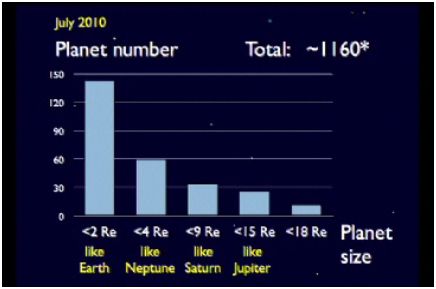
So there’s been a bit of a media buzz lately about the possibility that the Kepler space observatory may have discovered 100’s of earth-like planets orbiting other stars in our galaxy. Recently at a TED talk, one of the chief investigating scientists on the Kepler team, Dr. Dimitar Sasselov, mentioned that the team had found “candidates” for “earth-like” worlds, “that is, having a radius smaller than twice Earth’s radius.” Many mainstream media outlets have twisted this into reports saying that we’ve found 100’s of earth-twins (having an atmosphere, liquid water, etc…) orbiting other stars.
First of all, we HAVE NOT confirmed ANY of these as exoplanets yet. It will take considerable follow-up observations by other telescopes to confirm these as exoplanets, and not glitches or other phenomena that look like a transiting exoplanet. Also, the phrase “earth-like” as he used it simply means that it’s similar in size to earth. Just because an exoplanet is similar in size and composition to earth does not mean it is habitable. In fact, most of the exoplanet candidates have fast orbits and are very close to their parent star (which is why they were detected so quickly). This would make them much more akin to Mercury or Venus- both of which are far too hot to sustain life. The true earth-like exoplanets (that are in the habitable zone, have a similar radius, and could potentially harbor life) will take at least another year to discover, simply because they have longer orbital periods- closer to 1 year. Most of this information was culled from Dr. Sasselov’s NASA blog post in which he clarifies what he was saying in his talk. For even more info, check out Universe Today.
Don’t get me wrong, I’m incredibly excited about this mission, but I’m not going to pop the champagne cork until those scientists issue an official press release saying something like, “YES, we have definitely PROVEN that planet earth is not unique, and our galaxy is filled with small, rocky planets orbiting within the habitable zone of their parent stars.” That is a day I’ve dreamed of ever since I was a little boy fascinated by astronomy programs on the Discovery channel and the X-Files. There has been tons of speculation on this matter, but until now there was no solid, observational evidence to PROVE it.
 A massive grin sprawled across my face as I read this Nashvillest post about the upcoming “Way Late Play Date” nights at the Adventure Science Center. “Best idea ever” is an understatement. It’s been at least 15 years since I’ve been to that place- then it was called Cumberland Science Museum I believe- and I’ve wanted to go back ever since moving to middle TN in 2000. I’m quite sure I’m not the only one who’s wanted to go but felt like I’d get in the way of all the kids if I went without having my own kids. Some genius in their event planning dept. must’ve realized this and come up with the idea for this event. It’s a 21+ event, which will include 2 alcoholic drinks in the $15 ticket price. Booze+science is a winning combination in my mind. I just really hope some dumbass doesn’t get wasted and then hurl while in the moonwalk simulator. Oh, and you can also get a discount by buying 2 tickets together for only $25. The dates are June 24th and July 27th. Embrace your inner nerd and get tickets here before they sell out! (Megan & I will be there June 24th.)
I’ve written many blog posts about NASA’s Kepler Mission here early last year around the time it launched, but it’s been a while since I mentioned it. The spacecraft has been silently staring into the heavens looking for minuscule dips in stars’ brightness which may indicate a transiting planet orbiting said star. Now that it’s been over a year since its first observations, NASA is obligated by law to release the data to the public for further scrutinization. Astoundingly, Kepler has produced a list of 750 candidates for exoplanets. This is a massive list, considering the current list of known exoplanets is at about 450. I say “candidates” because these are not confirmed exoplanets yet, they are data sets that could indicate exoplanets, but those stars need further review and observation by other telescopes to confirm that the dips in their brightness was definitely caused by a transiting planet. This could take years, because in some of the cases, another transit will have to be observed to confirm that it’s indeed a planet. Nevertheless, this is very exciting news, and I have absolutely no doubt that at least one of these candidates will turn out to be the holy grail of planet-hunting: an earth twin. Read more about this at Universe Today, and even more at the NY Times.
Now behold the most badass kid ever. He had his tooth pulled by a rocket. (You may think this is a bit cruel, but I’m positive that the tooth was a baby tooth that was on the verge of falling out anyway.) (Also via Universe Today)
Space Hotel/Neil deGrasse Tyson
November 5, 2009
Plans for a “space resort” have been in the books of many commercial aerospace corporations for years and years, but now it’s actually about to happen. Space.com reports that a European company based Barcelona, Spain plans to open the first space hotel in 2012. I must admit my doubts that it will actually be ready and operational by then, but it’s a pretty cool notion nonetheless. The company even reports that 43 paying guests have booked a stay. Don’t get your hopes up though, as a 3-night trip is currently carrying a price tag of $4.4 million. Even if they don’t hit the expected opening date in 2012, it will eventually happen, almost assuredly by 2020. It’s quite possible that space vacations could eventually come down in price enough that your average Joe might be able to afford one.
The well-known Drake Equation has long been used by scientists to approximate how many intelligent might exist elsewhere in our galaxy. A major problem exists with the numbers, though, because depending on your level of optimism and reasoning to arrive at certain variable within the equation, you can get a result ranging from millions of intelligent civlizations to almost none. That’s a HUGE variability and thus the Drake Equation really isn’t very effective, at least not until we can arrive at more concrete variables to plug into it. Some new research from astronomers at the University of Louisiana at Lafayette may actually give us a better idea of just how common life, and intelligent life, is in our galaxy. The research has found that Sun-like stars are the best places to look for planets with intelligent life. Not surprising at all, but what may surprise you is the fact that Sun-like stars are actually pretty rare. Our Sun is bigger and hotter than 93% of the stars in our galaxy (and presumably the universe), which means that the habitable zone around most stars is closer than the earth is to the Sun. Their research has also shown that bigger stars (like our Sun, or even bigger) are more likely to form small, rocky planets around them. Since bigger stars generally have shorter lifespans, you can see how there’s a sweet spot in star size where the star is big enough to be likely to have small, rocky planets, yet small enough that the overall lifespan of the star is longer than the time it takes for intelligent life to develop. (It took about 4.5 billion years for us to develop on earth.) We have a pretty good idea of how many stars are in the Milky Way, as well as the size distribution. That means about 10% of the stars in the Milky Way fall into that “sweet spot” category. Since there are over 100 billion stars in our galaxy overall, that means about 10 billion stars likely to have earth-like planets and live long enough for those planets to develop intelligent life. I’d say those are some pretty damn good odds of alien civilizations out there, and that’s just in our own little galaxy, which is one of BILLIONS. Most astronomers and astrobiologists agree there’s a pretty good chance we’re not alone. To me that is really exciting. (Via Astrobiology Magazine and Space.com)
Now that I’ve rambled way too much, enjoy this Time interview with one of my favorite “celebrity astronomers,” Neil deGrasse Tyson: (Via Snarkmarket)
And then enjoy watching Mythbusters’ Adam Savage give a vial containing one of his farts to Craig Ferguson as a gift. I could go on and on about how wonderful Mythbusters is. But I’ll spare you that rant. (Via Bad Astronomy)
Rocky exoplanet confirmed/nerd Venn diagram
September 17, 2009

Image Via Space.com
A European satellite observatory recently discovered a very small exoplanet that is said to be the first with a proven density similar to Earth’s. Follow-up observations were done at a telescope in Chile to determine the planet’s mass, which was then combined with its radius to calculate its density. The planet has about 5 times Earth’s mass. But don’t get too excited just yet- the planet is far from habitable. It orbits VERY close to its parent star (23 times closer than Mercury is to our Sun), which not only means it’s really effin’ hot, but it also is probably tidally locked, which means the same side of the planet is always facing the star. So one side is literally boiling with molten rock, and the other side is extremely cold. There’s no way it could have any atmosphere, either. BUT this is still an important step toward finding an Earth-twin. No we know that we can find planets similar in size and density to our own. It’s just a matter of time until Kepler or CoRoT finds one orbiting in its star’s habitable zone. (Via Space.com)
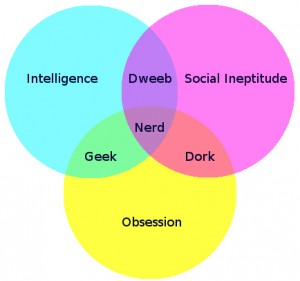
Ever wondered about the difference between a nerd, a geek, a dweeb, and dork? Look no further. This pretty much nails it down perfectly. (Via Clusterflock)

Credit: Pete Souza/official White House flickr photostream
Obama officially announced former astronaut Charles Bolden as his pick for the new NASA Chief Administrator. FINALLY! I’m just glad they now have a clear idea of who’s in charge, and soon will have a clear direction as well.
In case you’re under a rock, Obama also announced Sonia Sotomayer as his pick for the vacant U.S. Supreme Court Justice seat.
Space Shuttle Atlantis landed Sunday at Edwards Air Force Base in California after 3 scrubbed attempts to land at Cape Canaveral. The orbiter will spend a week there being prepped for the piggy-back ride on top of a modified Boeing 747 to take it back to Florida.
With the scheduled Soyuz Rocket launch tomorrow at 6:34AM, the International Space Station will have a full crew of 6 personell for the first time ever. Coincidentally, this also marks the first time that representatives from all 5 agencies involved with the ISS have been aboard it at the same time. Those agencies are NASA, the Canadian Space Agency (CSA), the European Space Agency (ESA), the Russian Federal Space Agency (Roscosmos), and the Japan Aerospace Exploration Agency (JAXA).
Ok, enough space stuff already… we’ll stick to science, though, because I found lot of good science news in my reader today, and not much else worth posting.
The National Ignition Facilily (NIF) in California is about to create a tiny man-made star with deuterium, tritium, and one big-ass laser. This has to be one of the coolest-sounding descriptions I’ve ever seen. In all honesty, though, it’s not really a star. But they will create nuclear fusion, the process that occurs at the core of stars, on a very tiny scale for a fraction of a second. This is just one small step toward the solution to all of earth’s energy problems. Not only will this device help solve energy problems, it will also help physicists study what happens when a star explodes, and also the inner-workings of any nuclear explosion. Back to the energy issue, though. If we can figure out a way to contain a sustained fusion reaction, and make it yield more energy than is required to create and contain it, then humans will have solved our energy crisis. As far as I can tell, there’s no Dr. Octavius employed at the NIF, thank goodness…
Stephen Colbert interviewed Seth Shostak on The Colbert Report. Shostak is the Senior Astronomer at the SETI Institute. (SETI stands for the Search for Extra-Terrestrial Intelligence.) Watch it on Colbert Nation.
Ok I have to post something not-so-serious now- Hurley has a blog! Seriously, it’s not the most interesting thing I’ve seen but it’s still way-cool to read about his real life. Besides, who doesn’t love Hurley?

 steve cross loves music and science