Absurdly awesome videos
April 19, 2012
Two videos which share a common theme of absurdity and awesomeness. Absurdly awesome? Awesomely absurd? You decide.
Exhibit A: Ridiculous/dumb/terrible things happening in super slo-mo. As in, 2500 frames per second slo-mo. It never ceases to amaze me how super slow motion can turn just about anything, no matter how gross or messy, into a captivating and beautiful spectacle. My favorite is the rocket-powered clothes drying rack. Why didn’t I ever think of that? Seriously though, this is one that simply MUST be seen in full HD, so set that shit on 1080p, pop it on fullscreen, and sit back. (Via Devour)
Exhibit B: The new video for Diarrhea Planet’s “Warm Ridin’.” This is a band that is not afraid of over-the-top absurdity or awesomeness, and this video is all of the above. Complete with rooftops, bare chests, flaming guitars, American flags, and jumping jacks. These dudes know how to party. If you haven’t checked out their debut album on Infinity Cat yet, go fix that right now. And if you can’t get around the name, you’re just missing the point altogether.
Two major things to mention (or re-iterate, since you may have already seen this):
Photographer/filmmaker Joey Ciccoline has been hard at work on a very cool-looking short film titled 88:88 and my pal Matt Pusti aka Makeup and Vanity Set did the soundtrack. Awesome in every possible way. Here’s the trailer:
You can also download the trailer and free mp3 of “The Cross” at the MAVS bandcamp. There will be a full soundtrack album released in the future as well.
 Uncle Skeleton released another (the third and final) teaser single from their upcoming album All Too Human. “The Well-Tempered Albi” is available for free download on their bandcamp, along with remixes from DPAUL, Makeup and Vanity Set, and Shaboi, as well as 2 unreleased b-sides.
What a treat to have all of these great projects originating right here in Nashville. *warm fuzzies*
The Sun is alive: auroral displays are on the rise
January 24, 2012
Credit: NASA
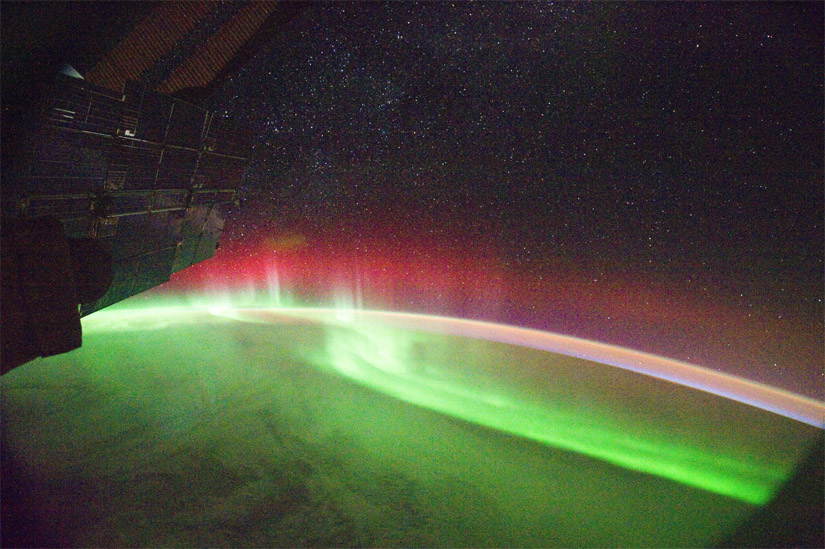
As I’ve mentioned before, our Sun is steadily heading toward the peak of its next 11-year sunspot cycle. The peak is expected in 2013. That means we can expect a steady increase in aurorae as well, because sunspots lead to solar flares and coronal mass ejections (CMEs) and when those happen to be aimed at earth, we get dazzling displays near the north and south poles. Sometimes those displays can even be seen as far south as Tennessee. Over the weekend there was a massive solar flare and CME, one that released the same amount of energy as millions of nuclear bombs, and it headed straight for earth. The blast of particles reached earth last night/this morning and created an astonishing auroral display, which was captured by many photographers at various locations. Here are a few blog posts and other links I’ve come across today showing some of those photos as well as explaining the physics of what actually causes the upper atmosphere to glow when bombarded by these particles.
Spectacular Aurorae Erupt Over Norway (Discovery News) Absolutely breathtaking photos by Bjørn Jørgensen.
Huge Solar Flare Seen By Solar Dynamics Observatory (Space.com)
The Sun Aims a Storm Right at Earth! (Bad Astronomy) Good explanation of the science behind the aurorae.
Can Solar Flares Hurt Astronauts? (Universe Today) Good explanation of why the flare/CME poses little risk to astronauts onboard the ISS.
Kepler finds earth-sized alien planets/Some amazing volcano photos
December 21, 2011

Credit: NASA
The Kepler team at NASA announced yet another exciting discovery yesterday: the first confirmed earth-size alien planets, Kepler 20f and 20e. The mission has found other exoplanets that pretty close to earth-size, but these two are by far the closest yet. What really befuddled me about this announcement was that that in addition to those two smaller, rocky worlds, there are three bigger gas-giant or super-earths in this system as well. No only that, but all five of these exoplanets’ orbits would fit inside our own Mercury’s orbit around our sun! That’s a lot of planets crammed into a tiny area! Of course that also means that these planets are scorching hot- far too hot to be habitable. But, it’s very reassuring to confirm that Kepler can positively identify alien planets that are earth-size and even tad bit smaller (Kepler 20e is about 87% the size of earth). As usual, Dr. Phil Plait at Bad Astronomy has a very good explanation of the whole thing. And I’ll also point you toward this article on space.com about the likelihood of us finding a true earth-twin within the coming year.
And now I will simply tell you to go take a look at this amazing set of volcano photographs and have a a few eyegasms. You’re welcome.
Monday videos: cats and space
November 14, 2011
Few words today, simply two videos to entertain you for different reasons.
HD timelapse footage of earth from the International Space Station. This has been making the rounds on the interwebs already, so you’ve probably seen it, but it’s just too good not to post. The city lights combined with the aurorae make this simply jaw-dropping/drool-inducing. Be sure to set HD to “on” and make it fullscreen!
And now let us take a quick look into the exciting new world of “catvertising”…
(Via yewknee’d)
Timelapse videos of auroras from the space station
October 20, 2011
This post needs very few words. Just sit back and enjoy these gorgeous timelapse videos shot from the International Space Station. They’re of the Aurora Borealis and/or Aurora Australis. Be sure to click on the resolution and choose the HD version, and make that shit fullscreen! (All via Universe Today)
Closet Case Vintage fall/winter 2011 lookbook
October 4, 2011
Take a gander at yet another impressive video/photo lookbook put together by Seth Graves (video) and Bradley Spitzer (photo) for my friend Carmen who runs Closet Case Vintage here in Nashville:
The whole deal with photos and all can be seen on the CCV blog. Among the models involved is the lovely Nikki Lane, who I just photographed performing at the Basement last friday for the Scene. I haven’t had a chance to check out her album yet, but her live show was quite impressive. She has a good “neo-classic” (to steal a phrase from the Spin review) country voice and a cast of Nashville indie/Americana staple players backing her up. Keep an eye and an ear on this one.
Two amazing pieces of imagery
August 22, 2011
- Good design can be defined different ways, but it almost always means organizing and presenting information in an engaging and/or innovative manner. The Weather Wheel created by Bard Edlund is an outstanding example of this, and I dare you to not stare at it for at least 10 minutes. (Hint: the size of the blue dots changes to represent how much rain the given city recieves, the orange circle’s intensity represents temperature, and the speed at which the arrow passes by the city represents how much wind it gets.) Via Kottke.org
- Cinemagraphs are photographs in which one small part of the image is animated to create continuous motion. This new technique creates surreal and sometimes slightly creepy images the blur the line between video and still photography. The technique is being pioneered by photographers Jamie Beck and Kevin Burg. Fascinating.
I’ve been waiting since the end of May for this:

(Click to enlarge) Credit: NASA/Paolo Nespoli
THAT is something that has never been captured on film before. It may not seem like a big deal, but the opportunity to to photograph a space shuttle docked to the ISS from space has never happened before, and never will again. The schedules happened to line up so that a Russian Soyuz capsule undocked from the ISS carrying three astronauts home while Endeavour was still docked. This gave astronaut Paolo Nespoli the opportunity to take photos of the shuttle/ISS combo from the window of the Soyuz capsule as they floated away. They paused the Soyuz some distance away and the space station actually performed a “flip” maneuver to allow for more angles. Please click through to the NASA image gallery and see the rest of these amazing images.
 Think the idea of humans boarding a massive spaceship headed into the cosmos for 100’s or even 1,000’s of years (a.k.a. real-life Star Trek) is completely in the realm of science fiction? Think again. Last fall DARPA (Defense Advanced Research Projects Agency), the highly secretive experimental arm of the Department of Defense who happened to invent the internet, released an official Request for Information regarding a “100-year starship plan.” Basically, they want people to come up with a fully thought-out plan for forming a team of researchers/engineers/scientists to investigate the technology necessary to build such a spaceship. Needless to say, this is one tiny baby step in a project that could cost many billions of dollars and require decades of advances in propulsion technology, but it’s still rather amazing that there is real, serious effort being put into something that has always seemed so far out of reach for humankind. As pointed out in their RFI, there will no doubt be unanticipated discoveries and technological advances as a “side-effect” of this research. So the actual spaceship itself is not the only purpose of this initiative. It really makes me happy to see something like this happening because I think manned space exploration has been quite stagnant for the last couple of decades. We need this kind of spark to really push forward the technology needed to extend our presence beyond low-Earth orbit. (Via Universe Today)
Ok, that’s really it for this week. Probably. I can’t fathom any more posts because tomorrow morning I will be heading to Manchester with the rest of the Scene/Cream team to photograph Bonnaroo. Keep your eyes on the Nashville Cream for updates on our shenanigans, and to see some of my photos.
- Credit: NASA
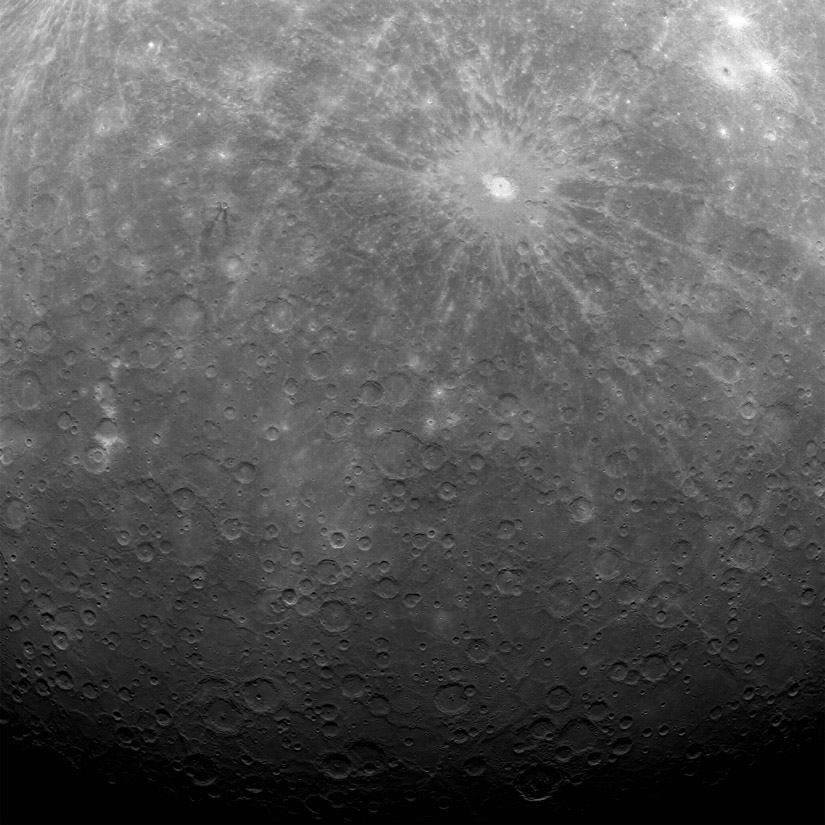
You’re looking at an important piece of history when you look at the above photograph. That’s the first ever image of Mercury taken from orbit. NASA’s Messenger spacecraft successfully entered stable orbit around the solar system’s smallest planet, and yesterday morning we got the first images taken from said orbit. The spacecraft has taken other images of Mercury as it approached, but Messenger just recently actually entered a permanent/stable orbit, and will remain there for at least a year, studying this hot, battered planet in unprecedented detail. This is also the first time any spacecraft has orbited Mercury to begin with. (Via Discovery News)
In some other space-related news, NASA decided to pull the plug on James Cameron’s idea to install a 3D camera on the next Mars rover mission, Curiosity. Honestly, I love this idea, as it would have allowed anyone with 3D glasses to watch cinema quality footage from the surface of Mars. When you really think about that, it’s absolutely mind-boggling: 3D video footage from another planet. However, NASA felt that since this rover is already way over-budget, the risk of failure was too great because the cameras haven’t been thoroughly tested. I’m certain that this technology will end up on another NASA mission to Mars in the future. So just wait. In another 5-10 year’s we’ll be looking at HD footage from Mars in 3D. NBD… (Via i09)

 steve cross loves music and science