Scientists create the iSquid/more eye candy from Mars
August 29, 2012
From the department of Holy Fucking Shit Nature Is Awesome: Scientists have hooked up squid skin to an iPod and made its pigment cells dance in time to Cypress Hill. They took the electronic waveform of the music and turned it into tiny electric impulses that caused the pigment cells, called chromatophores, to react in time with the music. The result is utterly fascinating:
(Via Kottke.org)
The MSL team at NASA has been as busy as ever testing, calibrating, and tweaking Curiosity’s cameras and instruments. A lot of great things have been accomplished over the last week or so, but two things are most interesting to me. The first recorded song ever to be beamed back from another planet was a song specially composed and recorded by will.i.am of the Black Eyed Peas. The song was called “Reach for the Stars.” While I’m not really a Black Eyed Peas fan, I’m really happy that such a big-name pop culture figure is trying to get kids more involved and interested in Science, Technology, Engineering, and Math (STEM). The other bit of news from Curiosity that really impressed me is this new image from the rover’s 100mm MASTCAM:

Click to enlarge. Seriously, you want to see this full size! Credit: NASA/JPL
This photo, to me, is much more interesting to look at than the other, wider images taken thus far. The reason is that it’s using a 100mm telephoto lens, which makes the scale and depth of the scene more prominent. Also, the photo was taken near sunrise or sunset when the angle of sunlight was low, which makes the jagged rock formations on Mt. Sharp more prominent and dramatic. Notice how there are many flat layers of rock exposed on the side of the mountain? They look just like the layers of bedrock along the sides of canyons and mountains here on Earth! The layers you see on Earth were formed by water, when sediments collected on the floor of oceans and lakes and eventually hardened into rock over millions of years. Therefore, scientists are pretty sure the rock layers seen in this photo on Mars were formed the same way, at the bottom of bodies of water on the surface millions of years ago. The big question we still have to answer is, what caused the water to disappear? Also, was there any life in or around that water millions of years ago? I can’t think of anything more exciting than answering those questions about Mars’ past.
We’re going to Mars again in 2016/More Curiosity updates
August 23, 2012
NASA announced that it has selected the InSight Mars lander for its next Discovery mission. (Discovery missions are NASA’s lowest cost tier of science missions, such as Kepler, Dawn, Messenger, Mars Pathfinder, and more.) You may be thinking, “ANOTHER mission to Mars? What for?” Well, despite all the awesome science that Curiosity will do, it can’t tell us much about the deep interior of Mars, or what Mars’ seismic activity is like. The InSight lander will be a stationary robot much like the Phoenix lander. In addition to measuring seismic activity, it will deploy a probe that will drill deep below the surface to measure the flow of heat inside Mars. These measurements will help scientists understand how Mars formed and what happened in the past that changed the surface from one of flowing water (and possibly life) to the barren dry wasteland it is today. (Via Universe Today)

Click to enlarge. Credit: NASA/JPL
Curiosity completed its first set of driving maneuvers on Mars. This image was the first that showed the wheel tracks, confirming that the rover drove successfully. This was only a test of Curiosity’s driving systems, the first of several. Tests of every science instrument and every other system on the rover will continue for at least a month or so before they’ve established a solid baseline for how everything behaves now that it’s actually on Mars. Only then can the scientists begin run the real experiments the rover was designed to carry out. Science is sometimes very tedious and slow, but the results and knowledge gained is very much worth it.
Mars Curiosity updates and images
August 15, 2012

The base of Mt. Sharp, Curiosity’s main destination. Credit: NASA/JPL
NASA’s Curiosity rover has been one resounding success after another, and every step of preparation and equipment testing has gone perfectly. The latest success was an upgrade to the rover’s software programming, changing its computer from landing mode to roving mode. The process took 4 days, but went swimmingly. For more details on that visit this Discovery News article.
There have been enough high resolution images made available from the rover that photographer Andrew Bodrov was able to create this absolutely STUNNING 360 rotating panorama of the rover’s surroundings. Seriously, this is one of the coolest things I’ve seen in a while. Brodov used images from NASA’s other rovers Spirit and Opportunity for reference to add-in the sun and sky components. (Via Universe Today)
Keep your browser on NASA’s JPL website for the latest images from this amazing mission.
It’s a great day to be a human. We just, you know, built a nuclear powered 1-ton robot, sent it into space a huge rocket on a trip to another planet, and landed it there with a hovering jetpack skycrane. Oh, and the whole hovering jetpack skycrane thing was all automated. NO BIG DEAL.
Everything went absolutely perfectly. And we even got back images from the rover just minutes after touchdown. Not only that, but I’ve seen tweets that the Mars Reconnaissance Orbiter was able to capture images of the capsule descending during its parachute phase. Those images should be out later today. In the meantime, here is the first image of the rover’s shadow. In the coming days we’ll have many amazing, full-color, high-resolution images of the surroundings.

UPDATE: The Mars Reconnaissance Orbiter did in fact get the shot of the capsule and parachute! Just consider this a victory lap for NASA. Check it out:

NASA’s Curiosity Rover lands on Mars Sunday night
August 2, 2012
You’d have to have been under a rock to no know that NASA’s latest and greatest Mars rover is about to land on the Red Planet. It’s been all over the news lately… but here are a few more deets that you may not know, including when and how to watch the coverage.
As usual, Universe Today is on top of the coverage, and this infographic was particularly interesting. They will also be teaming up with Google, CosmoQuest, and the SETI Institute to do a live webcast via Google+ to cover the event. Among the cast of hosts is one of my favorite fellow science enthusiasts/skeptics Dr. Phil Plait of Bad Astronomy. That begins at 10pm central time. The actual landing is scheduled for 12:31am central time. For more on the webcast check out the post on Universe Today.
Some random cool facts:
- This is the most complex landing procedure ever carried out by a NASA interplanetary mission.
- The supersonic parachute that slows the lander during the descent phase is a whopping 51 feet in diameter.
- The rover itself is about the size of a Mini Cooper.
- The rover weighs 1,982 pounds (on earth… on Mars it weighs about 747 pounds)
- The rover is powered by a small nuclear reactor.
- Curiosity will land inside Gale Crater, near the base of Mount Sharp, which has layers of exposed minerals that the rover will sample and study.
- The total cost of the mission is $2.5 billion.
Scientific eye candy
July 24, 2012
Two pieces of eye candy for your viewing pleasure today:
Over the past 40 years the US Geological Survey and NASA have teamed up on the LANDSAT mission, a series of imaging satellites that have taken some breathtaking photos of our planet. They recently posted a series of images and got the public to vote on the top 5. Those 5 can be seen in the video below, and the full gallery can be seen on the USGS website.
Secondly, I came across this set of amazing weather photos by photographer Camille Seaman last week. Feast your eyes on these simultaneously gorgeous and terrifying views of storm clouds over the great plains.

(Credit: Camille Seaman) Click through to view the full gallery.
A Few Good Shows: 7/20/12
July 20, 2012

Before we get to the show listings, I must quickly share something totally awesome- a new wing of xkcd called “what if?” On this new blog xkcd founder and physics genius Randall Munroe answers bizarre hypothetical questions that random people send to him. He presents the answers with a touch of that same humor and wit that makes the web comic so awesome. My favorite so far is Relativistic Baseball, in which he explains that a baseball thrown at nearly the speed of light would cause a nuclear explosion. This guy is my hero.
On to the show listings for this weekend. Nashville is very busy this weekend with good rock shows!
FRIDAY:
Infinity Cat 10 year anniversary ft. Skyblazer, Tristen, Deluxin’, and Psychic Hotline @ Exit/In. 9pm $10
QDP @ The 5 Spot. 10pm FREE
SATURDAY:
Chris Crofton & The Alcohol Stuntband w/ Tower Defense @ The 5 Spot. $5 10pm
SUNDAY:
Sunday School ft. Ogg, King Karl, TBA @ The End. 8pm FREE
The Goldroom, Ascent of Everest, Parlour, and Old Baby @ the High Watt. 8pm $7
Have a great weekend!
These are both Mars-related stories that popped up across the blogosphere over the past week:
The first bit of news is that NASA’s Mars Science Laboratory (MSL) mission is getting ever closer to its destination, and the dreaded “Seven Minutes of Terror” entry and landing sequence. They recently produced a video that does a pretty good job of conveying just how hard it is to land anything on Mars, and especially how insane this particular landing sequence is. It’s CRAZY HARD to do what they’re attempting to do. I’ve seen many other animations of this many times over, and it STILL blows my mind just how tedious and difficult this is from a scientific and engineering perspective. Seeing the video is essential, so here it is. Just watch:
The second bit of Mars-related news is a little crazier and far-fetched. A group of private investors are pooling their resources and claim that we can have humans on Mars by 2023. This project is called Mars One, and I have to be honest… the whole thing sounds utterly insane. They want to create such a huge media spectacle that the public interest and avenues for profit are such that they can raise the massive amount of cash it’ll take to make this happen. The craziest part of the whole thing is that it will be a one-way mission for the people who actually go to Mars. I think the ethics of such a thing are mostly subjective- I have no problem with a one-way mission if the people going are truly, honestly 100% dedicated to it. I think it’s honorable, and who am I to judge them for making such a profound decision. Neil Armstrong, Buzz Aldrin, and the rest of the Apollo astronauts all knew the extremely high risks involved with what they were doing. They accepted it and went on to accomplish arguably the greatest feat in the history of mankind thus far- walk on the moon. I hope they pull it off, I really do, and without all the oversight and red tape of a government agency like NASA, the likelihood of this happening so soon is greater. But still. 2023 is REALLY REALLY soon to put humans on Mars. Here’s their promo video:
Crazy? Or just crazy enough to make it happen?
Exoplanets: xkcd scores a home run
June 21, 2012
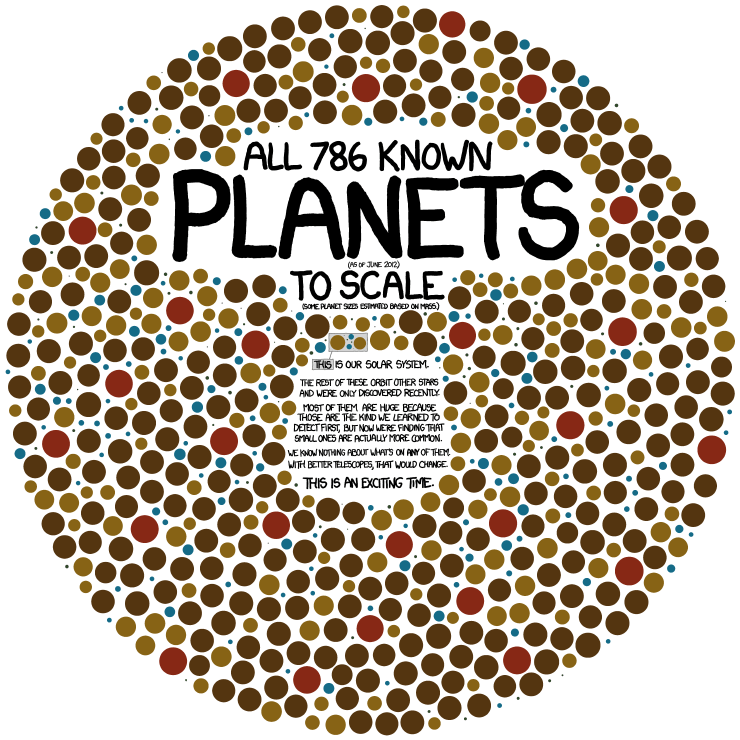
I’ve written a lot about exoplanets, planet-hunting missions such as Kepler, and various other topics related to the search for other worlds in the universe. Never have I seen any one image that could really sum up my feelings about it. But that time has come, and the brilliant Randall Munroe who does the well-known nerdy web comic xkcd is the man who did it. I can’t really say any more- just look and read for yourself. Be sure to click through to enlarge it enough to read the small text.
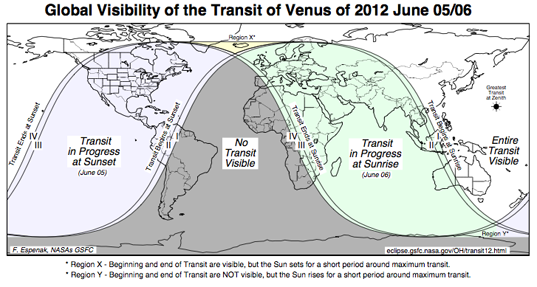 I’m sure by now you’ve heard about our planetary next door neighbor Venus transiting the sun tomorrow.
- What does this mean?
It means that from Earth’s perspective, Venus will appear as a small black dot moving across in front of the sun. It will be visible with out magnification, HOWEVER YOU MUST USE SPECIALLY DESIGNED EYE PROTECTION TO LOOK AT THE SUN. Seriously, you should never, EVER look directly at the sun- it could permanently damage your eyes! Here’s NASA’s page dedicated to safe sun viewing. Go read and learn how to do this safely! The transit will begin a little after 5pm Central Daylight Time and still be in progress when the sun sets on the western horizon. There are also tons of websites which will be streaming a live image of the sun, so you can watch it online quite easily. The best place is probably NASA’s website dedicated to this transit, but there’s also Bad Astronomy. Also of interest: 5 Weird Facts about Venus, and this guy who seems confident the space tourism industry will become cheap enough during most of our lifetimes that average middle class people will be able to afford a ride to a spot in space where we can see another transit, along with many other interesting things. I sure hope so! I think he might be a bit too optimistic, however… - Why should you care?
Well, you should care because you probably won’t be alive the next time it happens (from Earth’s view at least, 105 years from now). The reason it’s so rare is that despite what a lot of 2-D diagrams would have you believe, the planets in our solar system aren’t all exactly on the same plane, and none have a perfectly circular orbit. The orbits range from slightly elliptical to very elliptical, and all are at some degree of angle compared to the plane of Earth’s orbit. Therefore, the angle of Venus’ orbit causes it to only pass directly between the sun and Earth very rarely. The transits occur in pairs about 8 years apart, and those pairs only occur every 105 or 121 years.
So at the very least watch it happen online if you don’t have access to a telescope with a sun filter or sun safety glasses. It won’t be as spectacular as a comet in the night sky, or a solar or lunar eclipse, but it’s still a very rare event and worth seeing.

 steve cross loves music and science