The music of Les Miserables in a concert benefitting YEAH: tonight & tomorrow at Mercy Lounge
December 7, 2011
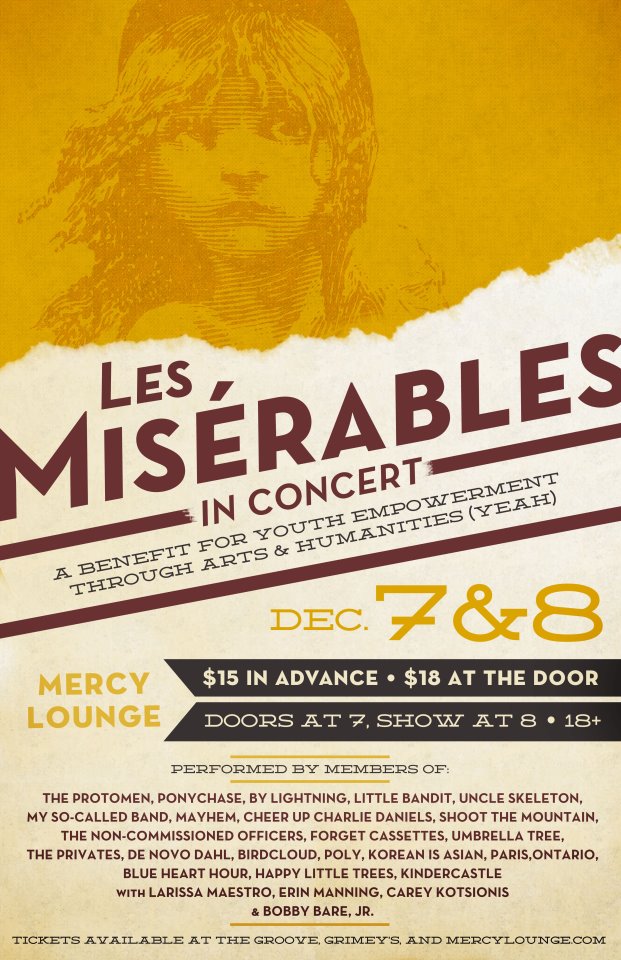 It’s been a big season of benefit shows for YEAH! but this one is probably the biggest- a bunch of local musicians/artists have teamed up to present the music of Les Miserables live in concert two nights in a row at Mercy Lounge. It kicks off tonight, tickets are $18, and it will be awesome. With Larissa Maestro and Jordan & Alex Caress at the helm and a huge cast of local musicians from such acts as Uncle Skeleton, By Lightning!, Ponychase, The Privates, Umbrella Tree, The Non-Commissioned Officers, Happy Little Trees, Blue Heart Hour, and many more, this is quite the undertaking. Again, this is a two night stand, but I have a feeling tonight will be the biggest of the two since Hall & Oates are at the Ryman tomorrow night. YEAH! is just about the coolest non-profit in all of TN and I’m proud to be an active volunteer with them. They deserve your support!
On a completely separate note (but still relevant to this blog), I’ve been approved by YEAH’s music programs director to start a new workshop at the Tennessee Teens Rock & Roll Camp this year- the Science of Music. Here’s the description I came up with, with the help of fellow volunteer (and former camper/fellow nerd) Alyssa Scheele:
How does an electric guitar work? How does a microphone work? How does MUSIC work? Learn this and much more in the brand new Science of Music workshop. This workshop will give campers a crash course in the science behind music and how different instruments and audio equipment create and amplify sound. This workshop is ideal for campers who might be interested in the production side of music. The Science of Music will empower campers to pursue science as well as music by showing them how science is an integral part of art.
I’m ecstatic about getting to teach kids how basically everything, let alone modern music, would not be possible without science. I want to get them to make that connection and realize that science isn’t all far-off labs, atom smashers, and old dudes in white coats. It’s also a part of literally EVERYTHING. I think that focusing on how science makes music possible is the best way to make it “hit home” with them. AND it will hopefully jumpstart some of them in the direction of music production, both studio and live.
Kepler finds potentially habitable exoplanet 2.4x size of earth
December 5, 2011
Should’ve gotten to posting this earlier today but I was waaay too busy.
Very exciting news in the science world today- NASA’s Kepler mission has been very busy lately, finding exoplanets left and right. Problem is, those observations have to be followed-up and duplicated by other telescopes, usually ground-based. Thus, it takes a while to fully confirm the existence of an exoplanet discovered by Kepler. Finally though, they’ve found one that is close to earth’s size, and orbits a star similar to our sun within its habitable zone. It’s not quite the “holy grail” of planet hunting because the planet is 2.4 times the size of earth, but it’s getting us ever-closer to the discovery of a true earth-twin. This is awesome. It’s only a matter of time…

Credit: NASA/Ames/JPL-Caltech
For more, check out this article on Space.com, or this article on Discovery News.
Mars Science Laboratory launches/other badassery
November 30, 2011
That is video of the final separation of NASA’s new Mars Science Laboratory rover (named Curiosity), sending it on its way to Mars. The probe launched successfully this past Saturday atop an Atlas V rocket, and will reach Mars in August of 2012. If you follow this blog you’ll know that I’ve mentioned this probe excitedly before- that’s because this is the biggest, boldest of all the robotic rovers we’ve sent to Mars. It’s about the size of a small SUV and it will be looking for evidence of conditions that may have been conducive to the development of microbial life, past and present. Important distinction: the probe is NOT searching for life itself, just for evidence that the planet may have been habitable in the past or maybe even the present. August 2012 will be a tense month for NASA and all following this probe’s progess, because the final landing stages are immensely tedious and complex. (See the landing animation below.) For now though, we just sit and wait as the probe zips through space and the engineers make the final adjustments to its trajectory. For some more expert commentary on this mission, check out Bad Astronomy or Universe Today.
Since I probably won’t be posting again until this Friday’s “A Few Good Shows” post, here are a couple more videos full utter badassery:
“Jetman” Yves Rossy flies alongside fighter jets on his jetpack. It doesn’t get much cooler than that…
Nothing like some shirtless 9-year-olds totally nailing “Crazy Train”
It’s turkey week: a weird video and some myth debunking
November 23, 2011
Before I remove myself from the interwebs for a few days to be with the fam, I thought I’d debunk one of the most pervasive turkey myths out there: that turkey contains more tryptophan than other foods and that it makes you sleepy. THIS IS NOT TRUE. Turkey contains about the same amount of tryptophan as other meats and some veggies. What makes you feel sleepy after a big holiday meal is what makes you sleepy anytime you eat way too much- food coma. There are some slightly differing opinions out there as to what causes the proverbial food coma, but it is not the tryptophan in turkey that directly causes sleepiness after holiday meals. It is simply the fact that you probably ate way too much in one sitting, and probably had some wine to go along with it. For more info see this article from Snopes, this article from NPR, and this article from Live Science.
I’ll leave you with this bit of complete and total absurdity from an Indian gameshow. That should hold you over till next week when I eventually resume posting. Have a great Thanksgiving!
Monday videos: cats and space
November 14, 2011
Few words today, simply two videos to entertain you for different reasons.
HD timelapse footage of earth from the International Space Station. This has been making the rounds on the interwebs already, so you’ve probably seen it, but it’s just too good not to post. The city lights combined with the aurorae make this simply jaw-dropping/drool-inducing. Be sure to set HD to “on” and make it fullscreen!
And now let us take a quick look into the exciting new world of “catvertising”…
(Via yewknee’d)
All you ever wanted to know about Daylight Savings Time
October 27, 2011
Every year in the spring and fall the debate about whether to keep doing daylight savings time pops up. If you look at it globally it really is quite complex, and makes things much more difficult than they need to be. I personally think it should be eliminated, BUT I want to keep the clocks permanently on DST. I like having the sun set later in the afternoon, because I’m not a morning person and I don’t really give a shit about when the sun rises. I DO give a shit about when it sets, because I despise how ridiculously early the sun sets in December/January, especially here in Nashville which happens to be on the eastern edge of the central time zone. On the winter solstice the sun sets at 4:33pm! I want at least an hour of sunlight to enjoy after I get of work! If we just kept DST on forever then we could have that. Anyway, watch this very informative video created by Colin Gregory Palmer Grey and learn everything you wanted to know about Daylight Savings Time: (via Devour)
Timelapse videos of auroras from the space station
October 20, 2011
This post needs very few words. Just sit back and enjoy these gorgeous timelapse videos shot from the International Space Station. They’re of the Aurora Borealis and/or Aurora Australis. Be sure to click on the resolution and choose the HD version, and make that shit fullscreen! (All via Universe Today)
Neutrinos faster than light? Let’s be realistic.
September 26, 2011

Of course the big news about the “faster than light” neutrinos would have to break right in the middle of Soundland, when I was insanely busy running around taking literally thousands of photos for 4 days straight… but the above image pretty much sums up how I feel about it. There’s an old saying in science- extraordinary claims require extraordinary evidence. However, in this case we’re not dealing with crackpot fringe scientists, we’re dealing with CERN scientists. In other words these people are very disciplined and have ruled out just about every other statistical anomaly, measurement inaccuracy, or other explanation for their results. So the fact that they measured neutrinos that appear to have traveled faster than light is not in question. The key word there is appear. And this is such a massively important discovery that the scientists involved are asking for comparison from the rest of the worldwide scientific community. They want others to repeat their experiments and see if they get the same result. When you’re questioning one of the most iron-clad, thoroughly proven theories of science such as General Relativity, you’d better have rock-solid, repeatable evidence to support your claim. No matter what the outcome of this, it will fascinating to sit back and watch as it unfolds. Here are a few links to interesting articles I’ve found relating to this news:

Artist's concept of NASA's new SLS
Today NASA Administrator Charles Bolden and members of Congress announced an agreement to build the most powerful rocket in US history. The launch system (or SLS for space launch system) is intended to take astronauts beyond low-Earth orbit, including asteroids and Mars. The SLS is a derivative of the space shuttle in that it uses 5 space shuttle engines and a fuel tank based on the design of the shuttle’s external fuel tank. There will also be two solid rocket boosters on either side of the main stack. The key difference is that the multi-purpose crew vehicle (MPCV), which is already under construction, will sit atop the entire stack, and will have an escape rocket system that will enable the crew to safely escape almost any type of failure or explosion at any stage during ascent. In many ways this new system is a hybrid of the Apollo-era Saturn V system and the space shuttle. For more info check out the official story on NASA’s website.
This is an exciting announcement, and it’s good to know that many aspects of this new SLS are based on or directly utilize existing technology. This means that the overall cost should be significantly lower than if we’d tried to build something entirely new. I’m glad there was bipartisan agreement that led to this decision being made relatively quickly. The target date for the initial launch of this new SLS is 2017. That seems realistic and I certainly hope it is. Humanity is long overdue to reach beyond low-Earth orbit and explore deep space.
New somewhat Earth-like exoplanet/Symphony of Science
September 5, 2011
It’s been waaaay too long since I had a good space/science post. So here are a couple of interesting things that have already been floating around the science blogs for a few days, but you may not have heard about unless you’re as big of a nerd as I am. 🙂
- We have another interesting exoplanet discovery worth talking about. It’s another super-Earth that sits within the habitable zone of its parent star- that is- liquid water could exist on its surface. At least, provided there is sufficient cloud cover. This planet, which has the fascinating title of HD 85512 b, is near the warmer edge of the habitable zone, which means there would have to be sufficient cloud cover to reflect some of the incoming radiation from its star, lest it have a runaway greenhouse effect that would make it very Venus-like (scorching hot and covered in dense, toxic clouds). This world is about 3.6 times the mass of Earth, but it was detected using the radial velocity method rather than the transit method, so we only know its mass, not its size. But if it’s a rocky world and its mass is 3.6 times that of Earth, it’s bound be a good bit bigger than Earth. Granted, we don’t know anything for sure about the atmospheric makeup of this exoplanet because we don’t have any instruments capable of detecting that yet. The radial velocity method detects planets orbiting a star by seeing the tiny gravitational wobble the planet exerts on its parent star. If we eventually aim a telescope such as Kepler at this star, and the planet transits the star, we’ll then know its approximate size and may even be able to make a better judgment on its atmospheric makeup. Until then, though, we have to rely on computer models to speculate what the air might be like. For more info see: Universe Today or National Geographic.
- You may recall Symphony of Science from back when Jack White’s Third Man Records released a 7″ vinyl single of the track “A Glorious Dawn ft. Stephen Hawking.” Phil Plait of Bad Astronomy mentioned in a post yesterday that John Boswell, creator of Symphony of Science, has put 11 tracks in a compilation on bandcamp for free (or name your own price). So go snag it now and throw the guy a few bones while you’re at it. It’s a pretty awesome idea, and I’m obviously a fan of anything that puts music and science in the same sentence.

 steve cross loves music and science