Magic Kids get signed/Monotonix singer injured
January 29, 2010

At a party in Murfreesboro several weeks ago I ran into an old acquaintance from college- Alice Buchanan. She’s from Memphis and had been in a band called Scandaliz Vandalistz which may or may not still exist… but when I talked to her she told me of this new band she’s involved with called Magic Kids that had just formed and were already gearing up for a tour with Girls. I was astounded at the speed of their ascent to label-signed status. As gorilla vs bear, Nashville’s Dead, and the Matador Records blog all report, they just signed to True Panther. Their quick emergence is not unfounded, though, as it’s literally impossible to deny the warm-fuzzy-feel-goodness of “Hey Boy.” It’s very summery, fun, and has the ability to turn even the dreariest winter day into a breezy summer afternoon. The first two bands that come to mind when I hear these songs are the Beach Boys and I’m From Barcelona. Grab two mp3s at Nashville’s Dead. Then just try to keep from putting them on repeat. I dare you. They’ll be playing at the Exit/In on Feb. 6th with Girls, and also hitting up SXSW in March. I’m sure they’ll be on my “must-see” list.
Monotonix singer Ami Shalev’s luck finally ran out at a show in Florida Wed. night. Though Brooklyn Vegan’s headline says he broke his leg, the statement from the band doesn’t quite make it that clear. Seriously dude, you should’ve expected this to happen sooner or later. You just can’t do crazy shit like that at shows without getting hurt eventually. Hopefully they’ll be able to resume melting faces soon enough.
As for this weekend, I’ll be attempting to get to the super-exclusive Clipse show at Phatkaps, but the snow/ice-gasm 2k10 may prevent it. The roads should be clear by tomorrow night, though, for the Wax Fang/How I Became the Bomb/Non-Commissioned Officers show at Exit/In.
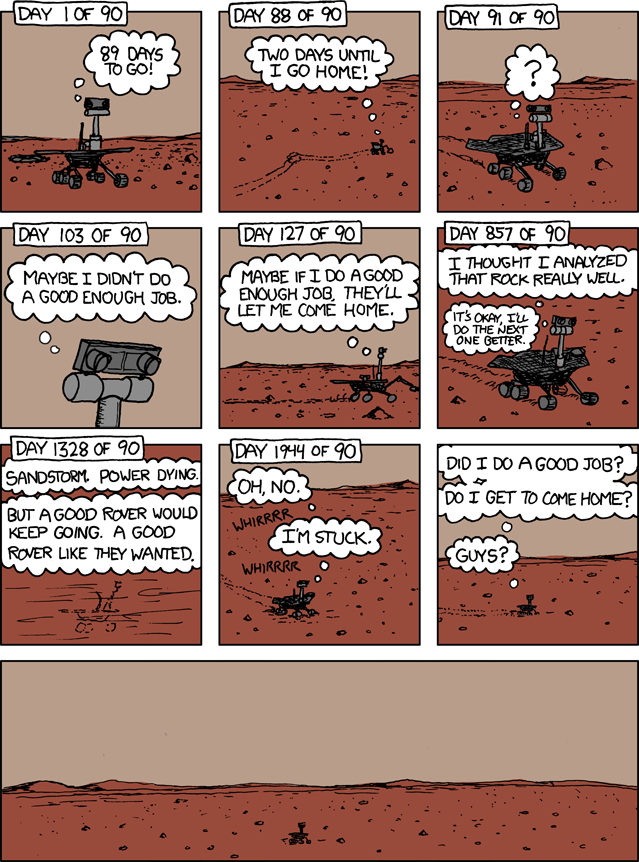
And, given my post yesterday about the Mars rover Spirit, I must share this adorable comic from xkcd:
Snowpocalypse: Part Duex/NASA rumors
January 28, 2010
Here we go again. I recommend investing in Kroger stock this year, because they’re gonna get a big boost in sales in TN from all these “snowstorms” wherein a meteorologist utters the word “snow” and 75% of the population immediately clears the milk, bread, and egg isles. (Apparently people only eat french toast during snowstorms?) As usual, I’ve been monitoring the progress of the forecast and find it interesting that the NWS hasn’t issued the winter storm warning yet, only a watch. I’m sure the warning will come, but it’s kinda funny that they’re hesitating, no doubt because of the giant snow fail from a few weeks ago. (To be fair, some areas around the midstate did get something close to the forecasted amounts, though no one really got the full 2-3 inches that was initially forecast…) This system is a little different than the last one, however. This one will most definitely have enough moisture to generate the 3-5 inches, unlike the last system which had moisture “issues.” The big limiting factor with this system will instead be temperatures. Nashville will literally be right on the dividing line between having an ice/rain mix and having an all snow event. If this system decides to track just 50 to 100 miles further north than the models think it will, that will cause more warm air to advect farther north, and we’ll end up having mostly rain friday changing to a little snow on the backside fri. night into sat. morning. If it decides to track slightly further south, we’ll have all snow, but much less of it, and areas to the south of us could actually see more snow than Nashville does. This system has a little better chance of “success” in giving us a good ol’ fashioned snowfall than the last one, but I wouldn’t place any bets yet.

Big rumors abound in the blogosphere about Obama’s budget proposal due to land in Congress on Monday. The biggest rumor is that it will completely cutout NASA’s Constellation program, which is the rocket system currently under development to not only replace the Space Shuttle, but also put men back on the Moon. I reported many times on the progress of the Augustine Commission and its recommendations for how NASA should proceed given that its current “trajectory” was financially unsustainable. One of the options they proposed was to eliminate the Constellation program and let commercial spaceflight companies like SpaceX takeover the duties of getting astronauts to the International Space Station and other low-earth orbit missions. I have a feeling that if the budget really does cut the Constellation funds, that’s where we’ll be headed next. Honestly I think it may not be a bad idea, because it would allow NASA to focus more on getting man further out into the solar system, and eventually to Mars. I tend to agree with Dr. Phil Plait’s (the Bad Astronomer) sentiments on the issue (as usual) but I’m not in total agreement with him that we should still go back to the moon. But then again, he’s the astronomer with a Ph.D and I’m not. For even more info, check out Universe Today. Check those blogs again on Monday afternoon, as I’d say they’ll be able to update waaaay sooner than I will once the actual budget info is released.
Skydiving from space/NASA Spirit rover stuck for good
January 27, 2010
Back in 1960, a man named Joe Kittinger did probably the ballsiest thing ever done by any human being. EVER. He jumped out of a balloon that had lifted him literally to the edge of space- 102,800 feet above sea level. That’s roughly 20 miles. Not only was it by far the highest skydive (space-dive?) ever, but he also set a record for the fastest that a human being has ever traveled outside of a machine. Because he was free-falling through such thin air during the first few minutes of his jump, there wasn’t nearly as much friction to slow his fall, which allowed him to free-fall at supersonic speeds. Yes, he was traveling faster than the speed of sound, with nothing but a pressure suit around him to keep him alive. I can’t think of anything more utterly badass than that. Now a couple of people are trying to break Joe’s record by jumping from an even higher altitude. Frenchman Michel Fournier and Austrian Feliz Baumgartner are both attempting to make these jumps this year, according to an article on Discovery.com. Some would say these guys are totally crazy, but I say they are total badasses, and envy them. Watch Joe Kittinger describe his experience in this video:
NASA’s Mars rover Spirit will now become a stationary asset. The twin rovers Spirit and Opportunity were launched in 2003, and successfully landed on Mars in 2004. They were only intended to operate for 90 days, yet amazingly they have lasted 6 years. The news that NASA has abandoned efforts to free the Spirit rover from the pit of sand in which it’s been stuck for the last 6 months is somewhat saddening, but in context, it really doesn’t matter at all. These rovers are quite possibly NASA’s 2nd greatest accomplishment, next to putting a man on the moon. We should only be thrilled that this amazing little robot lasted as long as it did. Its mission is far from over, however, as it can still do plenty of science sitting right where it is. Of course, Opportunity is still mobile and NASA continues to drive it around, exploring new territory. Who knows how long these things will last? I have a strong feeling the abrasive dust that now coats almost every inch of both rovers will eventually take its toll, but how long that takes is beyond me. For more check out this article on Space.com. Here’s a cool animated GIF showing the last few maneuvering attempts to free it from the sand dune:

Goodbye aughts: stuff to do tonight
December 31, 2009
So it’s New Year’s Eve. Inevitably everything in this post is somehow related to that fact. First of all, what to do tonight. Since I’m working the Generation Domination photobooth at Mercy Lounge’s “Happy Endings” party tonight, I must plug that first. But plugging is kinda pointless at this point, because if you haven’t already gotten tix, you’re pretty much SOL. According to a facebook message from 1:10am last night (this morning), there is only 1 VIP package left. The VIP package is for four people. Email drew@mercylounge.com for details. But honestly, it’s probably already gone by the time you read this. For a very visual representation of what else to do this NYE, check out the Nashville Scene’s official NYE flow chart:

Click through to see the bigger version at Nashville Cream
Nashville Is Dead has some details on a few select shows as well, most notably the (unofficial) Infinity Cat NYE show at the End.
Also of interest, i09 gives you ten reasons to live through the next decade. Among my favs: Ridley Scott’s return to sci-fi filmmaking, green development and progress toward 100% renewable energy, the LHC and possibility of finding the Higgs-Boson particle, and I totally agree with their #1 choice being the Mars Science Laboratory. I would, however, add to that the joint Mars program between NASA and ESA that I mentioned yesterday.
Now here’s the video to George Harrison’s “Got My Mind Set On You” just for kicks, via Yewknee’d.
Happy New Year, and we’ll see you next week!
Back with some science
December 30, 2009
The holidays obviously consumed my life to the point that I haven’t posted in over a week. Sorry ’bout that. I also haven’t shared any good sciencey tidbits in a while, so here you go:
I recently saw James Cameron’s latest epic Avatar. I won’t get too involved with reviewing the film as I’m no film critic by any means, but I will say this- it’s beautiful. The animation is astounding and most notably, the landscape is gorgeous. The dialogue and storyline is utterly pathetic. It’s basically the same story as Last of the Mohicans, Fern Gully, or Dances With Wolves, only this time it’s injected into a sci-fi mold. That being said, I always can enjoy that story to some degree no matter how many times it gets retold and rehashed. What is pretty cool about the movie is the science behind it. There will always be a big gap between “movie physics” and reality, but the over-arching idea of a habitable moon similar to Earth orbiting a gas giant similar to our own Jupiter in different star system is entirely plausible. The fact that the moon’s atmosphere is toxic to humans makes it slightly more realistic, along with the reduced gravity resulting in the native animal life being mostly large compared to that of Earth. Space.com has more on the science of Avatar’s Pandora.

Image via Universe Today
I’ve mentioned on here before that NASA and the European Space Agency have teamed up for the next decade or so of Mars exploration. The exact timeline and details of that effort are now beginning to come into focus, thanks to the recent discovery of a constantly replenished quantity of methane in Mars’ atmosphere The first step will be a new orbiting observatory launched in 2016 that is specifically equipped to further explore the possible sources of this methane, and map out exactly where it’s the strongest. Also on this first mission will be small lander designed to test the parachute/thruster landing system that will be used on the future missions involving the “real” landers/rovers. Those rover/lander missions will be launched in 2018, and will be specifically designed to search for signs of life. Recent developments in the theories about the possible source of the methane have started to lean more towards microbial life, probably living under the surface. That’s very exciting. More on this at Universe Today.
What kind of blogger would I be if I didn’t have some sort of “year-in-review” post? Unfortunately I haven’t had the time to come up with anything myself, but here are a couple of 2009 recap posts from other science blogs that you might find interesting:
Live Science: 9 stories we love, and hated, in 2009.
Space.com: The 9 top spaceflight stories of 2009.
Some of probably already know this, but I’m currently in the process of moving. Megan and I are renting a small house near Germantown, and though the house will be awesome once we get settled in, the timing really sucked. I can’t think of a worse possible time to be moving than during the holidays. So posting here will probably be limited until next week.
dpBestflow/more 2012 debunking/Vatican admits possibility of E.T.
November 12, 2009
As you can see from this video, NASA is joining in on the fight against junk science and stupidity in general by putting some of their scientists into the public eye to debunk the 2012 doomsday B.S. This is the manager of their Near Earth Object tracking office. I’d say he’s a pretty good one to talk about doomsday scenarios, since his office is responsible for tracking asteroids and any other objects that might slam into our pale blue dot and kill us all. DON’T BELIEVE THE SCAREMONGERS! THERE IS NO REAL, CREDIBLE SCIENCE BEHIND ANY OF THE 2012 DOOMSDAY MYTHS! (Via Universe Today)
In other science news, apparently the Vatican is officially acknowledging the possibility of extra-terrestrial life. They recently had a week-long study/discussion involving over 30 scientists and religious experts to develop an official stance/policy/statement about the subject. This is kind of surprising, because we all know that most sects of Christianity don’t always agree with science/reality. Good job, Pope. (Via Physorg)
The American Society of Media Photographers (ASMP) has been working with the Library of Congress for the past couple of years to create a huge online resource for photography info. They just launched it, and I can’t even begin to describe how awesome dpBestflow is. Find some downtime, and go check it out if you’re at all interested in photography. They’ve compiled loads of industry knowledge, standards, and general information, and it’s all in one place, for free. Basically, it’s everything you could possibly want to know about the profession of digital photography, all in one place. (Via Photo Business & News Forum)
Science tidbits: Mystery of the Pyramids/NASA gets Augustine report
October 27, 2009
 In addition to being a totally awesome sight to behold, the famous pyramids of Giza in Egypt have also been a bit of a mystery. Scientists and archaeologists had a hard time explaining exactly how they were built given the technological limitations of the time period. The Pharaohs had a massive army of laborers at their disposal, but carving those massive blocks out of stone and moving them over miles of scorching desert would seem to be an insurmountable task even for an army of men. I was intrigued when I stumbled across the work of Dr. Joseph Davidovits, who claims that the stones were actually cast from a type of limestone concrete. This method would’ve require FAR less man-power and makes the pyramids’ construction seem much more reasonable. The seemingly impossible construction of the pyramids has fueled some ridiculous crackpot ideas that aliens helped build them. I was very glad to see that real science has actually explained the mystery of their construction quite well. Science wins. As always. Read more about his book Why the Pharaohs built the Pyramids with fake stones on the website of the Geopolymer institute.
This morning NASA attempted to launch the Ares I-X, the very first full-scale test version of their new Ares I rocket, which (if NASA proceeds on the current path) will replace the space shuttle as our primary means of transporting astronauts to low earth orbit. But a series of silly issues such as a probe cover getting stuck and a cargo ship accidentally entering the danger zone, combined with bad weather caused the launch to be delayed… possibly until tomorrow, maybe later.
Speaking of NASA… last week they got the full, detailed report from the Augustine Commission, which is a group of aerospace industry experts put together earlier this year by the Obama Administration to assess the state of manned spaceflight within NASA. Basically it’s a more fleshed-out, complete version of the preliminary report I mentioned several weeks ago on this blog. It’ll be interesting to see which solution NASA administrator Charles Bolden and the Obama Administration decide to go with. Personally, I’d like to see NASA get that additional 3 billion they need, but who knows? I can’t really summarize the options any better than Universe Today did last week when they reported on this, so I’ll just quote:
1. Maintain all programs as is, but extend the space shuttle program to 2011 and ISS to 2020. Without extra funding, the Ares rockets wouldn’t be ready until 2020 and there would never be enough money to go to the Moon.
2. Maintain current funding, scrap Ares I, develop an Ares V lite version (about 2/3 of Ares V heavy) and divert extra funds to ISS for extension to 2020. Buy commercial LEO human space flight. The Ares might be ready by 2025, and perhaps get to the Moon after 2030.
3. Add $3 billion per year and proceed with the Constellation program to return to the Moon. The ISS would have to be de-orbited in 2016 to allow a return to the Moon by about 2025.
4. Add $3 billion per year. Extend the ISS to 2020 and get to the Moon by about 2025. Use either Ares V Lite, or Shuttle-C for heavy lift.
5. Add $3 billion per year. Extend the shuttle program to 2011 and extend ISS to 2020. Instead of heading to land on the Moon, orbit the Moon, or go to Near Earth Objects and prepare to go to Mars. Use either Ares V Lite; a heavy Evolved Expendable Launch Vehicles (EELV) or, a shuttle-derivative.
So there you have it.
Yesterday some news outlets reported on a possible crater in Latvia left by a large meteorite impact. Well, it’s been confirmed as a FAKE, so don’t let anyone tell you otherwise. Some Latvians must’ve had waaay too much time on their hands because after detailed inspection, shovel marks could be seen on the edge of the hole. I won’t spend too much time explaining all the obvious scientific inconsistencies because Dr. Phil Plait has done a thorough job of it at his blog Bad Astronomy. The biggest misconception about meteorites is that all of them cause a crater if they make it all the way to the ground- they don’t. In fact most that do hit the ground are less than a meter in diameter and actually are cold by the time they reach it. They also are traveling at normal terminal velocity and just hit with a non-crater-causing thud.
Finally, I’m really happy to see that the Large Hadron Collider repairs came along nicely and they’ve started inserting particles into loop. No actual collisions yet, but if all goes as planned they should be doing their first ones next month. Follow CERN on Twitter for updates.
 The floodgates of exoplanet discovery just opened. The High-Accuracy Radial Velocity Planet Searcher (known as HARPS) discovered a batch of 32 new exoplanets, pushing the list of known exoplanets to over 400. Most of these are low-mass planets about the size of Neptune. Since HARPS (which is a spectrograph) works with a land-based telescope which has to put up with the distortions and aberrations of the Earth’s atmosphere, that’s a very impressive feat. It shows just how good astronomers are getting at planet-hunting, and with the recently-deployed Kepler space observatory working like a charm, it won’t be long before we find the jackpot of astronomy to date: an Earth-like planet orbiting a distant star. (Via Universe Today)
I’ve mentioned that new theories challenging the textbook theory of a massive asteroid impact in Mexico killing off the dinosaurs are gaining serious momentum in the field of paleontology. The main challenge to the impact theory is the one involving a massive, long-erupting supervolcano in India known as the Deccan Traps. India has coughed up yet another, 3rd challenge to the impact theory: an impact event of its own. Some researchers from Texas Tech University think that a huge depression that exists beneath part of the Indian Ocean is actually an impact crater, and that it’s the result of an asteroid that smacked into the earth near the time the dinosaurs went extinct. (In geologic terms “near” actually means within a few million years…) If this turns out to be a true crater, and not just the result of normal tectonic plate movements or volcanic activity, then I’d say it definitely had at least some effect on the dinosaurs, and probably some effect on the ongoing eruption of the Deccan Traps. (Also via Universe Today)
NASA rolled out the first full sized test vehicle for its new Constellation program earlier this week. The Ares I-X was rolled out to launch pad 39B for its scheduled test flight next week on Oct. 27th. This is a full-scale mock-up of the Ares I, which (if the current plan is adhered to) will replace the Space Shuttle as NASA’s method of delivering astronauts to and from low Earth orbit. The test flight, of course, will be unmanned. Here’s a pic via NASA’s website. Keep up with the test launch at the launch blog. The new rocket is 327 feet tall, over 100 feet taller than the Space Shuttle.

Click to enlarge
Science-y tibits 10/13/09
October 13, 2009
I haven’t posted any science-related stuff on here in waaaay too long. Part if it has been Next Big Nashville, which I’m still recovering from, along with other general business. That being said, here are some goodies for you:
NASA has a renewed focus on the moon, especially to determine how much, if any, water is there. One of the ways they decided to do that was to smash the rocket stage of the current satellite into the surface and analyze the result plume of dust and debris. Sunday they did just that, and the results are still coming in, but it was definitely a successful impact. Check out more about the LCROSS mission here.
I’ve mentioned the 2012 doomsday myth on here before and linked to various website that thoroughly debunk it, but today one article caught my eye. I’d never even thought to research what the Mayan descendants have to say about this issue. Turns out they are pretty smart and fully understand that the world won’t end just because their Long Count calendar ends. The whole steaming pile of bullshit that is the 12/21/2012 doomsday myth is entirely a creation of modern Western culture that’s been imposed on the Mayan culture and one of their many calendars. The point to drive home here is that THE VERY PEOPLE WHO INVENTED THE CALENDAR DON’T EVEN BELIEVE THE HYPE BECAUSE IT’S BULLSHIT! They simply take it for what it is: an anniversary of sorts, a time when the Long Count calendar starts over again. Read the article at Discovery News.
Remember when Stephen Colbert lead a huge campaign to get the newest node for the Space Station named after him? While he did win the popular vote, NASA had the final say and didn’t name it after him, but they did come up with a ridiculous name for the new treadmill for the ISS that, when abbreviated, spells C.O.L.B.E.R.T. and the astronauts just completed its assembly. Here’s a pic of them using it for the first time:
 Via Space.com
Water on the moon/Stargate Universe/We are all made of germs
September 28, 2009

Image via Stargate Universe blog
Ok first of all I have to get out my excitement about Stargate Universe, the third show in the Stargate TV franchise. The 2-hour series debut will hit your screen this Friday at 9pm (8pm Central) on SyFy. io9 posted a fairly revealing clip from it today. Don’t get me wrong, no real spoilers there, just a good idea of the vibe and overall tone of the show. This series will be a much more serious take on the Stargate saga. I’m thinking it’s going to end up taking on a similar mood to Battlestar Galactica.
Ok now that’s out of my system….
I’m sure you’ve seen the headlines about how water was discovered on the moon recently by NASA’s mineral mapper instrument aboard India’s Chandrayaan-1 probe launched in 2008. First of all, this does NOT mean that water is swirling around on the surface of the moon. The moon has no atmosphere and therefore water can’t even exist in a liquid state at all. What’s happening is that the incoming solar rays are reacting with the material on the surface to create a thin layer of hydroxyl (OH) and normal water (H2O) in the very top milimeter or so of regolith. This layer is so thin that it would amount to 1 liter of water per ton of surface soil. That’s a VERY small amount, but it’s a lot more than we ever thought would be there. What does this all mean for the future of human exploration on the moon? Read this Universe Today article to find out.
Here is a great Daily Galaxy article about something that I had honestly never even heard or known before. I hadn’t the slightest clue that there are more bacteria/microbes in our bodies than there are actual human cells. That’s to say that if you counted the number of human cells and the number of microbial/bacterial cells in your body, there would be more bacteria/microbes. In fact it’s utterly awe-inspiring (and slightly terrifying) to think that some of the species if bacteria actually don’t exist anywhere else outside our bodies, and that we could NOT survive without them. Essentially they’re as important as any organ. We’re literally more germ than we are human, and it couldn’t exist any other way. Of course, we look more like us because human cells are MUCH bigger than bacteria cells. The crazy thing, as the article points out, is that doctors still don’t know anything about most of these bugs that live inside us. But they’re trying to change that.

 steve cross loves music and science